


Yongin Respia Begins Trial Operations of New and Expanded Environmental Infrastructure Facilities
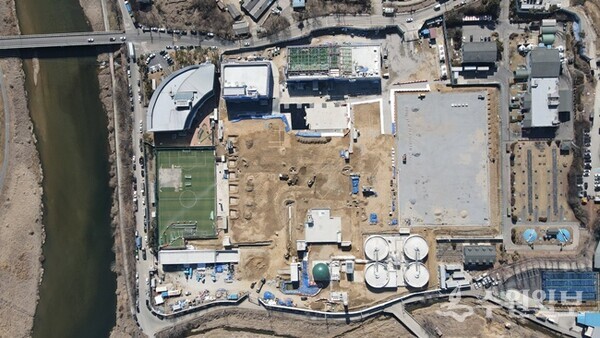
[Suwon Ilbo=Reporter Choi Ki-ho] Yongin Special City announced on the 8th that it has completed installation of major facilities including wastewater treatment systems being newly constructed or expanded as part of the "Yongin Eco-Town Development Project" at Yongin Respia in Pogok-eup, Cheoin-gu, and has begun trial operations to meet the scheduled completion in June.
The Yongin Eco-Town Development Project encompasses a 51,046㎡ underground section within the 101,177㎡ Yongin Respia site, where a Stage 2 wastewater treatment facility (expansion) with a daily capacity of 22,000 tons, a food waste processing facility (new) with 250-ton daily capacity, and a sludge resource recovery facility (new) with 220-ton daily capacity are being installed. The above-ground section is planned to include sports facilities such as 2 soccer fields, 1 baseball field, and a multipurpose gymnasium.
The city is expanding the environmental infrastructure of Yongin Respia by placing most facilities underground and designing the above-ground portion as a sports park for citizens' health promotion and recreation.
Mayor Sang-il Lee stated, "Through the Yongin Eco-Town Development Project, we have not only expanded the environmental infrastructure essential for the city's development and citizens' lives, including large-scale wastewater treatment and food waste processing facilities, but also achieved efficiency gains and budget savings by integrating these facilities into a single installation. This project demonstrates our capacity to harmonize urban development and environmental protection by transforming Yongin Respia, previously stigmatized as a nuisance facility, into a citizen-friendly space."
The city has operated a wastewater treatment facility at Yongin Respia with a daily processing capacity of 56,000 tons. Through this Yongin Eco-Town Development Project, the daily processing capacity has increased by 22,000 tons (39.3%), bringing total capacity to 78,000 tons.
Yongin Respia processes wastewater from the eastern district of Cheoin-gu, as well as Pogok-eup and part of Yangji-eup in the Gyeongsan River watershed. With increased processing capacity, the region faces reduced burden from development permit restrictions. This area is subject to total water pollution load management, making it necessary to enhance public wastewater treatment capacity to avoid disadvantages such as development activity restrictions.
The city has previously outsourced all food waste generated throughout the city to private contractors for processing. With the new 250-ton daily capacity facility at Yongin Respia, the city expects to process all food waste from general households such as apartments at this location, achieving approximately 30% cost reduction.
The city added that through the Eco-Town Development Project, it has secured additional large-scale sports facilities for citizens at Yongin Respia's above-ground space—soccer and baseball fields that are difficult to establish newly in large cities due to land constraints.
The city plans to install 2 soccer fields, including one of international standard, and 1 baseball field using the above-ground space made available by placing all environmental infrastructure underground. Landscaping trees will be planted around the fields to create a sports park atmosphere. Additionally, a multipurpose gymnasium equipped with a fitness center and bathhouse will be installed at the front of Yongin Respia as a resident convenience facility for local residents' convenient use.
■ All Environmental Facilities Underground... Above-Ground Space for Citizens
At the Yongin Eco-Town Development Project site, construction of soccer and baseball fields is currently in full swing, and the skeleton of the multipurpose gymnasium building has already been erected at the front. Viewing only the above-ground portion gives the impression of creating a large-scale sports park on an expansive vacant lot.
Although large-scale environmental infrastructure is already operating, all facilities are installed underground, so even when visiting the construction site for soccer or baseball fields above ground, no odor is detected. Only occasional odors from nearby livestock farms are carried by the wind.
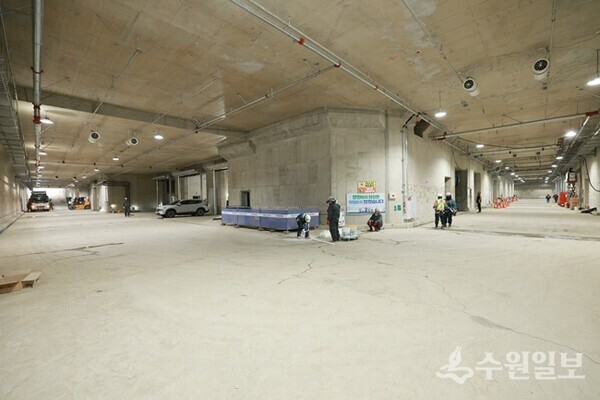
The underground space at Yongin Respia is constructed like a massive fortress. The basement level 1 corridor is so high and wide that large trucks can pass each other in rows or make turns without difficulty. Tanks could traverse the space.
Beside the corridors, countless pipes of varying diameters are installed, and only power switches and gauges are visible, with barely any noise detected.
Despite already operating a mega-scale wastewater treatment facility capable of processing 78,000 tons daily, a large food waste processing facility, and a sludge resource recovery facility, barely any odor is felt even on basement level 1. This is because most actual operational components of the facilities are installed at basement level 2 and below, with management in place to prevent odors from seeping to level 1.
Food waste collected from throughout the city is dumped into processing facilities on basement level 1, but even when visiting the facility space, only a large cover is visible over an empty area—the actual operating facility cannot be seen. The cover is only opened when food waste collection vehicles arrive and is closed again when they depart, preventing odors from escaping to the exterior.
An official from Yongin Special City's Wastewater Management Division stated, "All facilities at Yongin Respia are installed underground and maintained in a constantly clean state, so there is no odor above ground. However, livestock farms remain in the surrounding area, and odors from animal manure piled there cause Yongin Respia to be misunderstood."
■ Respia Transforms into Eco-Friendly Space Familiar to Citizens
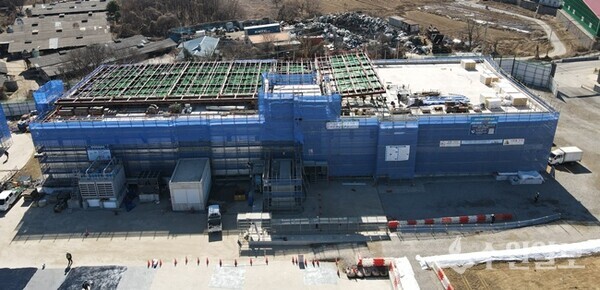
The city plans to transform Yongin Respia beyond a simple environmental infrastructure facility into an eco-friendly space capable of realizing carbon neutrality while providing environmental education to citizens. As the city must install various environmental infrastructure in the future, officials have determined the need to establish awareness that these facilities are not nuisance facilities but beneficial to everyday life.
The city first plans to supply part of the biogas (methane gas) generated during food waste processing as fuel to the sludge resource recovery facility and utilize part for hydrogen production.
Related to this, the city was selected in November 2023 for Gyeonggi Province's "Mini Hydrogen City Development Support Project" public recruitment and allocated 5 billion won in provincial funds and 5 billion won in city funds for a total of 10 billion won to produce 500kg (182 tons annually) of hydrogen daily using biogas. The city plans to supply part of the produced hydrogen to hydrogen refueling stations in the city and install a 890kw hydrogen co-combustion power generation facility to utilize part for hydrogen power generation.
The city will also establish the "Yongin Comprehensive Environmental Education Center" to transform the Yongin Respia area into an environmental education space. This represents confident expression that environmental infrastructure is not a nuisance facility but an eco-friendly space.
Related to this, the city broke ground in November last year on the Yongin Comprehensive Environmental Education Center with a scale of 2,702㎡ across basement 1 and above-ground 3 floors within the Yongin Respia site in Yuin-ri, Pogok-eup, Cheoin-gu. This center, with a total project cost of 19.9 billion won comprising 11.9 billion won in city funds and 8 billion won in Hangang watershed funds, will be constructed with "Net-Zero building" design targeting energy efficiency grade 1 and eco-friendly energy technologies such as solar power generation applied.
After completing this center in June next year, the city plans to designate it as a "One-Stop environmental education hub facility" to cultivate environmental specialists and provide diverse environmental education to general citizens and students.

Loading comments…