


One Axis of Yongin Semiconductor Cluster Power Problem Resolved
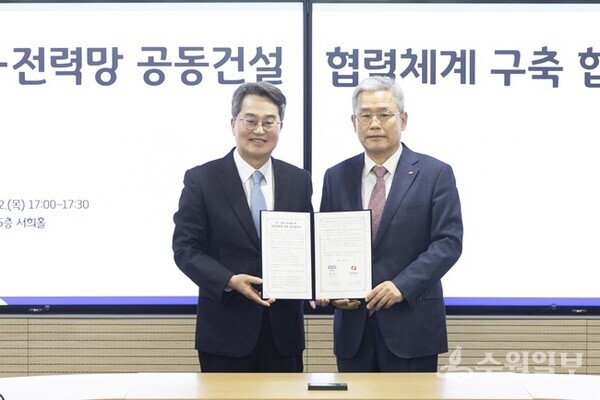
[Suwon Ilbo=Reporter Kim Gap-dong] The power problem, one axis of the Yongin Semiconductor Cluster, has been resolved.
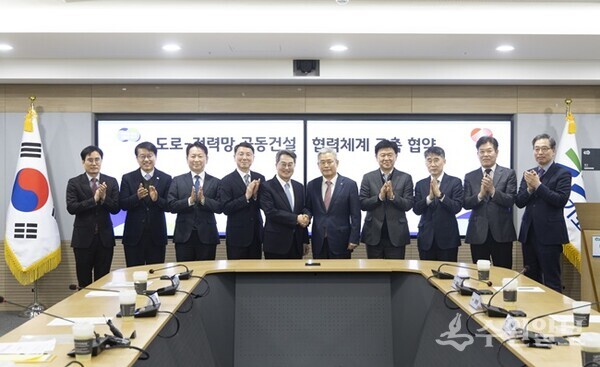
Gyeonggi Province Governor Kim Dong-yeon and Korea Electric Power Corporation President Kim Dong-chul signed a "Cooperation Agreement for Establishing a Joint Road-Power Grid Construction System" at 5 p.m. on the 22nd in the Seohee Hall of Gyeonggi Provincial Government.
At the agreement ceremony, Governor Kim stated, "The semiconductor industry is large-scale and stable power supply is key to competitiveness," and added, "Today, the final puzzle in building the power grid for the Yongin Semiconductor Cluster has been completed," giving significance to the agreement as "the first starting point combining road administration and the national power grid strategy."
Governor Kim emphasized, "We will continue to expand to other roads and industrial complexes within Gyeonggi Province, creating the nation's finest infrastructure-equipped Gyeonggi Province that supports future industries."
Whether the National Industrial Complex will similarly pursue "new road undergrounding" remains uncertain, but Governor Kim's assessment is that this method—equipping power grids with just one road construction project—can be expanded to other industrial complexes and road construction projects within the province in the future.
The Yongin Semiconductor Cluster is anchored by two axes: the general industrial complex led by SK Hynix (investment of approximately 600 trillion won) and the national industrial complex led by Samsung Electronics (investment of 360 trillion won). Through today's agreement, a solution has been prepared to expand SK Hynix's insufficient power (3GW).
Previously, citing power shortage problems, arguments even emerged to relocate the Yongin Semiconductor Cluster to Saemangeum, but in reality, there was no solution to this problem, with only political circles discussing it extensively.
Against this backdrop, with today's "Cooperation Agreement for Establishing a Joint Road-Power Grid Construction System" between the province and Korea Electric Power Corporation, "Kim Dong-yeon's Gyeonggi Province" has found a "new solution" that had not been previously discussed. This is the first practical solution to emerge and is being evaluated as a breakthrough in addressing the power problem.
Governor Kim Dong-yeon recently posted on Facebook, "The Yongin Semiconductor Cluster is a masterpiece attracted when President Lee Jae-myung served as Gyeonggi Province Governor. Gyeonggi Province is inheriting that achievement and carefully managing industrial infrastructure including power, water supply, and transportation." He also stated, "We will support the 'first year of Korea's great leap forward' with the Yongin Semiconductor Cluster."
As publicly promised, the province has derived a visible plan to resolve the power problem of the general industrial complex, one of the two axes of the national and general industrial complexes.
■ How Can the Power Problem Be Solved...Local Road 318 in Yongin and Icheon Is the Key
The secret key to resolving SK Hynix's general industrial complex power problem is the newly constructed "Local Road 318" (new construction and expanded road). It is a 27.02km section spanning Yongin and Icheon. Power grids will be built underground along this "Local Road 318."
The province will be responsible for road paving and land acquisition for "Local Road 318," while Korea Electric Power Corporation will undertake the construction of power grids beneath the road jointly. (The province handles land acquisition and road surface paving, while Korea Electric Power Corporation constructs the power grid and road base.)
This is Korea's first model where road construction and power grid installation are "pursued simultaneously," with "power flowing along as the road extends."
As reported, the general industrial complex led by SK Hynix has a capacity of 6GW, and the national industrial complex led by Samsung Electronics has 9GW, for a total electrical equipment capacity of 15GW needed to operate the Yongin Semiconductor Cluster.
The government and Samsung state that approximately 6GW of the 9GW for the national industrial complex has been "secured." The general industrial complex has also announced that SK Hynix has secured 3GW, leaving the remaining shortage at 3GW.
Upon completion of Local Road 318 construction as scheduled, power grid supply for the general industrial complex within the Yongin Semiconductor Cluster will become possible, allowing the power switch to be turned on for the Yongin Semiconductor Cluster.
■ Finding Solutions on the Road..."New Road Undergrounding"
Initially, the government prioritized transmission tower installation for power supply to the Yongin Semiconductor Cluster. However, strong resident opposition to transmission towers stalled progress.
In the meantime, in July of last year, under the direction of Governor Kim Dong-yeon, the province, which had been seeking solutions to the power problem, made a new proposal to Korea Electric Power Corporation through internal discussions. It was a plan to expand the power grid utilizing the space below the province's "new roads." After two rounds of working meetings, Korea Electric Power Corporation accepted the proposal, and a solution was established.
The department coordinating with Korea Electric Power Corporation was the "Gyeonggi Province Road Policy Division." It is a rare case where a roads-related department, rather than a semiconductors-related department, stepped forward to resolve the power problem of the Yongin Semiconductor Cluster. This is why the province's and Korea Electric Power Corporation's agreement coordinating department is the Road Policy Division. The province, centered on the "Road Policy Division," found "a way (way) in the road (road)."
■ Economic Effects of the New Solution
The advantages of this first "new road undergrounding" method, different from transmission towers or "existing road undergrounding," are diverse. Beyond resolving SK Hynix-led general industrial complex's power problem, it can reduce problems that previously arose from executing road and power grid construction separately: △redundant excavation △traffic congestion △noise and dust. As a result, construction period and budget are expected to be significantly reduced.
◇ Road Construction Period Shortened by 5 Years
- Unlike undergrounding on existing roads, the power construction is conducted simultaneously with new road construction, which has multiple advantages. Comparing the existing construction period in cases where the province conducts road and power construction separately versus the construction period from this "simultaneous construction," an estimated 5-year reduction effect occurs. This means the debut of the SK Hynix-led general industrial complex is accelerated by 5 years, which is significant.
◇ Project Cost Savings of 30%
- Conducting roads and power grids separately costs far more than joint construction. Compared to existing separate construction, project costs are estimated to be reduced by approximately 30%.
◇ Budget Expansion for Gyeonggi Province Through Construction Cost Savings
- If Gyeonggi Province pursues only road projects independently, the estimated construction cost is approximately 556.8 billion won. However, because construction is conducted simultaneously with Korea Electric Power Corporation, the province can reduce budget expenditure necessary for earthwork costs arising duplicatively in separate implementation (construction involving earth work such as piling or excavation) and unnecessary temporary facility installation. This cost is estimated at over 200 billion won.
Loading comments…