


New Year's Address Mayor Park Seung-won of Gwangmyeong City
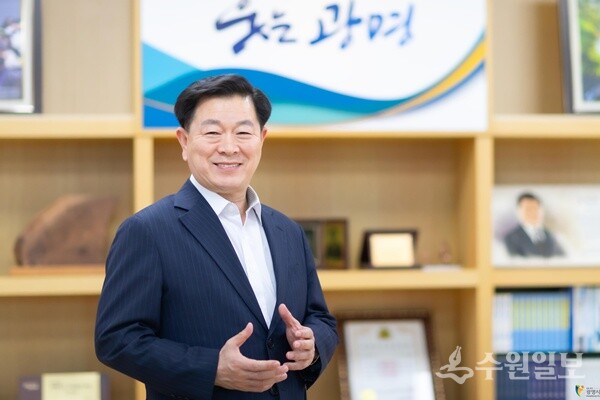
Esteemed citizens of Gwangmyeong, beloved civil servants of Gwangmyeong.
The new year of 2026 has dawned.
This year is the year of the Red Horse, the year of Byungoh (丙午年).
The Red Horse symbolizes the power to push forward through chaos, as well as decisiveness and execution.
In the new year, I hope that with the energy of the Red Horse, small but definite changes will begin in the daily lives of each citizen, and that accumulated change will create a meaningful year in which our lives advance one step further.
Over the past several years, we have passed through endless times of crisis.
The COVID-19 pandemic halted the flow of daily life and economy in an instant, and just a year ago, we experienced a crisis of democracy that shook our constitutional order.
Climate crises are becoming more frequent and severe, while low growth, population decline, and polarization are no longer temporary phenomena but deep-seated challenges permeating our entire social structure.
Yet we did not stop.
The Republic of Korea continues to maintain its clear standing in the international community with economic power ranked within the world's top 10 and defense capabilities ranked in the top 5, and has recovered democracy at a remarkable pace.
Centered on strategic industries such as artificial intelligence and aerospace, industrial competitiveness is also opening new possibilities.
As external and internal uncertainties ease and policy effects take hold, the economy has entered a phase of gradual recovery, with economic growth of 1.8% predicted for this year.
The strength to endure crisis and move forward again was a result created together by our citizens.
However, through repeated crises, one thing has now become clear.
It is the fact that the methods we have pursued so far—the grammar of rushing toward growth alone—will be insufficient to fully navigate future crises.
The achievements were clear, but the reality behind them is stark.
As of 2025, our nation's total fertility rate remains at 0.8 children, the lowest level among OECD countries, and our suicide rate exceeds twice the average of OECD member states.
Our happiness index ranks 58th globally, showing that growth has not translated into life satisfaction.
Behind the achievements revealed in statistics lies the reality of individuals isolated amid fierce competition, viewing one another only as competitors.
We stand at the very heart of growth's paradox.
Moreover, we have moved beyond an era asking how much further we can grow, and have reached a crossroads where we must choose the direction forward.
Now is the time to answer more fundamental questions that go beyond speed and achievement, asking again about mutual trust and the direction of our lives.
Have we, in truth, become happier?
And facing this question, Gwangmyeong has chosen a new future.
Rather than asking about outward growth, we first asked what kind of city we would become, and we have contemplated how to live together within this urban space.
Starting from that question, Gwangmyeong implemented neighborhood councils in all districts first, advancing as a citizen-sovereignty city where citizens become the masters of city governance, and has realized a lifelong learning city where people learn and grow together.
The Climate Corps, with 16,000 citizens participating, has created change equivalent to planting 70,000 trees, opening the path toward a citizen-participation-based carbon-neutral city.
Resource circulation, which won the Grand Prize for two consecutive years—the first among local governments nationwide—and social solidarity economy, which won the evaluation prize for social economy policy in 2025, have become standards for local governments nationwide, representing responsible policy that considers future generations.
Through garden creation, 6,000 pyeong of gardens have been established in front of homes since 2022, creating a city where we share nature together, and by enacting the nation's first basic society ordinance, we have laid the groundwork for a basic society led by local government.
Through choices centered on 'people' rather than physical scale or short-term gains, we have strengthened the city's sustainability, solidified citizens' lives, and rebuilt community trust.
Gwangmyeong is evaluated as a city that does not waver even in crises through the power of this solidarity and trust, a city ranked first nationally in resilience, demonstrating the new competence demanded by this era.
In 2026, I will make this choice even more clear and move forward on a path of new leaps.
We will read the changes of the times first and create answers in places closest to citizens' lives.
And the starting point will be a leap toward a safer city.
Protecting citizens' lives and property is the most basic and weighty responsibility of local government.
Especially in Gwangmyeong, where large-scale redevelopment, reconstruction, and urban development are proceeding simultaneously, safety is not an option but an inescapable top priority.
Gwangmyeong City will pursue thorough damage recovery and safety measures to prevent recurrence related to the Shin-Ansan Line collapse incident, as well as substantive support.
Regardless of whether it is a national project, we will continue to demand improvements from the central government to ensure that local government supervision, on-site inspections, and citizen participation are institutionally guaranteed.
Alongside this, we will inspect all construction sites issued by Gwangmyeong City, and through systems such as labor safety guardians, manage risk factors at construction sites on a continuous basis.
Rather than holding responsibility after an accident, we will raise Gwangmyeong's safety standards one notch through administrative preparation before accidents occur.
For both social and natural disasters, prevention and preemptive response are the only answers.
We will concentrate administrative capacity on prevention and recurrence prevention through comprehensive fire prevention measures and operate a 24-hour disaster response system to respond one step ahead of seasonal risks.
Second, we will strengthen the foundation for sustainable growth even further.
A sustainable city is neither a city that only protects the environment nor a city that only grows the economy.
It is a city where people and nature, today's citizens and tomorrow's citizens can live together.
Carbon neutrality is a core strategy that Gwangmyeong has chosen early on.
Last year, 12 apartment complexes participated in the public housing carbon neutrality support project, reducing greenhouse gas emissions by 220 tons, and we are steadily approaching the goal of reducing greenhouse gas emissions by 40% by 2030 through 150 implementation tasks involving all departments.
Going forward, we will supplement the "Gwangmyeong Carbon Neutrality and Green Growth Master Plan" in line with national 2035 targets and responsibly implement it through practice and inspection.
We will also accelerate the transition to renewable energy.
Following the nation's first municipal childcare center achieving Zero Energy Building Plus certification last year, this year we will green remodel the health center and disability comprehensive welfare center to expand zero-energy buildings.
We will expand solar facilities on public land such as Chulsan Citizens' Sports Stadium, Ha-an Citizens' Gymnasium, and Soha-dong retention facility to broaden the foundation for transition.
The resource circulation system linking environment and economy will also make a leap forward.
Gwangmyeong City achieved 100% resource recycling of discarded electronic products, even leading to legal amendments.
We will expand the installation of waste disposal areas in single and multi-family residential areas equivalent to those in apartment complexes, begin construction of an eco-friendly resource recovery facility, and continue to establish standards by growing resource circulation into urban competitiveness.
Green spaces throughout the city will also expand further.
Four mountains—Dogil, Gureum, Gahak, and Seodok—will be developed as forest-type citizen gardens, Anyang Stream Local Garden will advance to become a national garden, and Mokgam Stream will develop into a water-friendly space enjoyed by citizens.
Starting this year, large parks will debut in earnest.
The arboretum within Gahak Mountain Neighborhood Park will open in the second half of the year, and Soha Culture Park and Younghwon Waterside Park will begin construction to be completed as beloved representative gardens for citizens.
The local economy will be led beyond recovery toward structural growth.
Since its introduction, Gwangmyeong Love Currency has grown more than 31-fold in issuance, and last year we were selected as an outstanding local government for the implementation of people's livelihood recovery consumption coupons.
This year, we will maintain an issuance scale of 500 billion won and strengthen consumption circulation within the region through family dining cashback and paper-type local currency introduction.
Public employment achieved 119% of 2025 targets, realizing optimal welfare.
Going forward, we will continue to discover jobs matching regional demand to fulfill both job stability and fulfillment.
Social solidarity economy is an economy that goes beyond profit to foster people, relationships, and regional sustainability.
I look forward to the Social Economy Innovation Center, which will be its key hub, opening in the second half to create innovation through cooperation among social economy actors.
We will broaden the foundation of community asset-building projects through 'Good Morning Gwangmyeong' local brand development, international forums on community asset-building, and expanded public procurement, and will gradually form an urban community asset-building model by establishing basic ordinances and building local financial infrastructure.
Third, we will leap forward as a city where rights and basics are protected.
A basic society is not welfare that helps during difficult times but a social foundation that enables every citizen to design their own lives.
Its starting point is citizen sovereignty.
In December last year, the district head recruitment system, in which residents directly elected the Gwangmyeong District 6 chief, was the first step in institutionally expanding residents' right to self-governance.
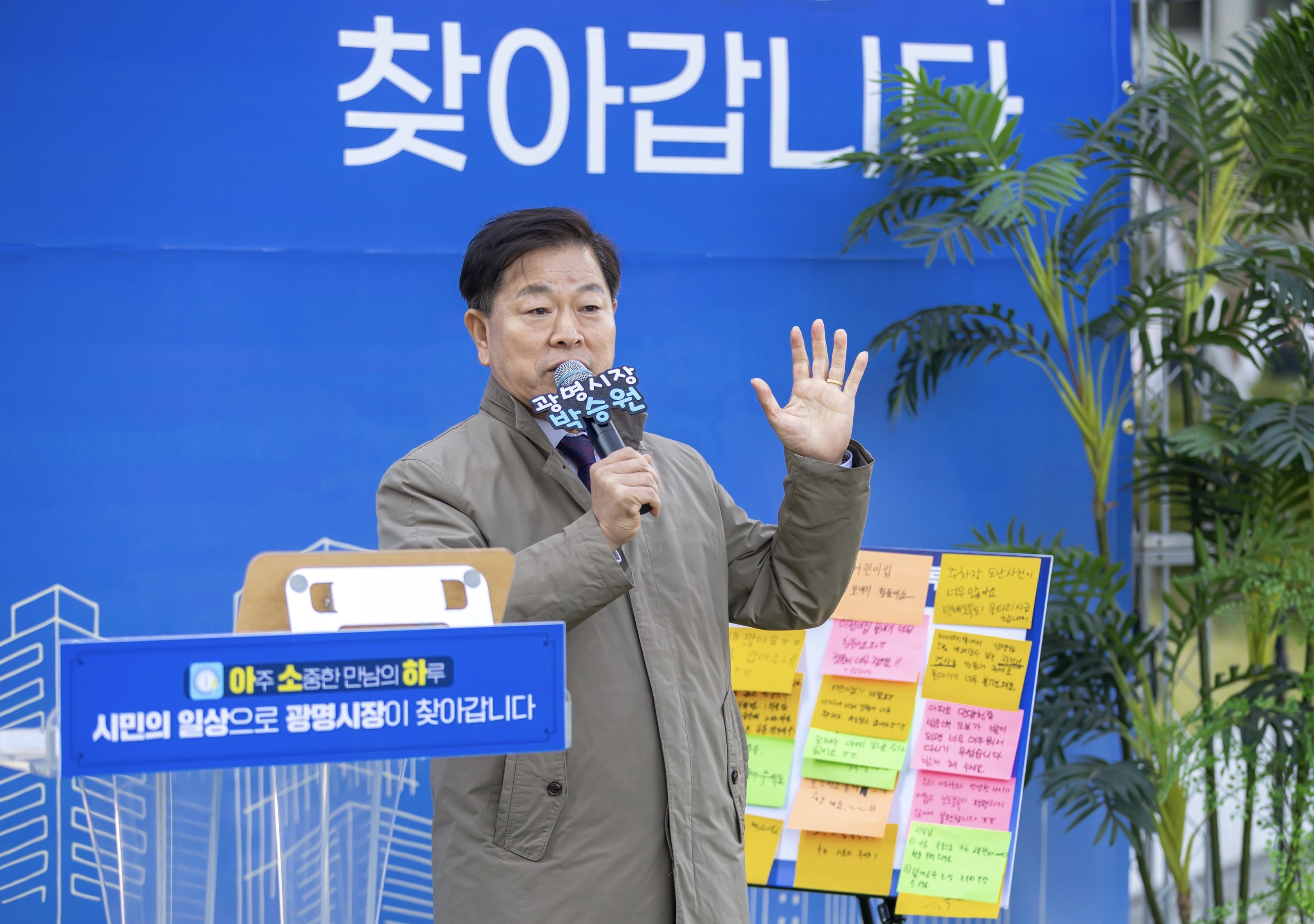
We will gradually expand the scope of application and strengthen the 500-citizen roundtable conferences held over eight sessions to complete genuine citizen sovereignty where citizens' decision-making authority is substantially expanded.
A city is a space where citizen communities live.
The foundation of Gwangmyeong's urban resilience is citizen communities.
Centered on living culture complexes, we will expand communication spaces and nurture communities that grow together through interdependence via apartment community initiatives and village governance activation projects.
Integrated care is a core pillar of a basic society.
Gwangmyeong City was the first nationwide to enact an integrated care support ordinance and newly established a dedicated organization to lay institutional foundations.
Starting in March this year, we will fully activate community-based integrated care together with health centers, 19 districts, and Gwangmyeong branches of the National Health Insurance Service.
Through mandatory home visits, functional recovery programs, and home medical centers, we will enable citizens to continue dignified lives in their original homes.
Elder policies will also be designed from a perspective of dignity.
We will pursue the construction of the Gwangmyeong Senior Happiness Center, an expanded model of the Life Plus Center, to systematically manage employment, and support elder life where social relationships and roles continue through lifelong learning, seasonal fruit support for isolated elderly, and smart senior centers.
Housing is the foundation upon which a basic society persists.
With the completion of the Gwangmyeong Soha District youth-focused public rental housing, new homes for 152 households have been secured.
We will continuously increase housing for housing-vulnerable populations and strengthen the housing safety net centered on housing welfare centers so that housing anxiety does not shake people's lives.
Finally, we will complete the future we have prepared through long-term vision.
Today's Gwangmyeong stands at a turning point where changes accumulated over many years are translating one by one into achievements.
Having passed the stage of laying the foundation of the city, now is the time to enhance completeness within an unwavering direction.
The future Gwangmyeong is not a city grown only in scale but a balanced city where industry and jobs, housing and culture, and people's lives are organically connected.
As a prepared city, we will complete it with calm and clarity.
First, we will solidly establish the foundation of future industries.
Centered on the Gwangmyeong Siheung Techno Valley Advanced Industrial Complex, which begins sales this year, we will focus on investment attraction strategies so that emerging industries such as advanced mobility and advanced manufacturing can take root, and will continuously pursue the creation of small and medium-sized parts and materials specialized complexes and economic free zone designation.
The 'Business ON Gwangmyeong' initiative won the 'Gyeonggi Province Business SOS Excellence Award' in its inaugural year, proving its potential.
Going forward, we will respond swiftly to corporate challenges and strengthen customized consulting and support to create an industrial ecosystem of shared growth.
The cultural industry is another growth axis for Gwangmyeong.
The K-Arena, which will be its starting point, will be developed as a complex entertainment space combining performances, content, retail, and convenience facilities with a capacity of 40,000 seats.
We will strategically respond to national competitions to position ourselves as a hub of cultural economy for the southwestern metropolitan region and open new paths of growth.
Urban transformation and living SOC that heighten residential density are proceeding without interruption.
The Gwangmyeong Ha-an 2 Public Housing District and Gureum Mountain Urban Development Project are advancing on schedule with site preparation, and we will achieve swift and fair compensation for the third phase of the Gwangmyeong Siheung New City.
Redevelopment and reconstruction projects will accelerate, but we will be clear on the principle that residents' rights and human rights come first.
Various cultural, sports, library, and community facilities including the Gwangmyeong Velodrome Multi-purpose Gymnasium, the National Fire Service Museum, Gwangmyeong District 3 Public Library, and the Women's Communication Culture Space are expected to open, where citizens gather, relationships continue, and the city's landscape transforms.
As cities grow, the completeness of connectivity becomes even more important.
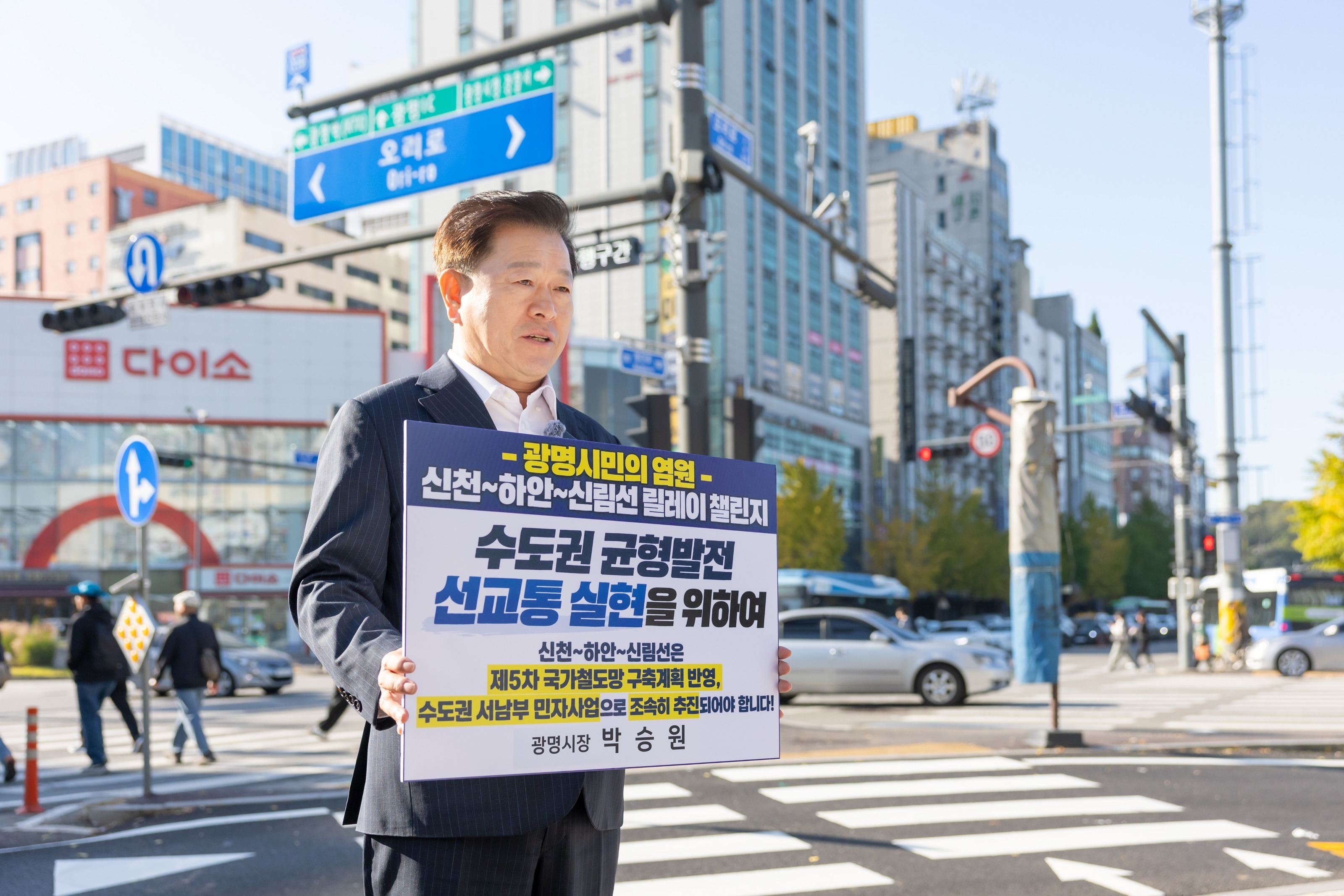
For the Sincheon Ha-an Simlim Line, we will find the fastest method for new construction through review of private investment projects and strategically approach inclusion in the Fifth National Railroad Network Master Plan alongside GTX-D and G lines.
Key railroad networks including the Gwangmyeong Siheung Line, Shin-Ansan Line, Wolkok Pangyo Line, and Suksek to Gwangmyeong High-Speed Rail will proceed without interruption to continually enhance metropolitan accessibility.
Additionally, in response to rapidly increased traffic from urban development, we will improve four major roads toward Seoul including Chulsan-ro, Bueman-ro, Digital-ro, and West Coast-ro, and resolve rush-hour traffic congestion through bus increases, route reorganization, and public bus introduction.
From the second half of this year, autonomous shuttle buses will operate on the 12 km section from Chulsan Station to Gwangmyeong Cave.
As a future mobility city, we will also preemptively respond to transportation changes.
The most certain investment in opening the future is investment in people.
We will further strengthen the learning foundation through Gwangmyeong Autonomous University and democratic citizenship education, enabling people from children to adults to learn and grow throughout their entire lives.
The K-Innovation Town on national land in Ha-an District, which begins demolition this year, will be rapidly completed as a youth complex space combining jobs, housing, and leisure, and we will advance one step further as a city enabling challenge and second chances through venture idea discovery, investment attraction, and management support.
And all this future is completed upon peace.
Peace is not a grand ideal but a condition that protects citizens' daily lives and preserves the city's sustainability.
Gwangmyeong will quietly continue its role as a city connecting Korean Peninsula peace, reducing conflict and building trust through exchange and cooperation.
Dear citizens of Gwangmyeong and fellow civil servants.
Over the past eight years, the Gwangmyeong we have built together was a city where we endured not alone but together, recovered not as individuals but as a community, and cultivated possibility.
The growth we have pursued was growth without abandoning one another, growth completed not through individual struggle but through the power of community.
In 2026, let us move forward unwavering as a city where living in Gwangmyeong conveys at least the belief that one is not alone, with citizen communities that are strength to one another and city administration that protects these communities.
A city that could endure because we were together, that could grow because we were together—that name is Gwangmyeong.
Wishing you abundant blessings in the new year.
Thank you.
Loading comments…