


Pyeongtaek's Super Opening Rice Proves Its Excellence Again in Quality and Taste Evaluation
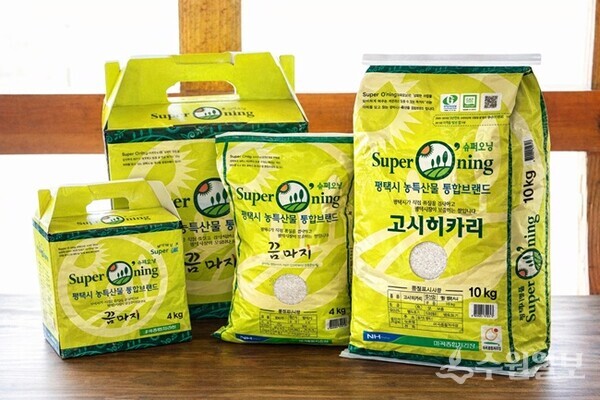
[Suwon Ilbo=Reporter Park Chan-hyeok] Pyeongtaek's representative agricultural product brand 'Super Opening Rice' has once again proven its excellence in quality and taste evaluation. The Korea Food Research Institute conducted a taste analysis on 'Koshihikari' and the domestic new variety 'Kkummaji,' the main cultivated varieties in Pyeongtaek, measuring protein content, whole grain rate, and analyzing rice taste, texture, and flavor after cooking, with these results being recognized.
According to the city on the 26th, while conducting quality and taste evaluations of premium Super Opening Rice since 2022 to manage quality, the city received taste analysis results this year for four varieties of rice produced this year by professional panels. In comprehensive scores evaluating overall quality including aroma, appearance, texture, and taste, as well as physicochemical and sensory characteristics of the rice, Kkummaji rice scored the highest at 74.4 points, and Koshihikari also scored well at 69 points. This represents improvements of 9.8 points (115%) and 10.6 points (118%) respectively from the 2023 taste evaluation comprehensive scores of Kkummaji 64.6 points and Koshihikari 58.4 points.
Additionally, white rice protein content (based on 15% moisture) is rated as 'superior' when 6.0% or below, 'excellent' in the 6.1-7.0% range, and 'good' at 7.1% or above. Both Koshihikari and Kkummaji meet the 'superior' standard under grain law with protein content of 6.0 or below.
These results are interpreted as outcomes of the city's management through reducing nitrogen fertilizer and conducting protein content inspections immediately after rice harvest.
Additionally, amylose content is within the optimal range for the most delicious rice at 14-16%, and moisture content is shown to be 15.0-16.5%. In particular, in the whole grain evaluation, which assesses the presence of broken rice and damaged grains, the Kkummaji variety showed an average of 97% or higher, and Koshihikari showed an average of 95% or higher, indicating superior rice quality.
This supports existing findings from multiple research results by the Rural Development Administration on rice taste characteristics—specifically that 'mechanical taste measurement shows positive relationships with texture, moisture content, and whole grain ratio, and negative relationships with protein content; lower protein content and higher moisture and whole grain ratios result in higher taste scores, with better rice taste when mechanical luster is higher and amylose content is lower.'
The following are the characteristics revealed through Pyeongtaek's 'Super Opening Rice' quality evaluation.
■ Kkummaji: Clear, Clean, and Aromatic Domestic Variety
Kkummaji is a variety developed in Gyeonggi Province and is characterized by its excellent adaptation to Pyeongtaek's cultivation environment. When cooked, the rice grains are clear and transparent, with an aromatic flavor and increasing sweetness with each chew, offering balanced taste. The chewiness and softness are harmoniously proportioned without excess, making it suitable for consumers who prefer clean rice taste, and recently it has been increasingly sought after by Japanese cuisine enthusiasts and camping enthusiasts.
■ Koshihikari: Premium Rice Taste with Shine, Softness, and Sweetness as Strengths
Koshihikari excels in shine and luster when cooked, with soft and chewy texture as its characteristics. It has a subtle sweetness and umami in harmony, and maintains relatively good rice taste even after cooling, earning recognition as a traditional premium rice. In particular, it shows consistent taste in various uses from everyday dining to sushi and lunch boxes, maintaining steady consumer popularity.
■ Super Opening Rice Broadening Consumer Choices
Through this variety-specific rice taste evaluation, the city presents rice options that can satisfy diverse consumer preferences. Koshihikari is suitable for consumers preferring soft and lustrous rice taste, while Kkummaji is appropriate for those wanting clean and aromatic taste. Both major varieties received high scores in rice taste evaluations, supporting the quality competitiveness of Super Opening Rice.
■ Super Opening Rice Raising Pyeongtaek Agriculture's Competitiveness
Particularly in cultivation aspects, Kkummaji is gaining popularity among local farmers as a shorter-stemmed variety strong against lodging and pre-harvest sprouting, showing strong resilience to abnormal weather like high temperatures and concentrated rainfall while securing stable harvest yields. Additionally, although Koshihikari is a variety developed in Japan, having established itself as Pyeongtaek's representative rice variety for over 20 years, it possesses technical know-how to produce high-quality rice in cultivation, and as an early-maturing variety capable of responding to abnormal weather, it can be harvested while avoiding the autumn late rainy season when planted in early May. Pyeongtaek applies nitrogen fertilizer at 4㎏/10a to achieve low rice protein content and prevent lodging damage—significantly less than the 7-9㎏/10a nitrogen typically required for other rice varieties—earning recognition as a low-carbon farming method that reduces carbon emissions.
A city official stated, "Super Opening Rice is raising consumer trust through rigorous quality management and variety-specific differentiation," adding "The city will continue to strengthen Pyeongtaek rice's brand value through ongoing taste evaluations and cultivation technology and variety management."


Loading comments…