


Mayor Park Seung-won of Gwangmyeong: "Strengthening Local Autonomy Needed for Sustainable Urban Development"
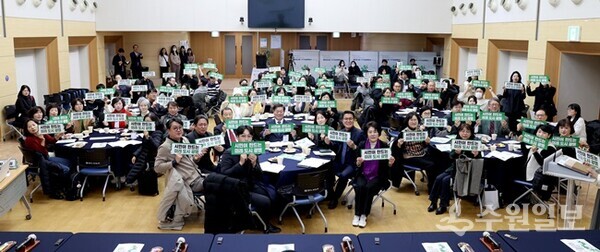
[Suwon Ilbo=Reporter Yu Je-sung] Mayor Park Seung-won of Gwangmyeong emphasized that strengthening local autonomy—including enhanced roles and authority for local governments and expanded citizen participation—is necessary for sustainable urban development.
On the 3rd, Mayor Park attended the '2025 Gwangmyeong Local Autonomy Policy Forum' at the City Hall conference room, themed on 'Balanced Development of Gwangmyeong-Siheung Third New City and Established Urban Areas as Citizens Speak.' He made these remarks at the event.
Mayor Park stated, "Gwangmyeong is currently facing a critical moment of change that will determine the city's future, including the Gwangmyeong-Siheung Third New City," and emphasized, "In particular, successful urban development is only possible when local governments, which best understand the field, have sufficient authority and citizens can participate throughout the entire development process."
He continued, "To create Gwangmyeong's future vision as a culture-leading city and high-tech industrial city, strengthening local autonomy that can reflect demands from residential communities in policy is essential, and citizen opinions must be reflected in actual policies and projects."
The forum was held as an opportunity to discuss balanced urban development from the perspective of local autonomy. Mayor Park, along with Park So-jin, advisor of the Korean Association for Local Government Studies, Professor Lee Beom-hyun of Sungkyul University's Department of Urban Design and Information Engineering, Lee Woo-jin, director of ㈜Comprehensive Architects and Engineering 101, and Park Eun-kyung, director of Hope Foundation, participated as urban development and local autonomy experts, sharing opinions on the necessity of local government roles and citizen participation in urban development processes.
Professor Lee Beom-hyun presented on 'Capital Region New City System and Local Decentralization.' He emphasized, "To ensure public housing districts are promoted consistently with the region's mid-to-long-term urban vision, strengthened roles and authority of local governments are essential." He also suggested, "Institutional mechanisms are needed to ensure resident opinions are balanced and not limited to formal procedures, reflecting voices from residential communities."
Director Lee Woo-jin then presented on 'Special Act on Aging Planned City Redevelopment and Regional Imbalance,' introducing overseas cases. He stated, "To revitalize established urban areas, it is necessary to go beyond simple physical space creation and adopt resident participation-based operational systems—in other words, a long-term governance transformation."
Following the presentations, comprehensive discussions took place with Park So-jin, advisor, serving as moderator, exchanging views with Mayor Park and experts. Various opinions were raised, including functional connectivity between new and established cities, innovation strategies responding to changing urban demands, and expansion of citizen participation.
Advisor Park stated, "If citizen opinions are not sufficiently reflected in the new city development planning stage, the development gap between new and established cities widens, making balanced growth of the entire city difficult," emphasizing, "For sustainable urban development, a structure is needed where citizen demands and opinions felt in actual residential communities are reflected in the policy-making process."
Mayor Park said, "The Gwangmyeong-Siheung Third New City is an important project that goes beyond simple new city development and determines Gwangmyeong's future competitiveness," and stated, "Through harmonious development with established urban areas, I will ensure the entire city grows in a balanced manner."
He added, "I will actively reflect the expert opinions proposed today and continuously communicate to ensure citizen voices are included in every process of urban development."
Loading comments…