


Gapyeong County, One Month After Flooding... "Wounds Run Deep, But Recovery Progressing Rapidly"
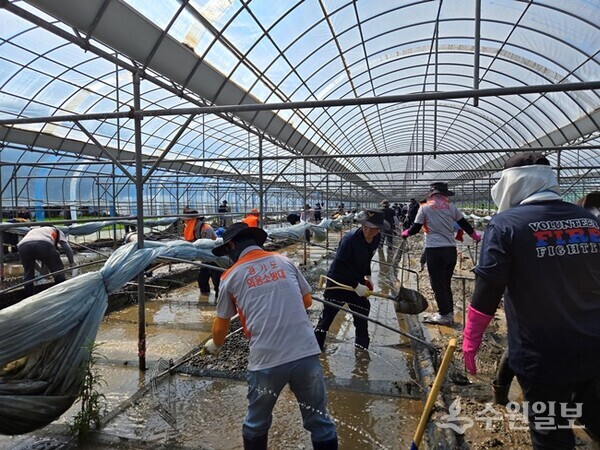
[Suwon Ilbo=Reporter Eom In-yong] Gapyeong County, which suffered significant damage from record-breaking torrential rain in the early morning of July 20, marked one month since the disaster on August 20.
While scars from the disaster remain visible at many sites, military units, residents, support from various sectors, and volunteer efforts continue as the community works to restore daily life.
Here is a review of progress to date.
Record-Breaking Torrential Rain Causes 115.6 Billion Won in Facility Damage
Heavy rain that fell over five days from July 16 to 20 brought an average of 322 millimeters or more of precipitation across Gapyeong County. Particularly in five eup and myeon areas including Jojong-myeon and Buk-myeon, concentrated rainfall of 36 to 110 millimeters per hour fell between 1 and 4 a.m. on July 20, triggering consecutive landslides and soil runoff.
As a result, seven deaths and nine injuries occurred, and 104 residents from 73 households lost their homes, relocating to temporary housing facilities and relatives' homes. Seventy-one houses were completely or partially destroyed, and 306 were flooded, devastating living areas in an instant. Farmland spanning 133 hectares suffered crop damage, and 948 livestock and approximately 92,000 aquatic animals died.
As of August 20, the total facility damage in the Gapyeong area was tentatively calculated at 115.6 billion won. Of this, private facility damage reached 12.6 billion won, while public facility damage totaled 103 billion won. The loss of critical infrastructure including road and river erosion, water supply and sewage damage, and landslides dealt a severe blow to the entire county.
100% Emergency Recovery Completion for Critical Infrastructure Including Roads, Electricity, and Water Supply
Immediately after the disaster, Gapyeong County mobilized all administrative resources for emergency recovery. As of August 20, emergency recovery rates showed 100% completion for roads, water supply, and electricity, and over 97% progress on communications and rivers, restoring basic living infrastructure for residents. However, sewage systems including wastewater treatment facilities remain under construction, and private facilities such as damaged houses continue repair work, leaving residents inconvenienced.
Warm support from across the nation gathered during the recovery process. A total of 10,900 volunteers from 429 organizations nationwide helped at disaster sites with house cleanup and soil removal. Centered on military units, police and fire departments deployed over 21,700 personnel to assist in restoring damaged houses and searching for missing persons. Additionally, 145 organizations and individuals nationwide contributed donations, and 132 organizations donated relief supplies including cup ramen and bottled water.
Permanent Recovery Short-Term Construction to Be Completed by June Next Year
Following emergency recovery, Gapyeong County is accelerating payment of private facility disaster relief funds and permanent recovery plans. The recent heavy rain damage recovery plan received central government review, and total disaster recovery funds of 258 billion won were confirmed. Consequently, private facility disaster relief payments are expected to become possible starting in September at the earliest.
The county is also expediting design service projects for permanent recovery, targeting completion by February next year. Beginning in March 2026, full-scale permanent recovery construction will commence, with priority given to completing short-term projects before the rainy season in June, followed by long-term initiatives including river improvement recovery.
Particularly for six rivers—Segok Stream, Sibitan Stream, Mile Stream, Seungan Stream, Anmile Stream, and Solan Stream—which suffered significant damage, the county determined that improvement recovery beyond functional restoration is necessary and has secured a budget of 146 billion won to undertake improvement recovery projects.
County Governor Seo Tae-won stated, "Although emergency recovery is nearing completion, the wounds of our residents remain severe," adding, "We will do our utmost to complete emergency recovery promptly and proceed without interruption on permanent recovery so that residents can safely return to their daily lives." He further emphasized, "As this flood damage is unprecedented, caused by record-breaking torrential rain, sustained attention and support from the central government level are necessary."


Loading comments…