


Gyeonggi Province Finalizes 'Gyeonggi Comprehensive Plan (2021~2040)' Containing 20-Year Future Vision
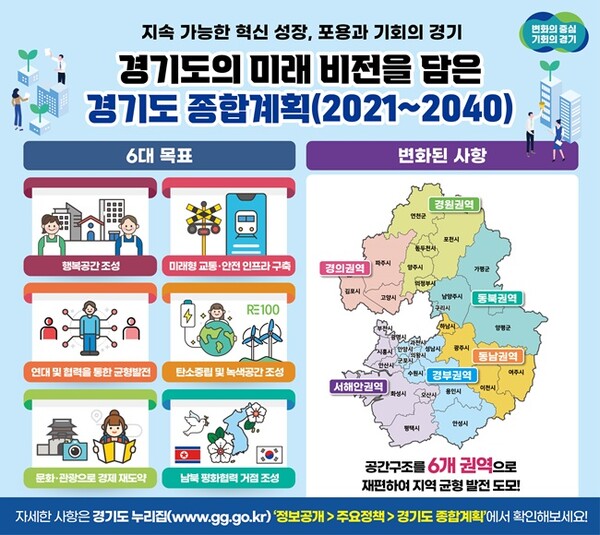
[Suwon Ilbo = Kim Gapdong] Gyeonggi Province has finalized the 'Gyeonggi Comprehensive Plan (2021~2040)' containing the development direction and future blueprint for the province over the next 20 years.
The province announced the 'Gyeonggi Comprehensive Plan (2021~2040)' with a future vision of 'Sustainable Innovation Growth, Inclusion and Opportunity in Gyeonggi' on its official website on the 19th.
This plan is the highest-level spatial plan at the provincial level based on Article 13 of the 'National Land Planning Act,' and serves as a comprehensive 20-year blueprint containing development directions and policy guidelines for all 31 cities and counties in Gyeonggi Province. It is coordinated with the 5th National Comprehensive Land Plan (2020~2040) and is newly established for the first time in 13 years following the Gyeonggi Comprehensive Plan (2012~2020).
First, the vision of the comprehensive plan was changed from 'Center of the Yellow Sea Region, Society of Sharing' in the previous Gyeonggi Comprehensive Plan (2012~2020) to 'Sustainable Innovation Growth, Inclusion and Opportunity in Gyeonggi.'
Accordingly, six major objectives have been set: △Creating comfortable living spaces (reorganization of transit-oriented development for compact growth and establishment of living areas, mitigation of regional disparities and balanced housing supply, etc.) △Constructing future-oriented transportation and safety infrastructure (completion of an efficient metropolitan transportation system centered on railroads, establishment of preemptive disaster prevention systems, etc.) △Balanced development through cooperation and collaboration (advancement of innovation hubs, improvement of four major regulations in the northeastern region, etc.) △Carbon neutrality and creation of green spaces (implementation of Gyeonggi Province's green mountain belt, establishing carbon neutrality foundation, etc.) △Economic revitalization through culture and tourism (fostering global premium tourism content, etc.) △Creating hubs for inter-Korean peace cooperation (activation of inter-Korean exchanges, etc.), with a total of 30 implementation strategies established for each objective.
The spatial structure has been reorganized from the existing five regional divisions (Gyeongui, Gyeongwon, Eastern, Gyeongbu, West Coast) to six regions by dividing the Eastern region into Southeast and Northeast. The plan establishes 47 core centers in four hierarchical levels (metropolitan hub, regional hub, regional center, strategic hub) and 11 development axes to promote balanced regional development.
By region, key strategic projects include: △(Gyeongui) Building converged industrial hubs combining broadcasting, video, culture, and biomedical clusters, etc. △(Gyeongwon) Creating new development hubs through inland distribution and logistics complex development, etc. △(Northeast) Developing station areas centered on GTX and railroads in the northeastern region, etc. △(Southeast) Developing station areas centered on GTX and railroads (Gyeonggang Line) in the southeastern region, etc. △(Gyeongbu) Creating innovation clusters for fourth industrial revolution and high-level service industries within urban centers, etc. △(West Coast) Nurturing convergent new growth industry hubs in the southwestern region, etc.
According to this plan, Gyeonggi Province's projected population for 2040 is 14.79 million, expected to increase by more than 1 million compared to the current 13.69 million.
The province went through resident surveys, public hearings, city and county consultations, and expert consultations from 2020 onwards to establish the plan, and finalized the final version through national land planning evaluation and coordination with central administrative agencies.
The plan will be used as a guideline for comprehensive plans of cities and counties and the establishment of administrative policies. The corresponding comprehensive plan can be viewed by anyone on the Gyeonggi Province website (https://www.gg.go.kr) under the 'Information Disclosure → Major Policies → Gyeonggi Comprehensive Plan' tab. For additional inquiries, contact the Gyeonggi Province Spatial Strategy Division (031-8008-6165).
A Gyeonggi Province official stated, "This comprehensive plan is a strategic roadmap for Gyeonggi Province to proactively respond to various future changes including population decline, climate crisis, and industrial structure changes," and added, "We will actively link and support the plan so it can operate effectively in cities, counties, and at the field level."


Loading comments…