


Gyeonggi Province to Supply 270,000 Workers from Public Sector to Address Labor Shortage During Peak Farming Season
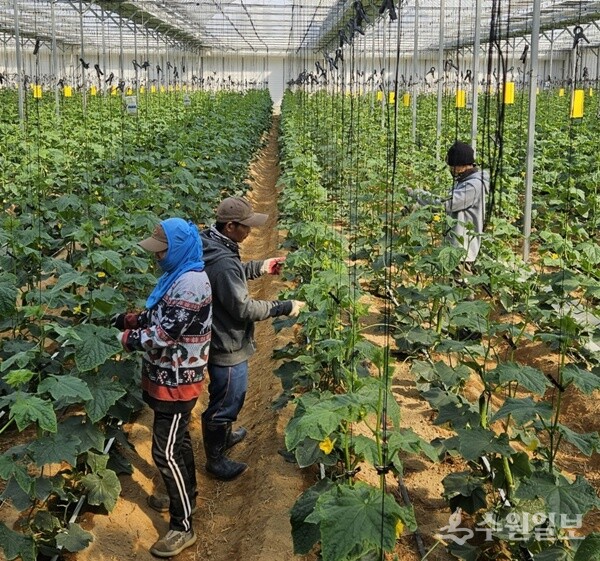
[Suwon Ilbo=Reporter Kim Gap-dong] Gyeonggi Province announced on the 6th that it plans to resolve the agricultural labor shortage by supplying a total of approximately 270,000 workers from the public sector during the peak farming season, ranging from job seekers at rural labor placement centers to foreign seasonal workers and volunteer personnel to support farming areas suffering from labor shortages.
The province estimates the total labor demand in the agricultural sector for this year at approximately 1.2 million workers, with plans to supply 270,000 of them from the public sector. Specifically, this includes approximately 42,000 from rural labor placement centers and public seasonal worker placements, approximately 180,000 through agricultural cooperatives and organizations' labor support programs, approximately 36,000 through the justice ministry's social service orders, and others. Additionally, approximately 4,000 farm-based seasonal workers and approximately 8,000 foreign workers under the employment permit system are included.
The province plans to operate a labor supply support situation room with city and county governments until June. Centered on nine cities and counties—Hwaseong, Pyeongtaek, Paju, Gimpo, Pocheon, Yangpyeong, Anseong, Yeoju, and Yeoncheon—that operate rural labor placement centers and public seasonal labor services, the province will monitor weekly the progress of farm work, labor supply and demand trends, and wage trends at the field level.
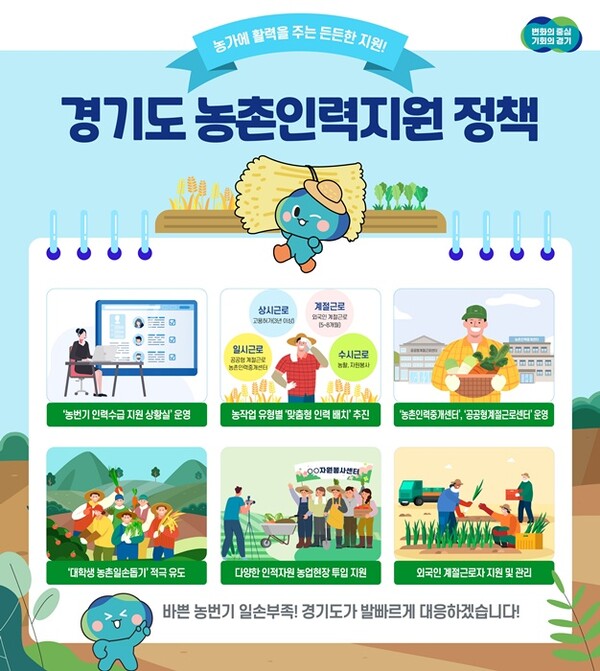
Currently, 11 rural labor placement centers and public seasonal labor centers are operating in nine cities and counties, and these centers connect domestic and foreign workers to small and medium-sized farms at no fee, helping reduce labor costs for farmers. The centers' performance is also regularly managed by the province.
The province also signed a memorandum of understanding with 29 universities in 2021 to actively encourage university students to help with farm work in rural areas, and is cooperating with volunteer centers, farmers' organizations, and the justice ministry to ensure that diverse human resources can be deployed to agricultural sites.
As for foreign seasonal workers, as of April 28, 3,032 workers have entered and been employed in 19 cities and counties, bringing vitality to farms. This represents approximately 70% of the first-half allocation of 4,336 workers, and it is expected that over 90% will enter the country in May to be deployed to agricultural sites facing labor shortages.
In particular, the province is implementing customized workforce placement considering that labor demand varies by type of farm work. Agricultural labor types are divided into four categories: △permanent workers △seasonal workers △temporary workers △occasional workers, with varying required personnel depending on the field and period.
Permanent workers are employed for more than three years through the employment permit system (E-9) in fields requiring constant labor such as livestock and facility horticulture. In contrast, seasonal workers are deployed short-term in seasonal categories (E-8) for crops such as fruits and vegetables where labor is concentrated during harvest periods of five to eight months. Temporary workers respond to short-term and non-continuous demands through rural labor placement centers or public seasonal labor services, while occasional workers are centered on family farm self-labor.
Park Jong-min, head of the Department of Agriculture, Fisheries and Life Sciences, said, "We will operate the workforce support system precisely according to agricultural work type and timing, and will work together with the public and private sectors to establish a field-oriented and practical workforce support system."


Loading comments…