


Gyeonggi Province Prepares Emergency Transport Measures in Preparation for Railroad Union Strike

Suwon Ilbo=Reporter Kim Gap-dong] As the Korail union has announced an indefinite general strike beginning at 9 a.m. on the 5th and the Seoul Metro union from 9 a.m. on the 6th, Gyeonggi Province has begun preparing emergency transport measures to minimize inconvenience to residents.
The province held two emergency transport measure meetings with the Ministry of Land, Infrastructure and Transport and announced plans to establish an emergency transport headquarters situation room from the 4th, one day before the strike, and operate it 24 hours until the strike ends.
The Gyeonggi Province emergency transport headquarters will be composed of a general coordination division and a transportation measures division, with the general coordination division handling situation room operations, coordination with related agencies, strike monitoring, and 24-hour disaster safety situation room operations, and the transportation measures division responsible for emergency transport measures such as buses and taxis.
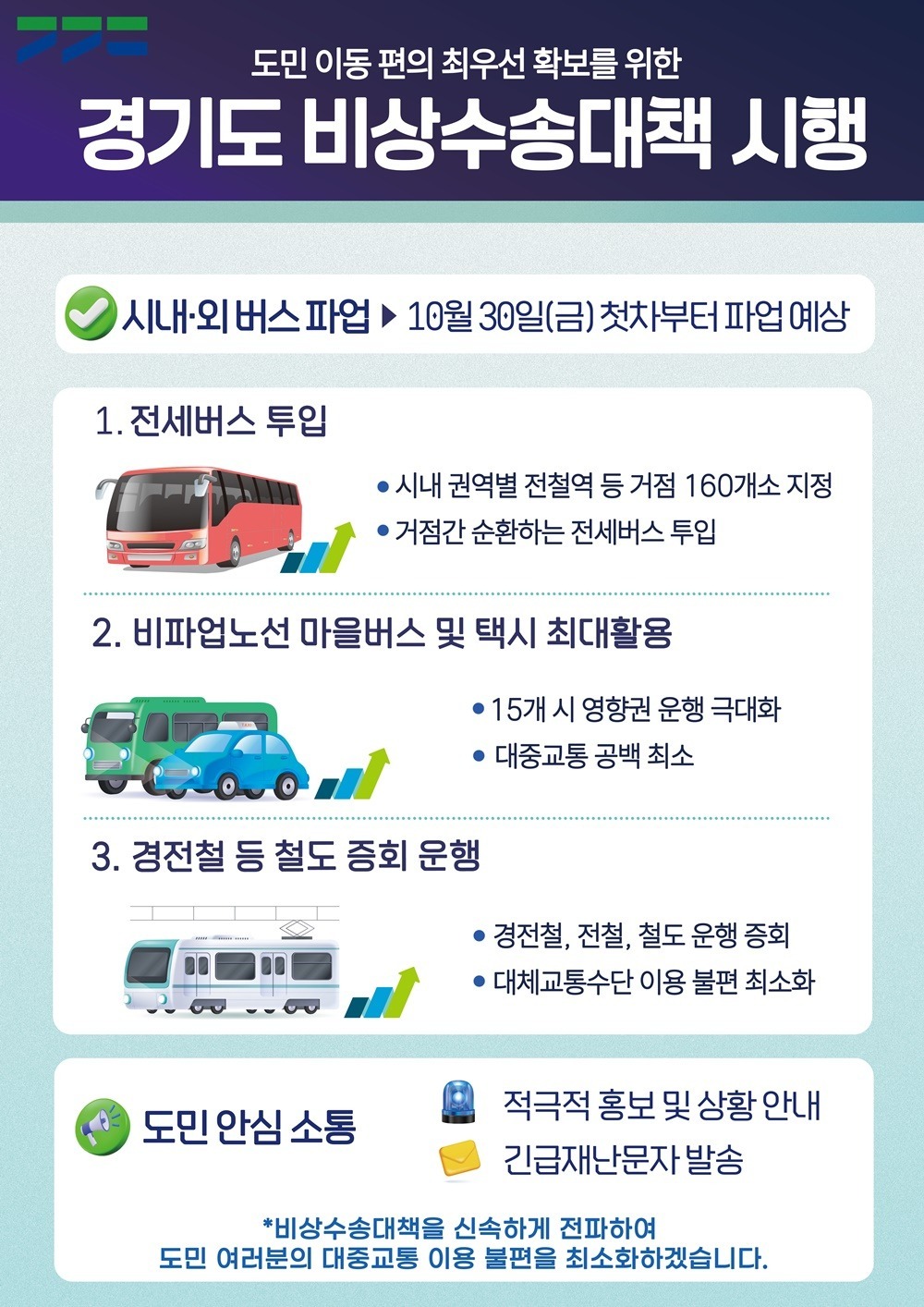
The emergency transport headquarters divides Gyeonggi Province into six regions—Gyeongui, Gyeongwon, Eastern, Southeastern, Gyeongbu, and West Coast—and will concentrate deployment of 2,141 vehicles across 202 metropolitan bus routes and 450 vehicles across 46 city bus routes entering and exiting Seoul during commute hours, improving transportation capacity. By monitoring demand, the province plans to deploy 124 standby metropolitan buses and 280 city buses on congested routes, and mobilize charter buses if necessary.
Inter-city buses will be divided into five regions (Seoul Metropolitan Area, Chungcheong, Gangwon, Jeolla, and Yeongnam) using spare vehicles owned by operators, adding 97 vehicles across 45 routes for 152 additional trips. Village buses across 832 routes and 2,923 vehicles will extend late-night service hours by one hour if needed, tailored to each city and county's circumstances, and taxi associations and local governments will be requested to actively encourage taxi operations during the strike period.
Additionally, the province will prepare for emergency situations such as crowd accidents through monitoring using CCTV at city and county integrated traffic control centers, deploy additional safety personnel at major stations on six provincial lines (Uijeongbu Light Rail Transit, Yongin Light Rail Transit, Gimpo Goldline, Hanam Line, Bucheon Line, and Byeolnae Line), and conduct on-site congestion inspections at major transfer stations to prevent safety accidents.
When the strike begins, the provincial emergency headquarters plans to provide residents with rapid updates on strike status and alternative transportation through media, Gyeonggi Province and city and county websites, the Gyeonggi Bus Information app, G-Bus TV, social media, and station information notices.
Han Tae-woo, director of the Gyeonggi Province Railroad Operations Division, said, "We will make every effort to minimize resident inconvenience during the railroad strike by supporting alternative transportation and monitoring situations such as crowd congestion."

Loading comments…