


Gyeonggi Economic Science & Technology Promotion Agency and Gyeonggi Credit Guarantee Foundation Achieve Top 'B' Grade in Gyeonggi Province's 'Public Institution and Executive Performance Evaluation'
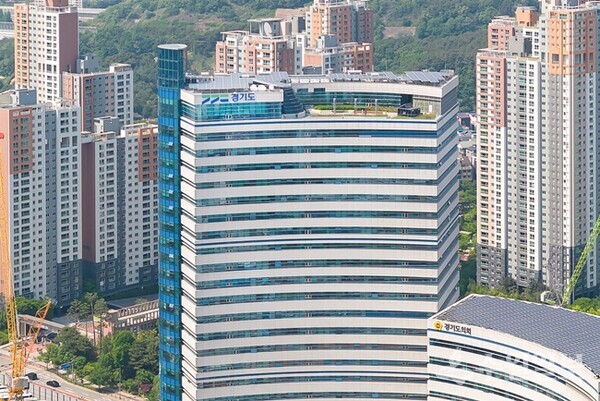
[Suwon Ilbo=Reporter Kim Gap-dong] Two public institutions—the Gyeonggi Economic Science & Technology Promotion Agency (GSTPA) and the Gyeonggi Credit Guarantee Foundation (GCGF)—received the top 'B' grade in Gyeonggi Province's 'public institution and executive performance evaluation for the previous year.'
The province completed deliberation and resolution at the Gyeonggi Province Investment and Subsidy Institution Steering Committee on the 16th and announced the 2024 (2023 performance) evaluation results for public institutions and executives on the 25th.
This evaluation focused on innovative performance and efforts, including the promotion of innovative projects reflecting provincial government values, and the social responsibility of public institutions, including RE100 achievement rates and best practices in addressing population issues.
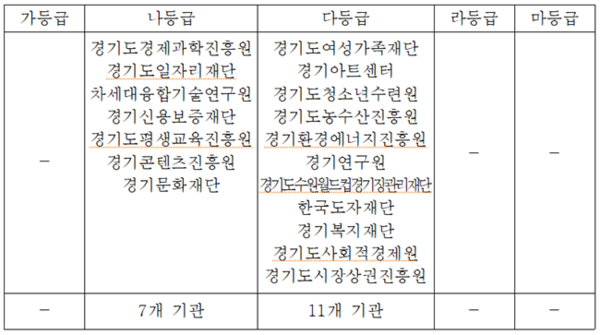
As a result of the evaluation, no institutions fell into 'A', 'D', or 'E' grades among the five grades (A through E), with seven institutions receiving 'B' grade and 11 institutions receiving 'C' grade.
Seven institutions, including the Gyeonggi Economic Science & Technology Promotion Agency, which received high evaluations for promoting 27 innovation projects such as establishing a Gyeonggi-style G-fund and implementing 'paperless administration,' and the Gyeonggi Jobs Foundation, which was recognized for achievements in implementing nine focused innovation projects including improving work efficiency through digital work platforms and public MyData utilization and the Gyeonggi Youth Gap Year project, received 'B' grades. Among the 11 'C' grade institutions, the Gyeonggi Small Business and Commercial District Promotion Agency received a poor evaluation in the major project performance assessment section.
Four institutions showed grade changes compared to the previous year. The Gyeonggi Lifelong Education Promotion Agency and Gyeonggi Content Promotion Agency advanced from 'C' to 'B' grade, and the Gyeonggi Small Business and Commercial District Promotion Agency moved up from 'D' to 'C' grade. The Gyeonggi Arts Center dropped one grade from 'B' to 'C', while other institutions saw no grade changes.
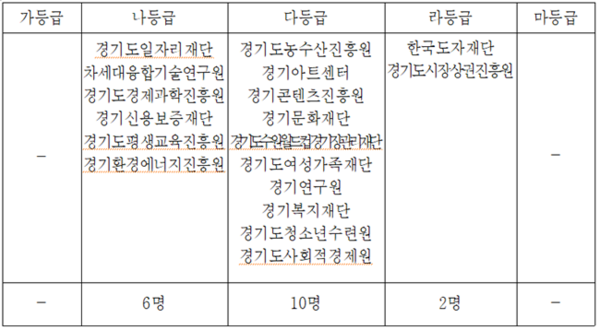
The evaluation of heads of invested and subsidized institutions was conducted for current and former executives of 24 institutions, excluding those who served less than three months based on the previous year. Six institution heads, including those from the Gyeonggi Jobs Foundation and Next Generation Convergence Technology Research Institute, received 'B' grades, while 10 heads, including those from the Gyeonggi Agricultural & Fisheries Promotion Agency and Gyeonggi Arts Center, received 'C' grades, and two institution heads from the Korean Ceramic Foundation and Gyeonggi Small Business and Commercial District Promotion Agency received 'D' grades. The evaluation results for the presidents of four local public corporations including Gyeonggi Housing & Urban Development Corporation and executives of the Gyeonggi Social Service Agency and Gyeonggi Medical Center will be finalized after reflecting evaluation results from central government agencies (Ministry of the Interior and Safety, Ministry of Health and Welfare).
Based on these evaluation results, the province plans to implement follow-up measures such as warnings for institution heads receiving 'D' grade or lower and to evaluate the implementation performance in the next year regarding management improvement tasks assigned to each institution through this evaluation. Additionally, institutions and executives rated 'C' grade or higher may receive performance bonuses within budget constraints.
Previously, the province formed a performance evaluation panel of 29 members including university professors and certified public accountants. Subsequently, from March to June, the province evaluated the 2023 management performance of 18 Gyeonggi Province invested and subsidized institutions through written assessment and on-site evaluation for each institution.
Going forward, the province plans to continuously monitor institutional efforts and achievements to enable public institutions to create tangible results that residents can feel based on efficient and transparent management and to contribute to solving social issues such as responding to low birth rates and climate crises.


Loading comments…