[Kim Chung-young's Suwon Microscope (140)] History of Suwon Wastewater Treatment Plant (1)
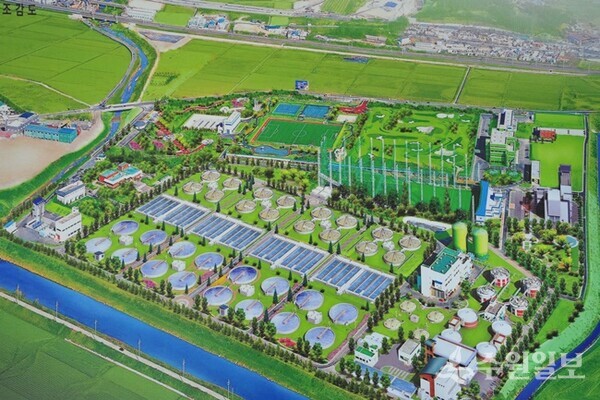
By the early 20th century, average human lifespan was 30 years, but by the early 21st century, it had extended to over 70 years. Research shows that human life expectancy was extended not by medical technology but by the provision of water and sewage systems. Through the distribution of water and sewage infrastructure, water pollution was prevented, resulting in reduced impact from cholera, dysentery, and typhoid.
Traces of sewage systems have been discovered in the four major ancient civilizations. In Korea, records show that in 1411, during the reign of King Taejong, a 'stream construction project' was implemented to safely protect the capital from flooding. During the reign of King Sejong, when streams passing through the fortress walls became blocked, causing floods, a 'second stream construction project' was carried out. By the reign of King Yeongjo, records indicate that dredging work was performed on the buried Cheonggyecheon.
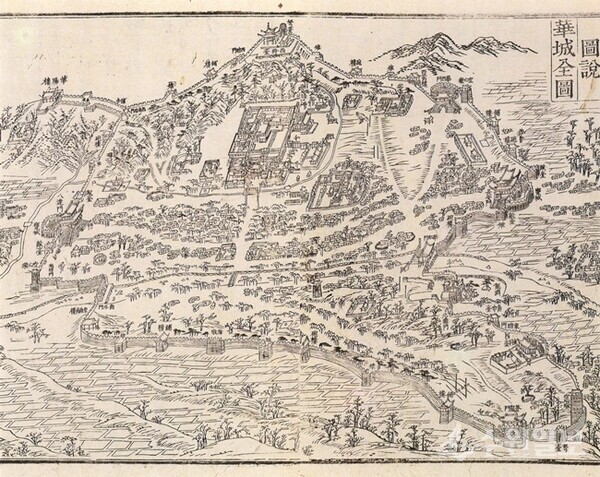
In Suwon, construction of the new Suwon town began on July 15, 1789, to develop Hyungnyungwon, the tomb of Prince Sado. Although detailed construction records from that time are not available, five years later, during the construction of Hwaseong Fortress, roads were expanded and ditches were created on both sides. To facilitate proper drainage, the Suwon Stream was dredged and silver channels were constructed to direct water from inside the fortress to the outside. This project was aimed at smooth drainage rather than wastewater treatment.
In modern times, sewage facilities were introduced to Korea. After the Byeongja Treaty of 1876 with Japan and subsequent treaties with the United States (1882), England, Germany, Russia, Italy, and France, the number of foreigners visiting Joseon increased significantly. The first impression Westerners had of Joseon was uncleanliness. What foreigners commonly pointed out was the poor condition of roads, with odors from abandoned garbage and sewage being the primary concern.
Due to unsanitary conditions, cholera erupted in 1895, killing 300,000 people. Those who pointed out the poor urban environment and uncleanliness at the time were envoys such as Kim Ok-gyun and Park Young-hyo. After investigating sanitation-related facility management in the United States and Japan, they emphasized three development areas through 'ruling methods': first, hygiene; second, agriculture and commerce; and third, roads. The ruling project they proposed was not realized due to the failure of the Gapsin Reforms.
Korea's full-scale sewage system project began in 1915 when Gyeongseongbu (Seoul under colonial rule) established and promoted a 'seven-year sewage improvement plan.' This project was carried out from 1918 onward, marking the 'first sewage improvement project.' Subsequently, it was promoted over several stages. At that time, both open channels and closed conduits were considered, but the less expensive open channel method was adopted. Until wastewater treatment plants were built, Korea continued to use a system that discharged both stormwater and sewage together.
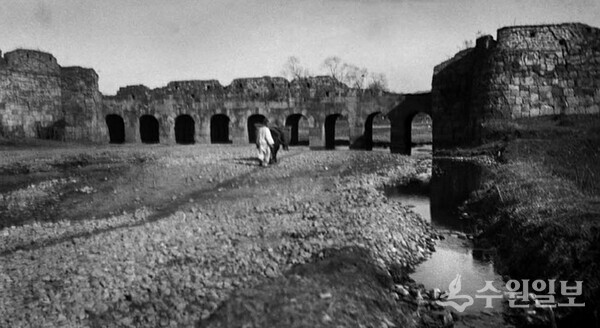
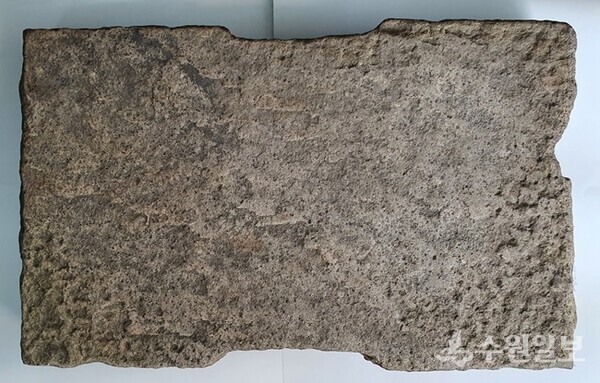
Sewage system projects in provincial cities were introduced in the 1920s. In Suwon, 'when the Namsumun Gate was lost in the 1922 Eulchuk flood, the stones from Namsumun Gate were collected and used for the sewage project. The stones were thinly split and used as covers for U-shaped open channels on both sides of National Route 1, extending from Janganeun Gate to Paldalmun Gate,' according to testimony from Professor Yun Han-heum, who painted old pictures of Suwon.
Suwon's sewage project primarily involved installing open channels on both sides of major roads and covering them with lids. For smaller roads, closed conduits were laid in the center of the road. Records on Suwon's sewage system do not appear in 1966 statistics. However, according to Suwon's 1967 statistics, the system had grown from 106,606 meters in 1965 to 119,846 meters in 1966, with open side channels totaling 29,044 meters. This indicates that before the land readjustment projects promoted to accommodate the rapidly increasing population following the relocation of the Gyeonggi Provincial Government to Suwon in 1967, no substantial sewage infrastructure had been installed.
In 1972, sewage plans were included in the 'First Comprehensive National Development Plan,' which mandated the installation of wastewater terminal treatment plants for major cities to prevent river water pollution.
As a result, the 'Cheonggyecheon Wastewater Treatment Plant' construction plan was established and implemented, and the plant was completed in 1976.
The completion of the Cheonggyecheon Wastewater Treatment Plant made it clear to other major provincial cities that they could no longer ignore complaints caused by river pollution. At the time, the Ministry of Construction (now the Ministry of Land, Infrastructure and Transport) promoted pilot projects before formally implementing sewage business improvement, targeting the industrial city of Ulsan.
In 1983, the Ministry of Construction issued a second-phase plan to promote the construction of wastewater terminal treatment plants in cities at the level of provincial government seats. It was at this time that the author, after working in the Urban Planning Division for a long time, was promoted to senior-level 7 and began working in the Construction and Sewage Section, establishing a connection with Suwon's sewage business. At that time, Suwon's sewage operations were truly at a rudimentary level.
Massive financial resources were needed to construct the wastewater terminal treatment plant and sewage collection pipes, making it urgent to secure revenue sources. To smoothly promote the work, I visited Ulsan with Park Soon-yong, an administrative level 8 official who worked alongside me, and obtained detailed plans on projects that had been previously promoted.
▷The first task undertaken was the creation of 'sewage network maps' through detailed investigation of existing sewage pipes. ▷The second task was to designate drainage areas where public sewage infrastructure had been installed based on the sewage network maps, which was necessary for collecting sewage usage fees. ▷The third task was to design sewage collection pipes to transport wastewater to the treatment plant, based on the completed sewage network maps. ▷The fourth task was to select the location of the wastewater treatment plant considering topography and proceed with its implementation.
In 1984, I visited the Economic Planning Board (now the Ministry of Strategy and Finance) to secure funding for the wastewater treatment plant construction. When I told the section chief in charge of Gyeonggi Province, 'River pollution in Suwon is severe, so I came to discuss the need for a wastewater treatment plant,' the official countered before even hearing a detailed explanation: 'What would happen to the Republic of Korea immediately if Suwon didn't build a wastewater treatment plant?' He then added, 'This position is not about providing budgets, but rather cutting back requests that exceed the national budget, and the timing is premature.'
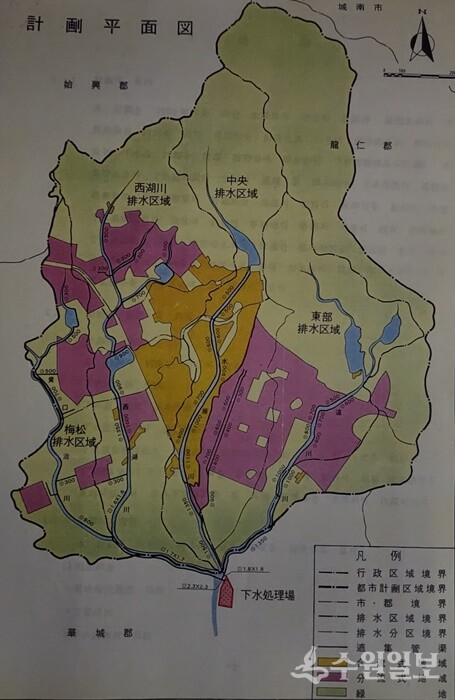
Despite this setback, Suwon steadily promoted sewage basic plan establishment, sewage network mapping, utility rate calculations for sewage fee collection, and sewage collection pipe design projects. To formally promote sewage operations, Suwon upgraded the Construction Division's Sewage Section to a full Sewage Division on October 31, 1985.
On that day, the author transferred back to the Urban Planning Division, my original department. (To be continued)