


Kim Dong-yeon Pledges to Cooperate with 15 Organizations to Build 'Gyeonggi RE100 Platform' for Climate Crisis Response
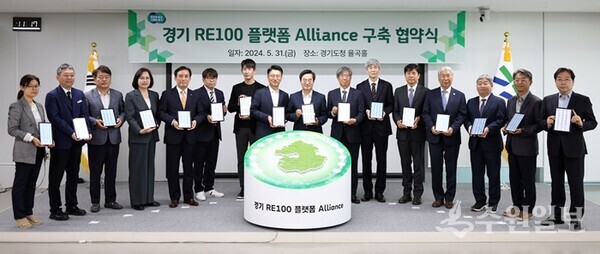
[Suwon Ilbo=Reporter Kim Gap-dong] Gyeonggi Province is cooperating with 15 public and private organizations, including the National Institute of Geographic Information and Kakao Mobility, to build the 'Gyeonggi RE100 Platform' that allows viewing climate and energy-related data such as carbon emissions, absorption volumes, and renewable energy potential across the province in one place.
Governor Kim Dong-yeon signed the 'Gyeonggi RE100 Platform Alliance Establishment MOU' on the morning of the 31st at the Gyeonggi Provincial Government with public organizations including the National Institute of Geographic Information, National Institute of Forest Science, National Institute of Ecology, Korea Institute of Civil Engineering and Building Technology, Korea Transport Institute, Korea Energy Agency, Korea Environment Institute, and private companies Kakao Mobility, SK Telecom, and Naver Cloud.
From Gyeonggi Province, the Gyeonggi Research Institute, GH, Gyeonggi Environment and Energy Promotion Agency, Gyeonggi Creative Economy Innovation Center, and Next-Generation Convergence Technology Institute participated.
Governor Kim said in his remarks that day, "I hope climate change can be addressed with one heart regardless of ideology or political considerations. Climate change is an issue that must be tackled head-on and utilized as an opportunity," and added, "I believe South Korea's future economic opportunities will not come from semiconductors or mobility as before, but from AI and climate change industries. I hope Gyeonggi Province and the nation will work together on South Korea's climate change response."
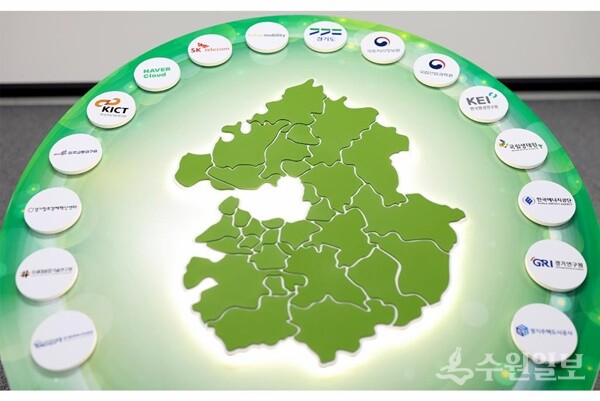
The Gyeonggi RE100 Platform will establish spatial information in the climate and energy fields across the entire Gyeonggi Province using aerial LiDAR, hyperspectral imaging (recording subdivided wavelengths of light outside the visible light spectrum), and building energy consumption data. It is the first platform in South Korea for climate crisis response based on objective and scientific data.
Through carbon absorption data, the province can easily identify areas lacking forests and parks and apply related policies. Through carbon emission data such as electricity usage and heating consumption, the province can establish effective carbon reduction policies and understand the effectiveness of policy implementation.
Additionally, the province can analyze optimal locations and potential for renewable energy for buildings and vacant land within the region, and can measure regional temperature and surface elevation, making it easier to identify heat wave-vulnerable areas and flood-vulnerable areas during heavy rains, facilitating advance prevention and countermeasure planning.
According to the agreement, the province will establish an inter-agency cooperation system and promote RE100 data disclosure and administrative support. The National Institute of Geographic Information will jointly establish digital elevation models (0.5DEM), the National Institute of Forest Science will support carbon absorption analysis technology, the National Institute of Ecology and Korea Environment Institute will support inter-agency data sharing and climate change response business model development.
Private companies Kakao Mobility, SK Telecom, and Naver Cloud will support platform users in easily accessing and utilizing the information they need through cutting-edge technologies such as AI and data held by each company.
The province expects the 'Gyeonggi RE100 Platform' construction project to gain momentum based on cooperation with these 15 public and private organizations.
The province plans to operate trial services targeting small and medium enterprises starting as early as October this year and begin official service of the Gyeonggi RE100 Platform in June next year.

Loading comments…