


'Practicing Filial Piety' to be Educational Focus... Suwon Steps Forward as an Education City
More than two weeks have passed since the new year began. We met with Lee Ki-jun, Superintendent of the Suwon Office of Education, to hear about this year's plans for education in Suwon, an 'Education City,' including issues surrounding school expansion in redevelopment areas and the polarization of elementary school student numbers in Suwon.
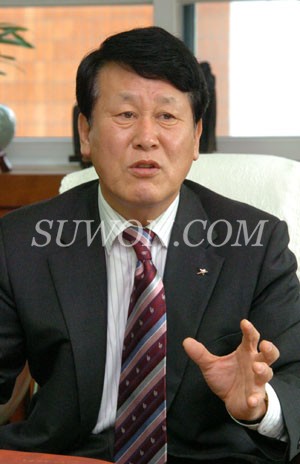
▲ This year we are emphasizing '3S,' which stands for speed, service, and satisfaction. For those who come to the Suwon Office of Education with inquiries, we aim to serve them quickly, provide the best service, and ensure their satisfaction.
Terms like 'service' and 'customer satisfaction' may sound unfamiliar in education, but I believe the reason civil complaints arise is a lack of trust between parties.
In other words, parents, students, and the local community are also a kind of customer, so we must serve such customers well, do so promptly, and ensure their satisfaction. Going forward into 2007, I plan to ensure that education receives trust through the spirit of '3S.'
To the degree that visitors here think, 'The Office of Education is truly different.' Recently, we even brought a blood pressure monitor for citizens waiting with inquiries. I plan to correct these matters one by one, starting with the small details.
- If there are any educational projects you are prioritizing.
▲ Suwon is a 'City of Filial Piety.' With Hwaseong, a UNESCO World Heritage site, and the spirit of filial piety embodied by King Jeongjo, this year we are prioritizing not merely filial piety education in words, but practical filial piety education that is actually practiced.
We plan to make education something students can experience through various curricular and extracurricular activities. We are budgeting for such initiatives and plan to implement them gradually through broad cooperation with Suwon City.
Additionally, society is undergoing rapid diversification and change.
We often speak of the 21st century, which above all means that in the future we must focus on cultivating global talent for the Suwon region and, more broadly, for our society.
For global talent, what is important is 'creativity.' The era ahead will be one where distinctive ideas determine success. Therefore, education must also prioritize creative education for cultivating global talent. Gifted education is one of the important projects to be considered.
- These days, there is conflict over standardized education and gifted education.
▲ When it comes to gifted education, people tend to have initial resistance. However, gifted education is not discriminatory education of students. Gifted education must coexist with standardized education.
In the rapidly changing society of the 21st century, gifted talent is indeed necessary, and one talented or gifted person can influence hundreds of thousands. Rather than unconditional cultivation of gifted students, gifted education should be conducted as part of standardized education where everyone can advance together.
That is, true gifted education is not education that benefits only certain special students, but rather opens the doors of gifted education to all students, discovers their potential, and cultivates talents and abilities superior to others.
For such gifted education to become active, not only must the curriculum at school be substantive, but also through after-school educational activities, an educational space must be provided where students can sufficiently develop their talents.
- Is it not the case that elementary school student numbers are declining due to the low birth rate.
▲ Overall, due to the low birth rate, student numbers are trending downward going forward. However, in the case of Suwon, because there are many redevelopment apartments and areas, elementary schools and middle schools are needed.
When facing a problem, we tend to think first of the negative aspects. But if we change our thinking positively, instead of a decrease in student numbers, the number of students per class will decrease, which I believe will strengthen the foundation of public education.
Currently, some schools have over 40 students per class, but if the number of students per class decreases to around 30, I forecast that the current problems of public education will be resolved.
- There are many redevelopment apartments. What are the plans for new school construction in this regard.
▲ If the Sinmaetan area development is completed, occupancy will be in 2008, and the plan is to convert the elementary school site there into a middle school. If the Gyeggae Jugong area is redeveloped, one elementary school is scheduled to be built.
An elementary school is planned in the Jeongja District. In 2009, when many new apartments are built in the Jeongja District area, we are planning to build one more elementary school.
Additionally, if the Homaesil area is developed, many elementary and middle schools will be needed, and as the Eui-dong area becomes an administrative town, schools are expected to be built as part of residential environment projects.
- Regarding redevelopment in the Suwon area, the polarization of elementary school student numbers has become problematic.
▲ In Suwon, areas densely packed with apartments have large-scale schools in terms of student numbers, while the old prestigious schools from long ago are continuously losing students, resulting in a kind of polarization. This is no small problem. We must plan concrete solutions to such issues and address them gradually.
A representative example is Namchang Elementary School, located in Paldal-gu, which currently maintains one class per grade level. Maesan Elementary School is also experiencing a steady decline in student numbers. When student numbers decline like this, it is a sensitive matter because it relates to the existence or closure of schools.
Moreover, as a secondary problem, the various facilities already built at these schools are becoming useless due to insufficient students, which is quite regrettable.
- Regarding Hwaseong projects, what is the status of Shinpung Elementary School's relocation.
▲ In fact, Shinpung Elementary School has the same history as Korea's elementary schools and also carries important symbolic meaning, so we are planning to maintain its traditions by relocating it to an appropriate location in the future. We are currently in ongoing discussions with Suwon City, and we are planning relocation to the Eui-dong administrative town area.
- These days, conflicts between elementary school students and teachers and student character issues are frequently discussed.
▲ I believe such problems are limited to extreme cases. There are likely more students living normally. I think modern students lack patience compared to the past, which is a manifestation of that. With nuclear family structures and limited lifestyles through computer-based play cultures, I believe accumulated frustrations are being expressed.
While character education and school education are important, I also believe that caring education from parents at home is important. If parents trust the school and teachers, such problems can sufficiently be prevented.
These phenomena did not appear overnight nor will they improve overnight, but I believe schools must conduct thorough student guidance and provide education and activities through various channels to address student grievances.
- Finally, as an educator, what do you believe is the correct direction for education.
▲ As an educator, I have spent some 30 years in the field. I was born in Suwon and have attended school here through middle and high school, so I feel a sense of fulfillment working for Suwon's education in this position of superintendent.
There is no special shortcut in education. What is most important in education is fulfilling the fundamentals. That means faithfully implementing the curriculum provided at school, and education is not limited to school alone but must proceed in parallel at home, in society, and at school together.
When society becomes one where principles come first and common sense is upheld, school education can also faithfully focus on fundamentals.
Moreover, education does not end at school but must move forward from homes to society and within the broader framework of lifelong education.
From the position of Suwon's superintendent, above all, I hope this year will be one where we are recognized not only by the local community and parents but also by students. What I particularly want to ask of Suwon citizens is that since all the work done at schools and by the Office of Education is for the students, I hope you will understand and participate in these efforts.
- Though late, if you were to give a New Year's greeting to Suwon citizens.
▲ It seems like only yesterday that 2007 dawned, but already half of January has passed. Though I often feel the swift passage of time these days, I expect this year will pass busily without our noticing time passing.
Suwon is the location of the Gyeonggi Province Office of Education and has significantly more elementary and middle schools than other regions. This demonstrates that Suwon is an education hub and has the potential to grow further as an education center city.
From the perspective of an educator, above all, I hope that this year Suwon will be well cultivated as an 'Education City.'
Loading comments…