


Smooth Prospects for Gyeonggi-Chungnam Joint Projects
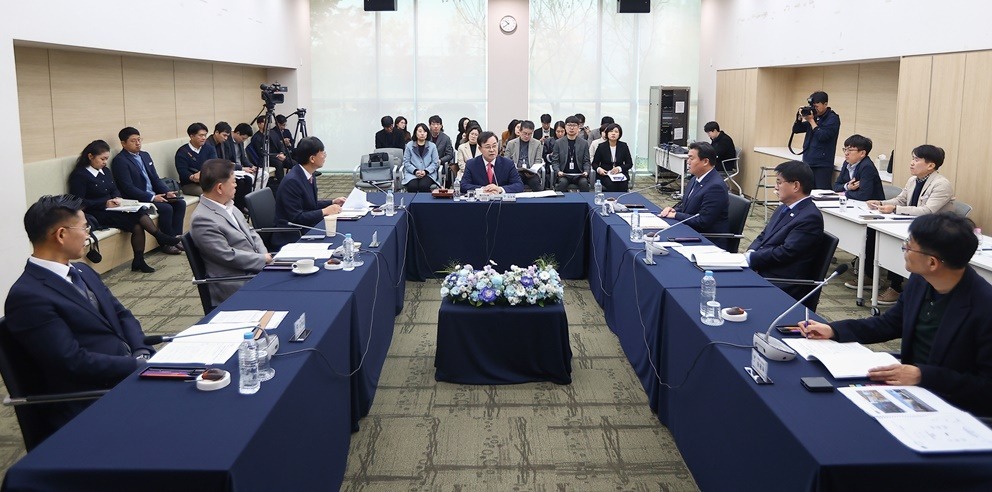
With the reciprocal working exchange of Gyeonggi Governor Kim Moon-soo and Chungcheongnam Governor Yi Wan-gu on the 26th, various pending projects being jointly pursued by the two provinces are expected to proceed smoothly within a framework of mutual cooperation and development.
The two provinces signed a "Regional Mutual Development Agreement" last January and agreed to develop cooperative projects for mutual development between the Seoul Capital Area and non-capital area local governments.
Under the agreement, the two provinces have currently concluded and are cooperating on a total of 15 agreements, including one in the economic sector such as joint promotion of an economic free zone, five in the SOC (social overhead capital) sector including roads and railways, four in industrial cluster development, and five in cooperation strengthening projects. They have also concluded an agreement on mutual support for efficient emergency recovery in the event of large-scale disasters.
Accordingly, the two provinces jointly applied to the government in April to designate the Asan Bay area as a "Yellow Sea Economic Free Zone."
The designated Yellow Sea Economic Free Zone covers approximately 7.93 million pyeong in the Pyeongtaek (Poseung District) and Hwaseong (Hyangnam District) areas of Gyeonggi Province and approximately 12.67 million pyeong in the Seosan (Jigok District), Dangjin (Songak and Seokmun Districts), and Asan (Inju District) areas of Chungcheongnam Province, totaling approximately 20.61 million pyeong.
The two provinces plan to invest a total of 53.437 trillion won in the Asan Bay area by 2025 and create advanced industrial production, international logistics, tourism, and research complexes. They expect to achieve investment effects of 59.77 trillion won and create approximately 321,000 jobs.
In the SOC sector, the two provinces have concluded agreements on issues including the construction of National Route 43 (Hwaseong, Gyeonggi to Yeonji, Chungcheongnam, 17.6 km), the Seohae Line railway (Yamok, Gyeonggi to Inju-Habdeok-Yesan, Chungcheongnam, 83.9 km), port pier development for Pyeongtaek and Dangjin ports (Phase 4, 97 berths development), opening of the Bukchenan IC on the Gyeongbu Expressway, and opening of the Pyeongtaek Port IC on the West Coast Expressway, and are making joint efforts for early construction.
In the industrial cluster development sector, the two provinces are actively reviewing plans to create an advanced industrial complex of approximately 2 million pyeong by 2012 in the border regions between the two provinces, and have established a joint fund for technology development and corporate support worth 500 billion won in two phases.
In particular, within such a framework of mutual cooperation, the two provinces jointly dispatched an overseas investment promotion team in October 2005, achieving results of attracting 30 million dollars in investment and conducting consultations worth 26 million dollars. They plan to dispatch a joint overseas market development team to the Middle East region around November this year.
Additionally, they are accepting Chungcheongnam students in Gyeonggi English Village vacation camps within 20% of total capacity and providing education, and have hosted Gyeonggi Slow Food Village tours and mutual development forums.
Furthermore, in October 2005, the two provinces established a joint business area to allow fishing boat operations freely in the waters of both the west coast regions of Gyeonggi (Pyeongtaek and Hwaseong) and Chungcheongnam (Seosan and Dangjin).
Gyeonggi Governor Kim Moon-soo said, "Gyeonggi Province and Chungcheongnam must play the role of a growth engine for the Republic of Korea by leveraging each province's strengths," and proposed, "Moving forward, based on the spirit of mutual cooperation and development, let us implement various cooperative projects including the Northeast Asia Rail Ferry Initiative, joint cooperation for yellow dust prevention, marine pollution prevention and environmental improvement, West Coast regional development projects, and attracting Beijing Olympic tourists."
Chungcheongnam Governor Yi Wan-gu emphasized, "If Korea's development centered on the Gyeongbu Axis until the 1990s, in the 21st century new growth engines will be formed centered on the West Coast Axis," and continued, "Let us join forces like Dubai's success story, which is becoming a hub of the Middle Eastern economy despite being 90% desert, and open an era of the West Coast."
Loading comments…