


Major Expansion of Transportation Infrastructure Planned for Gyeonggi Yongin Platform City
[Suwon Ilbo=Reporter Park No-hun] Underground roads will be constructed on Local Road 23 and National Road 43 surrounding 'Gyeonggi Yongin Platform City,' and interchanges connecting to the Gyeongbu underground expressway will be installed, significantly expanding transportation infrastructure.
Gyeonggi Province announced on the 29th that the 'Gyeonggi Yongin Platform City Urban Development Project' metropolitan transportation improvement plan was finalized on the 28th following deliberation by the Ministry of Land, Infrastructure and Transport's Metropolitan Traffic Review Committee.
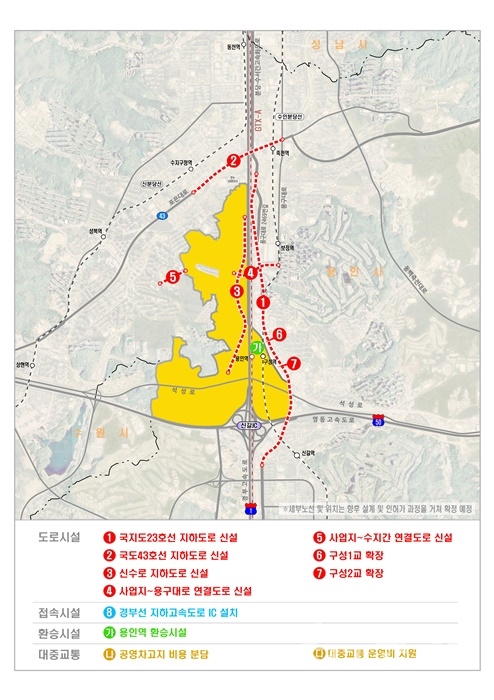
Gyeonggi Yongin Platform City is a joint project being implemented by Gyeonggi Province, Yongin City, Gyeonggi Housing and Urban Development Corporation, and Yongin Urban Development Corporation to create a new growth hub city in the southern Seoul metropolitan area.
The project is being promoted across approximately 2,757,000 square meters (approximately 830,000 pyeong) in Bojeong-dong, Mabuk-dong, and Singal-dong in Giheung-gu, Yongin City, with construction scheduled to begin in the second half of next year.
The metropolitan transportation improvement plan, established to address traffic issues resulting from large-scale residential development (areas of 500,000 square meters or accommodating 10,000 or more residents), consists of 11 measures with a total project cost of approximately 1.0784 trillion won.
First, in terms of road facility improvements, to distribute traffic demand in chronic congestion sections of the Yongin area, underground roads will be newly constructed on Local Road 23 (from the Driver's License Test Center to Samsung Renault Automobile Junction) and National Road 43 (from Suji District Office Junction to Pungdeokcheon Junction). In addition, an underground road on Sinsu Route (from Sammakgok to GC Green Cross) will be newly constructed for vehicles passing through Gyeonggi Yongin Platform City.
To improve accessibility to areas surrounding Gyeonggi Yongin Platform City, connecting roads will be newly constructed between the project site and Yonggu-daero, and between the project site and Suji. Existing Guseong 1 Bridge and Guseong 2 Bridge will be expanded to accommodate increased traffic volume around GTX Yongin Station.
Additionally, an interchange will be installed on the Gyeongbu underground expressway to resolve the inconvenience of residents in the Yongin area who must travel to surrounding areas such as Seongnam and Suwon to access the Gyeongbu Expressway.
The detailed matters regarding the location and specifications of the interchange will be reviewed by Korea Expressway Corporation, the implementing agency of the Gyeongbu underground expressway.
Plans also include construction of a GTX Yongin Station transfer facility to activate public transportation and improve railway convenience.
Moving forward, development plans include coordination with a multi-modal transfer center equipped with commercial and business support facilities. Public transportation operating costs will be supported to address cost-sharing for public parking facilities and minimize inconvenience to early-stage public transportation users.
Gyeonggi Province and joint project implementers, including Gyeonggi Housing and Urban Development Corporation, plan to promote the metropolitan transportation improvement plan in line with the project schedule for Gyeonggi Yongin Platform City Urban Development Project to efficiently resolve transportation issues.
Hong Ji-seon, Director of Urban Housing at Gyeonggi Province, stated, "Following the finalization of this metropolitan transportation improvement plan, we anticipate that commute times in the Seoul metropolitan area will be reduced, some chronic congestion sections will be resolved, leading to improvements in regional development and residents' travel convenience."

Loading comments…