


2 Out of 3 Middle and High School Students in Gyeonggi Province Say "Proxy Payment Problem is Serious"
[Suwon Ilbo==Park No-hun Reporter] A survey has revealed that 2 out of 3 middle and high school students in Gyeonggi Province view the "proxy payment problem" – high-interest illegal lending targeting youth, commonly called "daelip" – as serious.
In response, Gyeonggi Province has decided to launch consumer education for youth starting in October to prevent damage.
Gyeonggi Province released the results of a "Youth Illegal Lending Survey" on the 27th, conducted from August 9 to September 2 targeting 3,359 students (1,876 male, 1,483 female) in middle school grades 2 through high school grade 2 in Gyeonggi Province.
"Proxy payment" refers to the act of lending money to youth through social media services such as Twitter and YouTube to purchase idol merchandise or game items, while receiving fees (interest) and other charges, commonly abbreviated as "daelip."
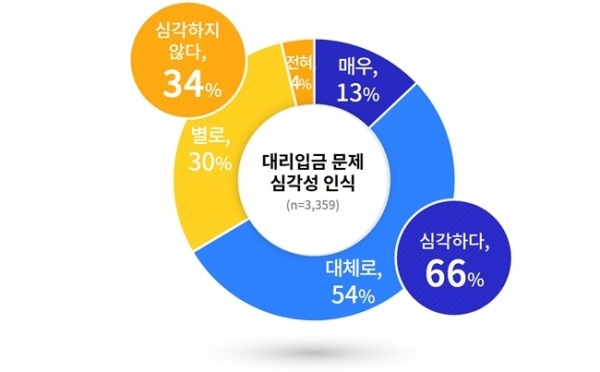
66% of respondents answered that the youth proxy payment problem is "serious" (very serious 13%, mostly serious 54%). "Not serious" accounted for 34% (not at all 4%, somewhat not 30%).
Prior to this survey, 21% of respondents (699 people) were aware of proxy payments, and they said they learned about proxy payments through people around them such as friends (31%) or through social media services including YouTube (29%), Facebook (26%), and Twitter (24%).
15 people (0.45%) have directly used proxy payments, consisting of 6 male and 9 female students.
The 15 people mainly used proxy payments to purchase celebrity merchandise (10 people) or concert tickets.
There were also reasons such as game item payments and use of sports betting sites.
In terms of frequency of use, approximately half of them – 7 people (2 times for 4 people, 3 times for 1 person, 5 times for 2 people) – were found to have used proxy payments repeatedly.
They borrowed various amounts ranging from 1,000 won to 100,000 won.
Looking at major cases, student A who borrowed 1,000 won paid 2,000 won (200% interest rate) in service fees and late payment fees, while student B who borrowed 100,000 won paid 100,000 won (100% interest rate) in service fees and late payment fees.
Despite experiencing such high-interest lending, 11 out of 15 users answered that the interest rate for proxy payments was low or reasonable.
Among the 12 people who defaulted on proxy payments, 3 were found to have suffered damages such as proxy payment operators contacting their families or threatening them using personal information as leverage.
Accordingly, all respondents (3,359 people) suggested the following support measures: ▲Strengthened punishment for illegal proxy payment operators (41%) ▲Support for protecting damaged youth through blocking contact with offenders (29%) ▲Counseling support for damage relief (14%) ▲Anonymous reporting guidance (14%), among others.
Based on this survey, the Province plans to implement consumer education for youth in the province starting in October.
The education will focus on damage prevention for illegal lending including proxy payments, such as damage counseling and relief procedures through the Illegal Private Loan Damage Report Center (gfrc.gg.go.kr) currently operated by Gyeonggi Province.
Meanwhile, this survey was conducted in cooperation with the Gyeonggi Province Office of Education, targeting 3,359 participants who were selected from 27,215 first-year middle school and third-year high school students (exam takers) who were initially sampled from 38 middle and high schools in the Province and excluded.
The sampling error is ±1.69%p at a 95% confidence level.


Loading comments…