


Suwon Military Airport Relocation Project Expected to Gain Momentum

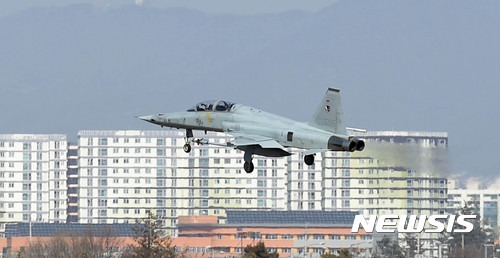
[Suwon Ilbo=Reporter Jung Jun-sung] The Suwon Military Airport relocation project is expected to gain momentum.
This follows the inclusion of 'private airport construction in southern Gyeonggi' in the '6th Comprehensive Airport Development Plan' confirmed by the Ministry of Land, Infrastructure and Transport. As a result, the Suwon Military Airport relocation and the construction of the integrated international airport for southern Gyeonggi, which have been stalled for years, are expected to accelerate.
The Ministry of Land, Infrastructure and Transport confirmed the '6th Comprehensive Airport Development Plan' on the 16th following deliberation by the Aviation Policy Committee, and stated, "Regarding additional development and relocation of regional airport facilities including private airport construction in southern Gyeonggi, we will devise necessary facility expansion plans in the medium to long term while taking into account changes in circumstances such as future aviation demand trends and surrounding development plan changes."
The Comprehensive Airport Development Plan is the highest-level statutory plan in the aviation sector established on a five-year basis in accordance with Article 3 of the 'Airport Facility Act'. The 6th Comprehensive Plan (2021-2025) consists of ▲individual airport directions including development of new airports and relocation of existing airports ▲medium to long-term airport policy promotion directions and key initiatives ▲future aviation demand forecasts and others.
Once the private airport in southern Gyeonggi is constructed, approximately 8.2 million residents of southern Gyeonggi will be able to use airports more conveniently, and it is expected to greatly help cargo transportation for IT and semiconductor companies located in southern Gyeonggi such as Samsung, LG, and SK Hynix as well as major export companies. With the construction of the private airport in southern Gyeonggi, transportation infrastructure such as subways and metropolitan highways will also be established, enabling southern Gyeonggi to become a single living sphere and economic zone.
Furthermore, based on transportation infrastructure, industrial facilities such as convergence-type high-tech industries, renewable energy complexes, agricultural and marine product biotech, and leisure tourism complexes will be developed around the airport, and the construction of an 'aviation industry cluster' utilizing the airport is expected to create regional jobs and promote economic development.
The heads of eight chambers of commerce in the southern Gyeonggi region (Seongnam, Yongin, Pyeongtaek, Ansan, Suwon, Osan, Icheon, and Anseong) submitted a 'proposal for attracting the integrated international airport of southern Gyeonggi' filled with the aspirations of regional business people to the Ministry of Land, Infrastructure and Transport, and alumni associations of Hwaseong Samgoae High School (Wujeong-eup, Hwaseong) and the on-site union of Kia's Hwaseong plant have also voiced support for attracting the integrated international airport of southern Gyeonggi.
According to Suwon City's development plan, if a 'civil-military integrated international airport' is constructed in the Hwawon district, which is the preliminary relocation site of Suwon Military Airport, investment support of over 20 trillion won is possible through a contribution-based transfer method.
The new civil-military integrated international airport will be built on a site of 4.4 million pyeong (14.545454 million square meters), approximately 2.7 times the area of the former site, allowing for a noise buffer zone.
The Ministry of National Defense selected the Hwawon district as a candidate for military airport relocation in February 2017. The reasons for selection were ▲aircraft takeoff direction faces the sea, minimizing noise damage ▲mostly state-owned reclaimed land with relatively few residents ▲connected to the West Coast shoreline, providing wide visibility ▲airspace is designated, meeting military airport location requirements and military operations suitability.
The new civil-military integrated international airport will be built as a low-carbon, eco-friendly international airport like Singapore's Changi Airport, a representative environmentally-friendly airport, and is expected to become a tourist attraction in its own right. In connection with leisure tourism complexes and international theme parks, it is expected to become a world-class economic and tourism hub city representing South Korea.
With the construction of the integrated international airport of southern Gyeonggi, the following are expected: ▲resolution of airport usage inconvenience for 8.2 million residents of southern Gyeonggi and overseas tourists ▲advanced cargo transportation for large-scale export companies such as IT and semiconductors ▲activation of international tourism industries including international theme parks, leisure tourism complexes, and traditional markets ▲balanced development of Hwaseong City.
Meanwhile, according to a 'preliminary review service for private airport activation' conducted at Ajou University in May of this year, the economic feasibility (B/C) was analyzed as 2.043, significantly exceeding the baseline value of 1, indicating sufficient economic viability.
Loading comments…