


Gyeonggi Province: "In Name Only Agricultural Corporations. Actually 'Real Estate Speculation Companies'"
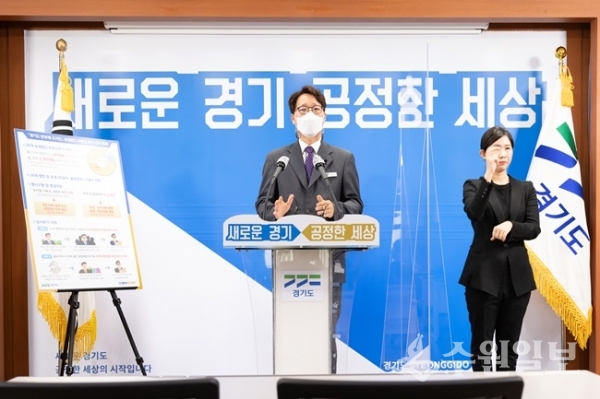
[Suwon Ilbo=Park No-hun] Gyeonggi Province announced on the 26th that it will prosecute 25 agricultural corporations that obtained false agricultural land acquisition certificates, conducted farmland transactions, and pocketed substantial gains.
The total area of farmland and forest land acquired and sold by these agricultural corporations within the province amounts to 600,389㎡, equivalent to the size of 60 soccer fields, and the illicit gains generated through short-term transactions were calculated to reach 139.7 billion won.
Of this, farmland comprises 422,986㎡, or 79% of the total area sold, and the 26 corporations were found to have obtained 110.6 billion won in illicit gains by reporting false intention to farm while having no actual farming intentions and then selling the acquired farmland.
Kim Jong-gu, Vice Director of the Gyeonggi Province Anti-Corruption Investigation Team, held a press conference at the Gyeonggi Provincial Government Briefing Room that afternoon and stated, "Following the LH speculation allegations, it has been confirmed that illegal activities by agricultural corporations are occurring frequently during the audit of public officials' speculation in development areas within the province." He continued, "Through real estate rights analysis and on-site visits, we have identified 26 agricultural corporations in violation of the Farmland Act, and have decided to refer 25 of them to police, excluding one where the statute of limitations has expired."
Vice Director Kim further stated, "Following the audit results targeting public officials and their families affiliated with the province and Gyeonggi Housing and Urban Development Corporation in the Third New City area, some employees were found to own or conduct real estate transactions, but speculation was not discovered as they inherited or acquired properties through gifts, and there was no job-related connection whatsoever."
According to the province, under the Farmland Act, farmers and agricultural corporations may own farmland of 1,000㎡ or more only when purchasing for farming purposes.
In addition, non-farmers may acquire only farmland of less than 1,000㎡ for weekend experience farm purposes.
In this process, farmland acquirers must obtain an agricultural land acquisition certificate from the relevant eup, myeon, or dong office without exception and must actually farm the land.
However, after the province conducted an investigation into 67 agricultural corporations that acquired farmland in 6 development districts by Gyeonggi Housing and Urban Development Corporation since 2013 (Gwangmyeong Hwakon, Seongnam Geumto, Yongin Platform City, Anyang Indeokwon, Anyang Gwanyang-go, and Pyeongtaek Hyeonduk districts) and Third New City development districts (Namyangju Wangsuk, Hanam Gyosan, Goyang Changneung, Ansan Jangsang, Gwangmyeong Siheung, Gwacheon Gwacheon, and Bucheon Daejang), it was found that 26 corporations, after acquiring farmland, engaged in the practice of subdividing parcels without conducting farming activities and reselling them to numerous private individuals in a short period of time, thereby securing substantial profit margins.
Corporation A purchased 285,000㎡ of farmland and forest land in one district and another district from 2014 to 2020 and obtained agricultural land acquisition certificates for 167,000㎡ of farmland.
However, from the date of acquiring land ownership through January 28, 2021, it subdivided and sold the land to 1,267 people, with sizes ranging from 17㎡ to 3,990㎡, generating 50.3 billion won over three years.
Notably, Corporation A continued subdividing and selling farmland 77 times even after being referred to prosecution for issuing false farmland acquisition certificates on August 4, 2016, in one city.
Corporation B's speculation activities were carried out extensively across nine cities and counties within Gyeonggi Province.
Corporation B acquired 44 parcels totaling 430,221㎡ of farmland and forest land in one district and another district from 2014 to 2020, then subdivided and sold them to 437 people in sizes ranging from 0.5㎡ to 1,650㎡ beginning from the date of ownership transfer registration. Despite being referred to prosecution on July 12, 2018, it continued farmland transactions through 2020.
In this process, the illicit gains generated by Corporation B amounted to 6.793 billion won.
Additionally, Corporation C purchased 3 parcels of farmland totaling 1,088㎡ in one district for 360 million won for farming purposes and resold them to 8 people for 880 million won, pocketing 520 million won.
However, the farmland purchased by these 8 people from Corporation C was acquired for 790 million won in the one district development project by January 2021, resulting in losses of 90 million won for the 8 people compared to their purchase price.
Furthermore, Corporation D subdivided and sold 1,589㎡ of farmland in one eup of one city to an individual and Corporation E at 331㎡ and 1,258㎡ respectively, selling to the individual at 780,000 won per ㎡ while selling to Corporation E at 190,000 won per ㎡, thereby selling to the individual at four times the higher price.
In addition, the province's Anti-Corruption Investigation Team conducted on-site investigations of farmland owned or sold by 67 audit target agricultural corporations.
It was confirmed that 35 parcels totaling 39,358㎡ had been left fallow for extended periods, covered with weeds and brush, or abandoned as barren land.
Furthermore, 11 parcels totaling 14,461㎡ were illegally converted to parking lots, warehouses, livestock distribution facilities, and gardens.
Vice Director Kim Jong-gu stated, "The 26 agricultural corporations falsely obtained agricultural land acquisition certificates and purchased 89 parcels totaling 64,601㎡ of farmland solely in the 13 development project districts, resold them to 634 people, and obtained 24.3 billion won in illicit gains." He continued, "We expanded the audit scope throughout the province to confirm the illegal activities of these corporations, and the land purchased by these 26 corporations for subdividing and reselling comprises 431 parcels totaling 600,389㎡, equivalent to approximately 60 soccer fields in area, with the illicit gain scale alone calculated at 139.7 billion won."
He further stated, "We will refer 25 of these corporations to police on suspicion of violations of the Farmland Act, and we will notify the competent local government of the 1 corporation where the statute of limitations has expired for administrative action." He added, "We will also notify cities and counties for administrative action against 16 corporations that left farmland fallow for extended periods without justifiable cause or illegally converted it to parking lots, warehouses, or distribution facility sites."
Separate from police referral measures, the province's Anti-Corruption Investigation Team, noting that the constitutional principle of "Gyeongja Yujeon (耕者有田)" is being undermined and farmland is being utilized as a means of real estate speculation due to legal or systemic loopholes in the Farmland Act and related legislation, plans to notify relevant departments of the audit findings and prepare fundamental institutional improvement measures for formal recommendation to the government.
Vice Director Kim Jong-gu pointed out, "According to the 'Act on Development and Support of Agricultural and Fisheries Management Entities,' the nation and local governments cultivate and support agricultural corporations for rural social stability and national development, but agricultural corporations exploiting the law to speculate on farmland is a serious malpractice." He stated, "Speculative farmland transactions utilizing agricultural corporations are prevalent, and many people purchasing farmland from these corporations are unable to actually farm, resulting in frequent cases of land being left fallow or illegally converted to other uses. Therefore, urgent institutional improvements to prevent real estate speculation such as restricting real estate transactions by agricultural corporations, establishing mandatory farmland holding periods, and strengthening penalties for violations are necessary."
Meanwhile, the province's Anti-Corruption Investigation Team separately conducted an audit on public officials' real estate speculation in the Third New City development districts, selecting 22 speculation suspects for in-depth investigation. However, it was revealed that 4 cases were through inheritance, 3 through gift, and the remaining 15 had no job-related connection.
Specifically, of the 22 people, a total of 10 were owners or traders of real estate within the business districts. Following in-depth investigation, 3 were found to have acquired properties through inheritance, 7 through acquisition by brothers-in-law before marriage or before 2000, showing no job-related connection.
Additionally, 12 were owners or traders of real estate in areas adjacent to business districts, with 1 through inheritance, 2 through gift, and the remaining 9 excluded due to no job-related connection.
By district, there were 9 in Namyangju Wangsuk, 4 in Hanam Gyosan, 3 in Goyang Changneung, 2 in Ansan Jangsang, 2 in Gwangmyeong Siheung, and 1 each in Gwacheon Gwacheon and Bucheon Daejang.
To enhance the credibility and transparency of the audit, the province's Anti-Corruption Investigation Team involved citizen auditors from the beginning of the investigation, with 37 citizen auditors actively participating in audits on public officials and agricultural corporations' real estate speculation and major decision-making.
Additionally, on the morning of the 22nd at the Gyeonggi Provincial Government, a "Second Self-Audit Results on Real Estate Speculation" was reported in the presence of 10 citizen auditors, and after soliciting opinions from the citizen auditors, the audit results were finalized.
Currently, the province's Anti-Corruption Investigation Team is conducting audits on speculation-purpose false farmland acquirers and public officials' real estate speculation regarding business districts related to a former Gyeonggi Province public official currently in custody.


Loading comments…