


Gyeonggi Province Tackles Fine Dust and Resource Recycling Through Concentrated Collection of Agricultural Waste and Compensation Payments
[Suwon Ilbo=Reporter Park Nohun] Gyeonggi Province will intensively collect agricultural waste such as waste plastic film and pesticide containers during the fine dust seasonal management period through March of this year.
This is to prevent fine dust generation caused by illegal incineration.
Agricultural waste consists mostly of discarded plastic film and used pesticide containers.
According to data from the Korea Environment Institute's agricultural waste survey publication, Gyeonggi Province's annual generation of waste agricultural plastic film amounted to approximately 31,249 tons as of 2018, which is being collected and recycled or incinerated by both public and private sectors.
Uncollected waste plastic film and similar materials are estimated to be disposed of through illegal incineration, soil burial, and open-air dumping, causing fine dust generation through incineration and serving as a cause of forest fires, making proper treatment through collection necessary.
Concentrated collection of agricultural waste takes place twice a year during farming seasons, in the first half (March-May) and second half (November-December), and last year alone saw the collection and treatment of 17,288 tons of rural waste plastic film and 2,767,000 pesticide containers.
The collection process involves waste plastic film and pesticide containers collected from farms being stored at village collection sites and then transferred to the Korea Environment Institute under the Ministry of Environment.
Waste plastic film is recycled as recycled raw material through shredding, washing, and compressing, while waste pesticide containers are recycled or incinerated.
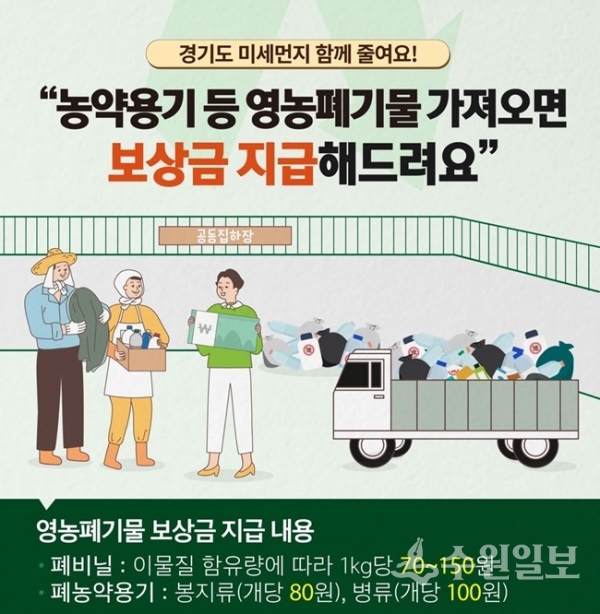
Gyeonggi Province plans to promote proper disposal methods for agricultural waste to farmers during the seasonal management period and provide collection compensation payments to actively encourage participation.
Collection compensation payments are provided when farmers bring agricultural waste to village collection sites, with compensation determined according to the type and amount of waste.
Waste plastic film is compensated at 70-150 won per kilogram depending on foreign material content, while waste pesticide containers are compensated at 80 won per unit for bag-type containers and 100 won per unit for container-type containers.
Meanwhile, Gyeonggi Province has pursued a "shared collection site expansion support project" since 2014 to address inconvenience for farmers due to rural population aging and long-distance collection and transportation, and has so far installed a total of 214 shared collection sites.
The province plans to increase shared collection site installations to 26 locations, more than double compared to last year, to raise the collection rate of agricultural waste plastic film this year.
A province official stated, "Agricultural waste collection is a win-win project that reduces fine dust in rural areas and recycles resources, and active participation and cooperation from residents are necessary to ensure concentrated collection."


Loading comments…