


Gyeonggi Province Shows Longest Late-Night Travel Distance and Time Among Three Capital Region Jurisdictions
[Suwon Ilbo=Reporter Park Noh-hun] Research results analyzing late-night mobility characteristics in the Capital Region, which operates on a 24-hour basis, have been released.
The research empirically analyzes late-night travel characteristics that were difficult to identify through conventional survey-based travel behavior surveys using mobile data generated from mobile phones and presents methods for application.
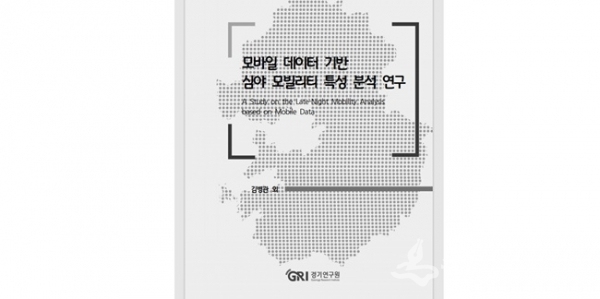
The Gyeonggi Research Institute published "Analysis of Late-Night Mobility Characteristics Based on Mobile Data" containing these findings.
The report analyzed late-night mobility characteristics from midnight to 6 a.m. for the Capital Region centered on Gyeonggi Province, using 391 million mobile data points collected over one month in November 2019.
Weekday daily late-night travel volume showed Gyeonggi Province with the highest at 1.099 million trips (48%), followed by Seoul at 942,000 trips (41%), and Incheon at 259,000 trips (11%).
Late-night travel concentration among daily trips was 4.8% in Gyeonggi, 4.5% in Seoul, and 5.4% in Incheon. The "late-night travel unit rate" (per capita late-night travel volume) was 0.08 trips/person in Gyeonggi, 0.10 trips/person in Seoul, and 0.09 trips/person in Incheon, with Gyeonggi Province showing the lowest rate.
Among Gyeonggi Province's 31 cities and counties, late-night travel volume ranked as follows: Suwon (100,000), Seongnam (86,000), Goyang (80,000), Yongin (77,000), and Bucheon (74,000). The per capita late-night travel unit rate (trips/person) ranked: Pyeongtaek (0.11), Guri (0.11), Icheon (0.10), Hanam (0.10), and Yangju (0.10).
Regions with large-scale residential development and high populations showed high late-night travel volumes, while areas with large-scale industrial and logistics facilities such as Pyeongtaek showed high per capita late-night travel unit rates.
Regarding late-night travel on weekdays versus weekends, Gyeonggi Province's late-night travel was highest on Saturday at 1.178 million trips and lowest on Sunday at 982,000 trips.
On weekdays, Friday showed the highest volume at 1.144 million trips.
When considering intra-Capital Region travel, Gyeonggi Province showed longer travel distances and greater travel time on weekdays than weekends.
Monday showed the longest travel distance and time at 11.3 km and 61.8 minutes, while Sunday showed the shortest at 7.7 km and 47.7 minutes.
By age group in Gyeonggi Province, those in their 50s accounted for the largest share of late-night travel at 268,000 trips (24.4%), followed by those in their 40s, 60s, 30s, 20s, 70s and over, and teens.
The travel unit rate was highest for those in their 50s and 60s at 0.12 trips/person, indicating the highest frequency of late-night travel.
By gender, males accounted for 65% and females for 35%, with males showing a higher proportion due to late-night characteristics. The male unit rate was 0.11 trips/person, approximately twice that of females at 0.06 trips/person.
Regarding late-night travel distance and time characteristics, Gyeonggi Province's average travel distance was 10.3 km and travel time was 58.6 minutes, the longest among the three Capital Region jurisdictions.
By Gyeonggi cities and counties, Yeoju showed the longest travel distance at 15.0 km, while Anyang showed the shortest at 8.2 km. For travel time, Yangju required the most at 67.3 minutes, while Seongnam required the least at 54.5 minutes.
Kim Byung-gwan, Research Fellow at the Gyeonggi Research Institute, stated, "Gyeonggi Province exhibits long travel distances and considerable travel time due to its vast area and Seoul-oriented travel patterns," and added, "In particular, evidence-based research and policy development using advanced data such as mobile data should be conducted to ensure the safety and convenience of Gyeonggi residents in late-night mobility."
The report recommends the following: ▲identifying major late-night travel points and underserved areas to provide appropriate late-night transportation services by time period and travel direction, ▲conducting traffic policy analysis and development based on data, and ▲developing traffic service monitoring indicators that integrate private and public data.
Loading comments…