


Gyeonggi Province Plans Second-Half Lifelong Education Strategy Including Non-Face-to-Face Learning Expansion
[Suwon Ilbo = Reporter Park No-hoon] In response to increasing non-face-to-face learning due to COVID-19, Gyeonggi Province is establishing a new video conferencing educational system that enables real-time two-way communication. The province plans to establish a portal where residents can view and apply for lifelong learning courses operating throughout Gyeonggi at a glance, while also expanding future-oriented education equipped with virtual experience systems and 3D printers. Fair lifelong learning environments accessible to all, including persons with disabilities, out-of-school youth, and middle-aged adults in their 50s and 60s, are also being prepared.
Kim Neung-sik, Director of Lifelong Education at Gyeonggi Province, held an online press conference at the Gyeonggi Provincial Government building on the 29th to announce "Five Strategies for the Future Learning Era," which outlines the lifelong education plans for the second half of the seventh civilian-led term.
Director Kim stated, "Due to COVID-19, there are various movements in the lifelong education sector preparing for the post-coronavirus era, such as non-face-to-face learning," and added, "Reflecting new learning trends in preparation for the future era, we will prepare systems and content in the second half of the seventh civilian-led term to ensure all residents of the province can receive education fairly."
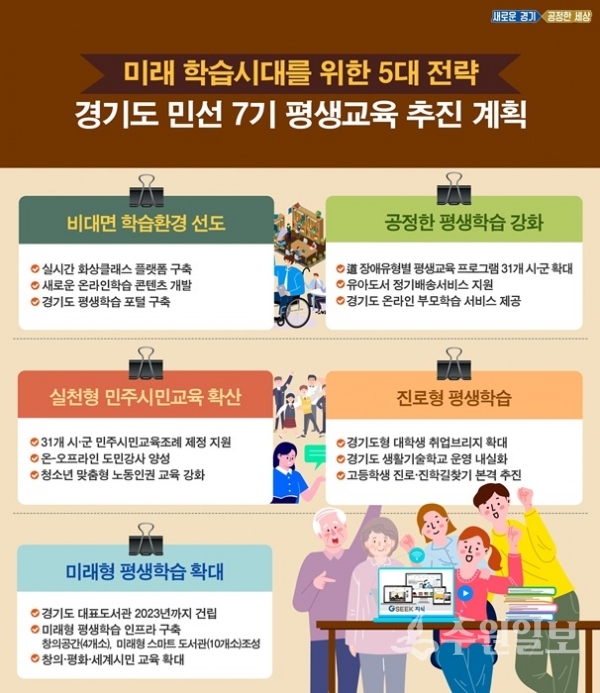
The five strategies announced by Gyeonggi Province on this day are non-face-to-face learning environment, future-oriented lifelong learning, practice-based democratic citizenship education, fair lifelong learning, and career-oriented lifelong learning.
▲ Leading Non-Face-to-Face (Un-Tact) Learning Environment
As the era of non-face-to-face learning activation approaches, the province plans to establish a "Gyeonggi-style Real-Time Video Class Platform" in the online lifelong learning portal Gyeonggi Knowledge (GSEEK) by 2021, enabling lifelong learning instructors to communicate bidirectionally with residents through real-time video conferencing. As part of this direction, the province has decided to expand the current non-face-to-face education ratio from 17% of 14 lifelong education project budgets to 40% of each project budget by 2022.
Additionally, the province plans to establish a "One-Stop Gyeonggi Lifelong Learning Portal" by 2022, consolidating learning information residents desire in one place, to provide all lifelong learning programs operating throughout Gyeonggi on a one-stop basis. In addition to verifying course information from the province and its public institutions such as Gyeonggi Life Skills Schools and local lifelong learning course information by city and county, the system will integrate and operate reservations and confirmations of lifelong learning spaces by city and county.
▲ Expanding Future-Oriented Lifelong Learning for Sustainable Growth
The province plans to establish a future-oriented "Gyeonggi Representative Library" by 2023 to lead information exchange and lifelong learning among residents. The province plans to develop advanced information services that analyze user demands based on artificial intelligence and big data and provide valuable information.
The province will establish creative spaces for cultivating creative thinking abilities, such as coding, 3D printers, and future plus English convergence education, at the Gyeonggi Future Education Campus located in Paju and Yangpyeong. Additionally, the province plans to support the creation of future-oriented smart libraries that utilize various cutting-edge technologies of the Fourth Industrial Revolution such as the Internet of Things, robots, and artificial intelligence.
▲ Spreading Practice-Based Democratic Citizenship Education for Advancement to an Advanced Society
Democratic citizenship education, which has shown noticeable growth since Governor Lee Jae-myung's inauguration, will expand further. The province will first support all 31 cities and counties in establishing democratic citizenship education ordinances to activate community-based democratic citizenship education.
Additionally, by 2022, to protect the labor rights of working youth and spread a labor-respecting culture, the province plans to nurture 300 labor rights instructors with online and offline teaching capacity and operate customized labor rights education visiting middle and high schools and out-of-school youth more than 7,000 times.
▲ Strengthening Fair Lifelong Learning for All
To guarantee the lifelong learning rights of persons with disabilities, the province plans to expand the "Gyeonggi Province Disability-Type-Specific Lifelong Education Program" to all 31 cities and counties by 2021. The disability-specific programs include six lifelong education programs tailored to disability characteristics, such as a chorus for people with autism spectrum disorder called "Harmony of Love" and pottery for people with developmental disabilities called "Beautiful Pottery." The province plans to nurture 50 instructors and disseminate the programs to all 31 cities and counties by next year.
To enhance the self-reliance of out-of-school youth, the province plans to review providing training participation allowances to youth participating in education and training, as well as qualification acquisition allowances upon obtaining certifications.
To resolve gaps in reading welfare, the province plans to provide the "Gyeonggi Province Infant Book Bundle Regular Delivery Service," which supports regular book deliveries and 30-minute reading parenting coaching to children aged 3 or older in six northeastern cities and counties of Gyeonggi Province, including Yangpyeong and Gapyeong, beginning in 2021.
▲ Realizing Educational Welfare for Happy Work and Life Through Career-Oriented Lifelong Learning
The province plans to expand the Gyeonggi-style university student employment bridge, which combines a university major course (5 months) and a company's long-term on-site practical training (5 months) into a single educational course, from the current scale of 6 universities and 300 students to 8 universities and 400 students by next year.
Reflecting the educational needs of middle-aged adults in their 50s and 60s seeking employment, the province has introduced new curriculum such as YouTube creator, elevator maintenance, and complex building management at Gyeonggi Life Skills Schools and plans to continue developing and expanding educational courses.
To resolve inequality in access to career and academic information based on economic capacity, the province will implement the "Gyeonggi High School Students' Career and Academic Pathfinding Project," which provides one-on-one career and academic consulting by current teachers visiting schools.
Meanwhile, since Governor Lee Jae-myung's inauguration, Gyeonggi Province has been operating the Gyeonggi Future Education Campus to provide English experience learning support and creative and character education for children and youth, preparing lifelong learning tailored to different life stages.
Additionally, the province operates the nation's largest-scale democratic citizenship education and Gyeonggi Life Skills School for successful retirement preparation for residents in their 50s and 60s, and has expanded 25 public libraries to promote reading culture in daily life.
For education without discrimination, the province was the first at the provincial government level to provide free uniforms and meal costs to alternative educational institutions and also provides meal costs to youth using out-of-school youth support centers.
In addition, to strengthen employment-linked lifelong education, the province operates "Visiting Learning Classrooms," which connect job-seeking prospective instructors with children and youth learning communities, and successfully linked 2,600 people to job activities last year. Furthermore, all 31 cities and counties in the province were designated as lifelong learning cities for the first time at the provincial level, achieving significant results in the lifelong education sector.

Loading comments…