


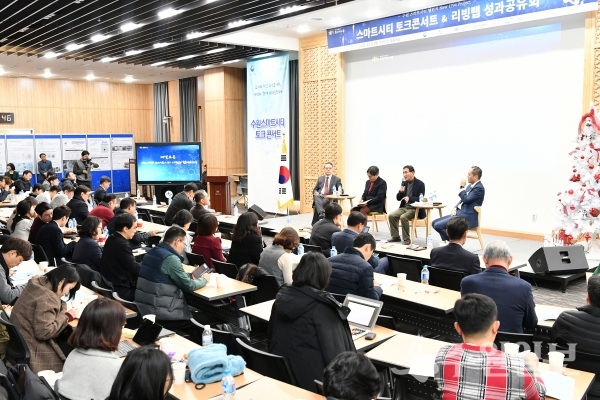
[Suwon Ilbo=Reporter Suh Dong-young] Suwon City held a 'Smart City Challenge Project Talk Concert and Results Sharing Session' in the City Hall conference room on the 5th to explore ways to develop a smart city.
The event, attended by approximately 150 people including city officials, citizens, and experts, was held as a 'Smart Talk Concert' co-hosted by Suwon City and the Ministry of Land, Infrastructure and Transport, and a 'Smart City Challenge Project Living Lab Results Sharing Session' hosted by Dankook University and the Korea Institute of Digital Economy.
The talk concert began with a 'Smart City Special Lecture' by Park Won-ho, Senior Official of the Ministry of Land, Infrastructure and Transport, and Kim Do-nyeon, Professor of Architecture at Sungkyunkwan University, followed by a panel discussion exploring ways to develop a smart city.
Prior to the panel discussion, Professor Kim Tae-hyung of Dankook University's Department of Data Knowledge Service Engineering, who presented on the theme of 'Building Suwon's Human Smart City,' emphasized that a smart city model capable of solving urban problems by actively utilizing data generated through citizens' urban activities should be implemented.
With Professor Kim Do-nyeon as moderator, Jo Young-tae, Director of the Smart City Research Center at Korea Land and Housing Corporation, and Kwak Ho-phil, Visiting Research Fellow at Suwon Research Institute, participated as panelists.
Research Fellow Kwak Ho-phil said, "The key is to develop a 'grassroots smart city' where citizens are both suppliers and consumers," adding "A smart specialized center is needed that can professionally manage smart city projects and handle startups and distribution."
Director Jo Young-tae said, "To successfully operate a living lab (citizen-participating research institute), citizen participation is ultimately the most important factor," and stressed "We need to consider ways to expand citizen participation and discover and operate practical citizen participation programs."
In the second part, five teams participating in the Smart City Challenge Project Living Lab presented achievements they discovered and developed from September onwards in four areas: transportation, traditional markets, vulnerable populations, and safety.
The transportation team presented the 'EASY PARKING' app, which provides real-time information on public and private parking lots in Haenggung-dong using parking lot sensors, and the safety team presented the 'S Mom 365' app as a prototype, which can check a child's location in real time and send messages in cooperation with the Suwon Urban Safety Integration Center.
The traditional market teams (two teams) presented an app that provides customized information on Suwon tourism content to visitors, and an app that provides market and store-specific information so that people in their 20s and 30s can visit traditional markets more frequently, equipped with payment functions.
The vulnerable population team presented an artificial intelligence (AI) speaker as a prototype to help ease loneliness among elderly people living alone.
Virtual scenarios reflecting the daily lives of elderly people living alone, such as sleep and wake times, hospital visits, and leisure activities, were created and applied to the AI speaker.
Meanwhile, the city was selected as a target site for the '2019 Smart City Challenge Public Recruitment Project' led by the Ministry of Land, Infrastructure and Transport in May, received 1.5 billion won in government funds, and is currently promoting demonstration projects including 'Eco Mobility,' 'Smart Safety Service,' and 'Living Lab' in Haenggung-dong.

Loading comments…