


Gyeonggi Province's 'Doctor Helicopter' Saves One Life Every 2-3 Days

Rescue
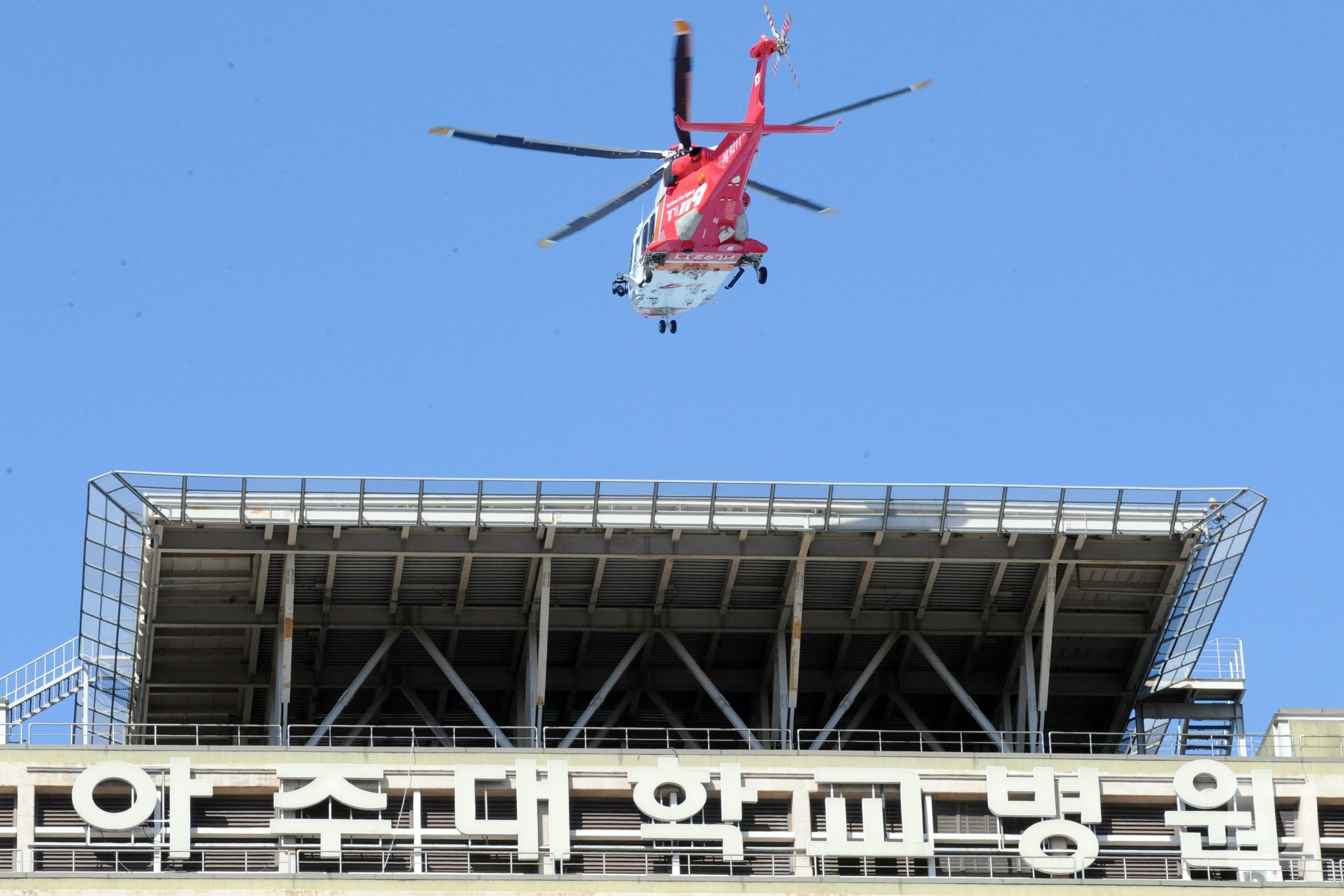
[Suwon Ilbo= Reporter Park No-hun] The 24-hour emergency medical dedicated 'Doctor Helicopter' introduced by Gyeonggi Province as the 'nation's first' has been saving precious lives, with 17 lives rescued in the 39 days since full operational launch began, successfully performing the role of 'guardian of people's lives.'
The province announced on the 17th that the Doctor Helicopter, which began its first operation on the 4th of last month, conducted a total of 19 emergency dispatches over 39 days through the 12th, including 6 'night-time dispatches' and 1 'out-of-jurisdiction dispatch' to South Chungcheong Province and other areas, saving the lives of 17 'critically injured patients.' Having responded to incidents regardless of day or night and regional boundaries, the helicopter has rescued one person approximately every 2-3 days. This achievement is being evaluated more positively as it resulted from the effects of the 'Emergency Medical Dedicated Helicopter Landing and Takeoff Facility Construction Business Agreement' concluded in June, which allowed helicopters to freely land at previously unused locations such as school athletic fields and sports facilities.
The most representative success case is the rescue operation at the scene of a 'rear-end collision' that occurred on the 4th on a road in Maesong-myeon, Hwaseong. Around 8:24 p.m. that day, a forklift and bus collided on a road in Maesong-myeon, Hwaseong, resulting in an accident with approximately 20 injured persons, including 3 severely injured and 17 lightly injured. The condition of the overturned forklift operator was severe and life-threatening, but thanks to the Doctor Helicopter arriving at the scene in just 12 minutes, the person was fortunately able to survive. By shortening the time that would normally take 50 minutes to 1 hour by car by approximately 40 minutes, the precious lives of citizens were saved. In particular, Namyang High School, where the helicopter landed at that time, was a place where landing was previously permitted only during daytime when students were absent, and it had never been used even once at night. This is evaluated as a realization of the policy initiative of Lee Jae-myung, Gyeonggi Province Governor in the 7th civilian-led administration, who stated, "The Gyeonggi Province will take all responsibility for helicopter landings, so use them actively and without delay for the lives of the people."
The province explained that the effects of the 'Emergency Medical Dedicated Helicopter Landing and Takeoff Facility Construction Agreement' are having positive impacts on 'reduction of rejection rate' and 'increase in scene dispatch.' Out of 20 total dispatch requests, 19 dispatches were successfully executed, with a rejection rate of only 5%. Considering that the 1 rejection case was processed as a 'rejection' after the patient suddenly died at the accident scene even after dispatch preparation was completed, the province explained that the actual rejection rate can be considered 'zero.' Looking at the 19 dispatches by category, 'scene dispatch' to actual rescue sites was the most frequent with 11 times, followed by 'inter-hospital transfers' to larger hospitals capable of surgery with 7 times, and 'return to base' 1 time. More than half (57.9%) of all 19 dispatches were 'scene dispatches.' Going forward, the province plans to make multifaceted efforts to minimize the 'rejection rate' to allow the Doctor Helicopter to freely respond to scenes and to increase the 'dispatch success rate' by further shortening the time required from receipt of report to dispatch.
A provincial official stated, "Since the Doctor Helicopter was introduced, it has been operating day and night without interruption and performing its role effectively. In particular, the reduction in difficulties securing landing sites has lowered the rejection rate and increased scene dispatches, which are very positive developments," adding, "We will continue to make improvements so that the Doctor Helicopter can save more people's lives going forward."
Meanwhile, out of 19 dispatches, 17 were completed successfully, achieving a 'dispatch success rate' of 89.5%. The 2 cases not recorded as successes include 1 case where the helicopter 'returned to base' after the patient died at the scene before helicopter arrival, and 1 case where a patient being treated for 'cerebral hemorrhage' at a hospital in the province died during helicopter transport.

Loading comments…