


Taking Bold Steps Toward 'Suwon Special City'
[Suwon Ilbo = Reporter Seo Dong-young] 'From Suwon-eup to Suwon City, and now moving forward to Suwon Special City.'
On August 15, 1949, Suwon-eup was elevated to city status. It was the day Suwon City took its first step. At that time, Suwon was a rural city with an administrative area of 23.04㎢ and a population of approximately 50,000.
It subsequently grew rapidly. Over 70 years, the population increased 25-fold to reach 1.25 million, becoming the nation's largest basic local government.
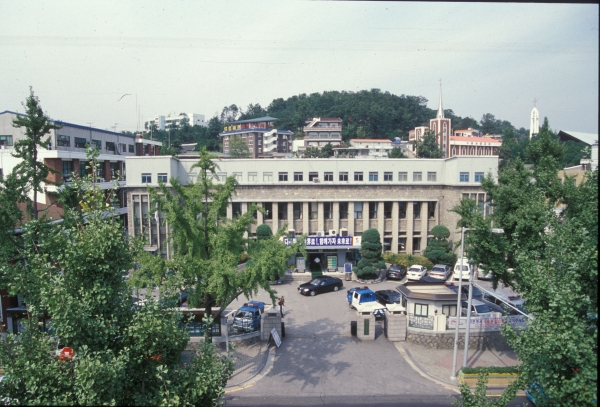
After the Korean War broke out just one year following the city's elevation, Suwon City devoted itself to recovery from war damage and completed the Suwon City Hall (now Suwon City Family & Women Center) in Kyodong in 1956. After using the Kyodong office for some 30 years, it completed the current City Hall (main building) in Ingyedong in 1987 and expanded the annex building in 2006.
In June 1967, when the Gyeonggi Provincial Government, located in Sejongno, Seoul, relocated to Suwon, Suwon City established itself as the de facto provincial capital of Gyeonggi Province.
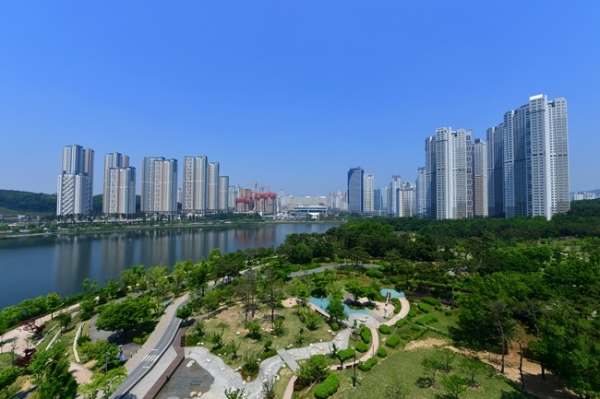
Suwon City's population steadily increased during the industrialization of the 1960s-70s, and surged with the development of eastern Suwon areas such as Wuman-dong, Ingye-dong, and Gwonseon-dong in the 1980s. In 1989, the population growth rate reached 11.1%.
In the 1990s, the population continued to grow as Yeongtong New City and other developments were undertaken, and in 2002, it finally surpassed the 1 million mark, emerging as a metropolitan-level city.
There was a significant milestone in 1997. On December 6, Suwon Hwaseong was inscribed as a UNESCO World Heritage Site. Known as the 'flower of fortresses,' Suwon Hwaseong became a catalyst for introducing 'Suwon, a City of History and Culture' to the world.
The first nationwide local simultaneous elections were held in 1995, and the first mayors directly elected by citizens were born. Mayor Shim Jae-deok served as Suwon City Mayor for the 1st and 2nd popularly elected terms, and Mayor Kim Yong-seo served for the 3rd and 4th terms.
Mayor Yim Tae-young, who took office as mayor in the 5th popularly elected term in 2010, was successively elected as Suwon City Mayor for the 6th and 7th terms in 2014 and 2018, becoming the first mayor to achieve a third term since the implementation of the local autonomy system.
In the late 1990s, Suwon City led the nation's restroom culture through the 'Beautiful Restroom Culture Movement.' The late former Mayor Shim Jae-deok, so nicknamed 'Mr. Toilet' for his deep interest in restrooms, raised Suwon City's public restrooms to the nation's highest standards during his tenure.
At that time, the restroom culture movement, which was still unfamiliar, played a decisive role in improving the standard of public restrooms across the nation. The 'Firefly Restroom' built at the entrance of the Gwanggyo Mountain hiking trail in September 1999 won the grand prize at the 'First Beautiful Restroom Competition' hosted by the Ministry of Interior and Safety and the Restroom Culture Citizens' Association that same year.
The Suwon 1, 2, and 3 Industrial Complex development project, which began in 2003, was completed in 2016. The Suwon Industrial Complex, spanning 1,257,510㎥, serves as an industrial cluster for cutting-edge industries.
Following the launch of the 5th popularly elected term, Suwon City consistently pursued governance. Over the past nine years, governance has been continually strengthened and now permeates all corners of city administration, forming the foundation of all policies Suwon City pursues.
The 'Good Governance Committee,' a public-private cooperation body established in February 2011, plays a core role in governance. Examples include the 'Urban Policy Citizen Planning Groups,' '500-person Round Table Discussions,' and 'Citizen Auditors.'
In January, Suwon City promulgated the 'Suwon City Collaborative Governance Ordinance,' which institutionalizes and expands citizen participation and autonomy throughout the entire process from policy decision-making to implementation and evaluation.
On March 1 of this year, the Suwon High Court and the Suwon High Prosecutors' Office opened. Suwon City became the nation's sixth city with a high court and prosecutors' office following Seoul, Busan, Daejeon, Daegu, and Gwangju, and the only basic local government entity with such institutions, thereby acquiring metropolitan-level status.
Suwon City is currently making concentrated efforts to realize the 'Suwon Special City.' The city plans to achieve special city status, which will become the foundation of devolution of autonomy, thereby securing concrete authority and status befitting the city's position.
Loading comments…