


The Suwon City Council's administrative affairs audit of the Suwon City government began on November 30.
Each standing committee received audits from its related departments.
City council members conducted detailed audits of Suwon's administration that day, emphasizing the need for efforts to enhance administrative efficiency and eliminate wasteful spending of taxpayer money, directing criticism at the executive branch.
Notably, during this administrative affairs audit, an unusual sight unfolded when 'Bulhwi 21,' a liquor product manufactured by Hyowon Co., Ltd., made an appearance at the audit session.
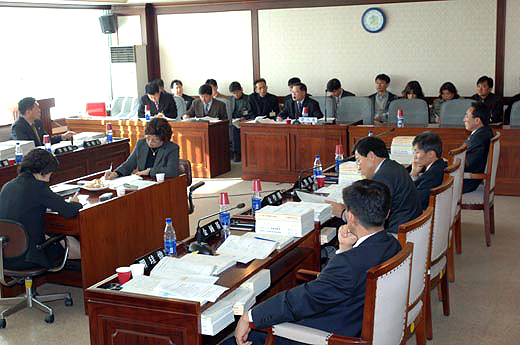 | ||
| ▲ City council members question city administration during the Suwon City administrative affairs audit, which began on the 30th of last month. | ||
The Autonomy and Planning Committee held an administrative affairs audit on November 30, the first day of the audit, at the committee conference room, conducting audits of the General Affairs Division, Planning and Budget Division, Suwon City Facilities Management Corporation, Hyowon Co., Ltd., and the International Trade Division.
Some committee members noted that the Sports Complex operated by the Facilities Management Corporation is being used free of charge by public institutions, and urged expedited amendment of ordinances to collect usage fees.
Council Member Oh Sang-woon (Maetan 1-dong) pointed out regarding nine organizations using the Sports Complex free of charge, stating "at minimum, lease agreements should be signed and nominal lease fees paid," and urged "amend the ordinance to ensure fees are charged fairly."
Additionally, Member Oh noted that a shortage of 40 personnel total across district offices and neighborhood offices occurs primarily in departments closely related to civil complaints, and criticized the lack of policy consideration for morale-boosting of overworked employees at these offices.
Member Oh further stated, "While a certain division chief at headquarters has moved through 4 different departments in a year holding the chief position, only 1 civil servant transferred from district and neighborhood offices to headquarters came this year," pointing out fairness issues in personnel matters.
Council Members Hwang Yong-gwon (Maetan 3-dong, Taejang-dong) and Myung Kyu-hwan (Ingye-dong) emphasized, "While headquarters is overstaffed, frontline district and neighborhood offices face actual vacancies," and "practical opportunities such as advanced studies tours and benchmarking, along with preferential consideration, are necessary to boost morale among staff in demanding divisions."
They also criticized the need for concrete measures to revitalize Gwanggyo Mountain, noting that the Gwanggyo Mountain Festival conducted annually by the Gwanggyo Mountain Association changes its budget support department each year.
Members Oh and Hwang voiced unanimous concern, stating "the city invests considerable budgets claiming it will protect Gwanggyo Mountain, yet ignores the relocation issue of the Water Training Center due to concerns about water source contamination."
Council Member Hwang Yong-gwon (Maetan 3-dong, Taejang-dong) stated, "The city allocates budget to a specific organization's Gwanggyo Mountain Festival while claiming to revitalize it, causing Gwanggyo Mountain itself to suffer," adding "if the city wants to revitalize Gwanggyo Mountain, it should plant trees or devise measures, not hold events gathering people."
Member Hwang criticized the city's complacent attitude, saying "there are currently cases of illegal facility usage such as karaoke at the training center, but the city remains silent on this."
▲Finance and Economy Committee
The Finance and Economy Committee conducted an administrative affairs audit on that day regarding the Tax Administration Division, Accounting Division, and Local Economy Division.
Regarding the selection of the city treasury related to Accounting Division duties, an issue was raised about the need for an ordinance to ensure transparency.
Council Member Lee Eun-ju (Goksun-dong) questioned during the Finance and Economy Committee audit, "Do you have no intention of enacting an ordinance with integrity to secure transparency regarding city treasury selection?" When the division chief responded that ordinance enactment is the exclusive authority of the local government head, voices were raised in exchange.
Additionally, it was pointed out that approximately 30 million won in overpaid taxes over the past three years under the Tax Administration Division's jurisdiction has not been refunded and remains in the city treasury waiting for its owner.
By category, out of 24.27 million won in municipal taxes, ▲resident tax totaled 8.26 million won (1,571 cases), the highest amount, ▲comprehensive land tax 7.98 million won (332 cases), ▲automobile tax 5.75 million won (389 cases), and ▲property tax 980,000 won (128 cases).
Council Member Kim Young-dae (Seryou 2-dong) pointed out, "Tax overpayments are not being refunded and are being transferred directly to the city treasury," and "citizens sometimes fail to receive refunds because they are unaware."
Member Kim further urged, "Regarding tax arrears, you conduct proactive administration to pursue collections, but seem stingy about money that should be returned," requesting "proactive administrative services be provided for refunds."
An assertion was raised that the budget scale supported for senior citizen centers across the Suwon region varies drastically.
During the Finance and Economy Committee's administrative affairs audit of four district offices on December 1, Senior Citizen Center A located in Jangan-gu was found to have received 11 million won in budget support since its completion in December of last year, with 6.88 million won allocated for goods purchases.
Regarding this, a dispute ensued over whether the amount spent on office furniture support due to new construction was appropriately included or whether this was budget concentration based on political pressure.
Council Member Lee Nam-ok (Youngtong 1-dong) stated, "In 2003, budget was distributed evenly among each senior citizen center, whereas in 2005, budget appears concentrated on Center A," questioning "isn't this a phenomenon stemming from some political pressure?"
Division Chief Chang Hee-bok of Jangan-gu Office countered, "For the newly constructed senior citizen center, budget is fully allocated for securing office furniture and equipment," and added "costs necessary for the senior citizen center relocation would have been included."
Council Member Kim Tong-rae (Jungja 2-dong) pointed out, "Senior citizen centers are known to register more members than actual rosters to receive larger subsidies," and "attention from relevant authorities is necessary to prevent budget concentration."
▲Urban Construction Committee
The Urban Construction Committee proceeded with related inspections of district office operations.
On that day, committee members pointed out that vacillating enforcement commitment from civil servants and standardized enforcement practices have allowed illegal real estate agents to run rampant.
Council Member Kim Jin-gwan (Uman 1-dong) pointed out that the actual number of illegal real estate offices cracked down on last year averaged fewer than 5, representing very poor performance considering the enforcement period.
Member Kim raised issues with the enforcement method itself, directing sharp criticism at the complacent sense of duty among civil servants.
Member Kim stated, "When enforcement officers visit, shouldn't they check businesses that close and conduct follow-up enforcement starting with those establishments?" and criticized "since rumors of enforcement spread through legitimate businesses, illegal operations close during enforcement periods, causing repeated problems."
In response, the Comprehensive Civil Service Division Chief of Paldal-gu Office stated, "When enforcement is conducted, all illegal real estate offices close, creating difficulties," and "to inspect one location requires 2-3 continued visits, so the period inevitably becomes longer due to circumstances."
Additionally, criticism was raised that budget allocated to neighborhood offices under the guise of neighborhood athletic competitions benefits only certain residents, and such patronizing budget merely wastes taxpayer money.
It was pointed out that riverbed occupation fees calculated decades ago are still being applied to specific individuals to the present.
The Urban Construction Committee found that Ha-dong 896-3 in Suwon is priced at 3,000 won per square meter, with land value determined by public notice prices from 1991, and has not been re-evaluated to date.
Ui-dong 1095-12 and 1095-13 are set at 14,000 won and 9,000 won per square meter respectively in submitted data, yet land registries themselves do not exist, leaving the basis for occupation fee settings in unclear status.
Council Member Kim Jin-gwan stated, "Beyond riverbed land, comprehensive review and re-establishment regarding state-owned land is urgent," and pointed out "the convention of annually leasing to the same occupants, fallen into habit, is problematic."
Meanwhile, council members, seemingly conscious of monitoring by a 'citizen observation group' featuring the largest number of civic organizations since the council's establishment, demonstrated more pointed criticism of division chiefs who submitted materials insincerely or provided unsatisfactory answers, demanding substantive responses.

Loading comments…