


Resolve District Boundary Disputes Through Citizen Referendums
| Boundary adjustment disputes between local governments have been consistently raised since the launch of local autonomy, but as they drag on without finding a solution, divisions between municipalities and residents are spreading. Recently, as disputes over administrative district consolidations persist, Jeju Province and Cheongju City have conducted citizen referendums and achieved residents' long-held wishes for administrative district integration. Boundary adjustment disputes fail to find a solution because although the Local Autonomy Act specifies administrative districts through presidential decree and provides that superior bodies adjust disputes with approval from relevant municipalities and local legislatures, local legislative approval is not being obtained due to regional favoritism. In disputed areas requiring administrative boundary adjustments, residents have their daily lives centered on the Suwon region and easily receive administrative services, but public opinion cannot be consolidated due to turf wars between municipalities. /Editor's Note |
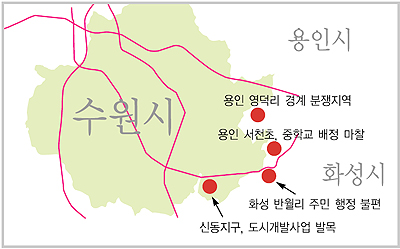
▲ Seocheon Elementary School in Yongin requests assignment to Suwon Yeongdong middle school
Seocheon Elementary School, located on the boundary between Suwon and Yongin, is administratively under Yongin's jurisdiction, but its daily life zone is the Yeongdong area.
 | ||
| ▲ Area near Suwon. | ||
Parents at Seocheon Elementary School in Yongin's Seocheon-ri area, demanding nearby middle school assignments, boycotted their children's attendance, resulting in classes not being held temporarily in July and last week.
Furthermore, parents from 10 elementary schools in the Yeongdong area have countered, stating "We oppose Seocheon-ri elementary students advancing to middle schools within Yeongdong" and "Since the administrative boundary clearly exists, it is unreasonable to request assignments to Yeongdong middle schools based on proximity grounds."
As a result, parents from Seocheon Elementary's Yongin area held multiple rallies in front of the Suwon Office of Education from August through October, demanding assignment to the Yeongdong school district.
Accordingly, the Suwon Office of Education and Yeongdong parents have taken a step back by agreeing to place Seocheon Elementary's Yongin area students in lower priority assignments.
▲ Yongin Yeongdeok-ri residents say "administrative district consolidation is necessary"
Yongin's Yeongdeok-ri and Sinbong-ri were incorporated into Suwon's urban planning zone in 1969 with the consent of Yongin County, and among these, the Yeongdeok-ri area is experiencing resident inconvenience due to unreasonable administrative boundary divisions.
Accordingly, Suwon annexation has been proposed to address residents' inconvenience caused by unreasonable boundary divisions.
The Suwon City Council ultimately requested in September 2001 that 4.59㎢ of Yongin's Yeongdeok-ri area be annexed to Suwon.
At the time, the Suwon City Council explained, "The two areas are in the Suwon daily life zone in geographical, historical, and all other aspects including medical care, transportation, and education," and "Residents experiencing inconvenience such as economic burden due to unreasonable administrative boundaries desire Suwon annexation."
However, despite these residents' long-held wishes, Yongin responded, "Yeongdeok-ri and a portion of Eonreung-ri in Suji-eup have already been annexed to Suwon as Eonreung-dong," stating flatly, "Further Suwon annexation through boundary adjustment is out of the question."
Regarding this, current Yeongdeok-ri residents stated, "Yongin is pursuing irresponsible administration without regard for resident inconvenience and administrative confusion," adding "Our daily life zone is Suwon, and it's convenient to receive administrative services there, so for resident convenience, the Yeongdeok-ri area should be annexed into Suwon."
▲ Hwaseong Banwol-ri residents say "unreasonable administrative boundary division"
Sinyeongdong refers to Suwon's Yeongdong-gu Taejangs-dong (Mangpo-dong) and Hwaseong's Taean-eup Banwol-ri, and these two areas are called Sinyeongdong because they are located across the street from Yeongdong.
The Sinyeongdong area, rapidly emerging as a new residential district, has its daily life zone centered on Suwon but receives administrative services from Hwaseong.
Accordingly, local residents, with their daily life zone in Suwon, desire annexation to the Suwon area due to unreasonable administrative boundary divisions and for convenient access to administrative services.
Suwon in late September 2001 submitted a recommendation to Gyeonggi Province that 1.28㎢ of Hwaseong's Taean-eup Banwol-ri be annexed to Suwon, accepting residents' requests.
However, Hwaseong and the Hwaseong City Council, ignoring residents' requests, maintain their opposition, stating annexation to Suwon is impossible.
A Hwaseong City Council official stated, "Annexing Hwaseong's Taean-eup Banwol-ri in the Sinyeongdong area to Suwon is out of the question," claiming "Residents requesting Suwon annexation are only a minority."
Regarding Hwaseong's position, residents of the Banwol-ri Sinyeongdong Hyundai Apartment in the Sinyeongdong area complained, "Blinded by fiscal gains, you are ignoring citizens' right to pursue happiness," and "Not providing quality administrative services, you are only harming residents," demanding annexation to the Suwon area.
Another resident also expressed regret, stating "Initially, there was talk of annexation to Suwon, which made us happy," adding "However, due to Hwaseong's convenience-focused administrative approach, Suwon annexation fell through."
Moreover, the Sindong district, parceled into an urban development zone, faces difficulties in urban development projects because some of the Woncheondong riverside access area falls within Hwaseong's administrative jurisdiction.
▲ 'Citizen referendum' as the solution
Disputes between municipalities and residents over regional boundaries have been endless.
These disputes have been persistent since the launch of directly elected mayors, with conflicts among residents intensifying.
Accordingly, Jeju Province held a citizen referendum on July 27 regarding a reform initiative to eliminate the two divided local autonomous bodies and restructure them into a single provincial autonomous entity.
The referendum results showed support for consolidation, resulting in South Jeju County merging into Seogwipo City and North Jeju County merging into Jeju City. County and city councils were abolished, and the provincial council was expanded.
The provincial governor can now directly appoint mayors, and Jeju residents now elect only the provincial governor and provincial council members.
By contrast, the citizen referendum held on September 29 resulted in the proposed consolidation of Cheongju City and Cheongwon County in North Chungcheong ending in failure due to residents' opposition. This reflected the will of the local residents.
As such, for areas experiencing persistent regional boundary disputes, there is a growing call for implementing citizen referendums that can reflect the thoughts and sentiments of residents.
Loading comments…