


We Will Build a Financial Hub in Northeast Asia with Dignity
| The "Opening the Dawn Lecture Series" is a section that broadcasts breakfast seminars held by the Korea Human Development Institute (KHDI) under the slogan "Good people create a good world." Over the past 30 years, KHDI has held breakfast seminars without fail every Thursday at 7 a.m., recording 1,414 sessions (as of this week) and earning the highest reputation as the most frequently held lecture series in Korea. We hope this article, which summarizes a lecture delivered by Lee Young-taek, President of Korea Exchange, on August 11 at the Emerald Room on the second floor of the Lotte Hotel on the theme of "The Role and Tasks of the Korean Securities and Futures Market in Achieving an Asian Financial Hub," will be of some help to the cultural enrichment of our local residents. (Editor's Note) |
Amid the stock price index setting its highest level in a decade and recovering to four digits, the Korea Exchange (KRX), which was launched on January 27, is drawing attention. Prior to KRX's launch, the Korea Exchange Act was promulgated by the government in January of last year, and in July of that year, four institutions—the Securities Exchange, the Futures Exchange, the KOSDAQ Market, and the KOSDAQ Committee—signed a merger agreement. This consolidation was undoubtedly undertaken to overhaul the financial and securities market system, which despite dazzling quantitative growth had maintained inefficiencies in qualitative aspects, and to prepare for international competition.
Lee Young-taek, who took the helm as the first president of the newly launched KRX, opened his lecture by emphasizing the urgent changes in financial paradigm.
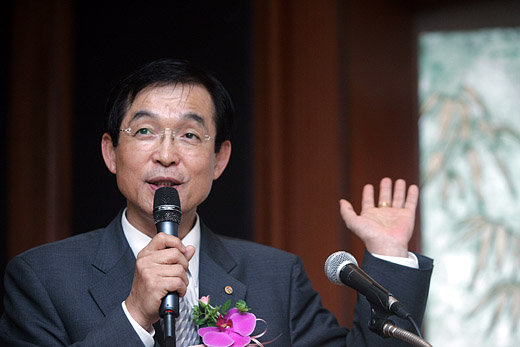 | ||
| ▲ On the 11th, a breakfast seminar hosted by the Human Development Institute was held at the Lotte Hotel in Sogong-dong. Lee Young-taek, President of Korea Exchange, delivered a lecture on the theme of "The Role and Tasks of the Korean Securities and Futures Market in Achieving an Asian Financial Hub." /Yeouido Communications, Reporter Kim Jin-seok | ||
"With the emergence of the Digital Economy, called the third great transformation in human history following the agricultural and industrial revolutions, the financial and securities markets have undergone rapid changes. First, as online transactions such as internet banking and home trading systems (HTS) have increased, the pace of business automation has accelerated further. Consequently, new services such as electronic currency, electronic payment, and online public offerings have emerged. The shift in business operations from tangible assets centered on storefronts and employees to intangible assets such as IT-based networks, commercialization capabilities, and services is a phenomenon that cannot be overlooked. As exemplified by bancassurance, the breaking down of boundaries between banking, securities, and insurance is also a noteworthy phenomenon."
Bancassurance, a French compound word meaning bank (Banque) and insurance (assurance), refers to a marketing strategy in which a bank or insurance company sells its products through the sales channels of other financial sectors. The collapse of boundaries between business areas does not stop here. Predictions are even emerging that information and communication companies like Reuters and Bloomberg, or internet portals like Yahoo, could become potential competitors to exchanges.
"The Korean securities and futures markets are tasked with a dual mission: coldly recognizing such paradigm shifts while urgently addressing pressing challenges. First, the Korean securities market maintains roughly the 15th position among 47 member countries (56 exchanges) of the World Federation of Exchanges (WFE), while the futures and options markets rank 4th and 1st globally, respectively. However, despite this quantitative growth, the Korean securities and futures markets are undervalued in Asia at the lowest PER level. This is a symbolic index most vividly demonstrating the so-called 'Korea Discount' phenomenon. Accurately diagnosing and overcoming this cause is our pressing task."
Here, 'PER' refers to the stock price divided by earnings per share. It is an index indicating how many times the stock price is of the earnings per share; the lower the figure, the more undervalued the stock price is. Based on this index, Korea (7.7) is valued far lower compared not only to Japan (20.9), the United States (17.6), and the United Kingdom (14.7), but also to Taiwan (13.2) and Singapore (11.73).
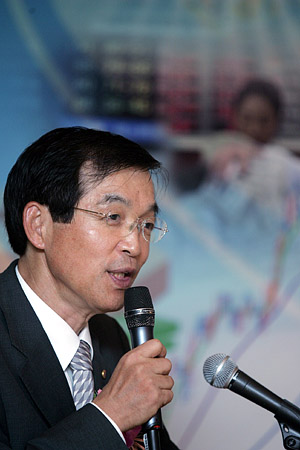 | ||
| ▲ On the 11th, a breakfast seminar hosted by the Human Development Institute was held at the Lotte Hotel in Sogong-dong. Lee Young-taek, President of Korea Exchange, delivered a lecture on the theme of "The Role and Tasks of the Korean Securities and Futures Market in Achieving an Asian Financial Hub." /Yeouido Communications, Reporter Kim Jin-seok | ||
However, it is true that the 'realization of an organization with dignity' among the three strategies presented by President Lee Young-taek seems somewhat abstract. Did he feel the same way? He explained using the following example.
"In the early 1990s, just before being assigned as director of the Securities Bureau, I wrote a book called 'Economic Stories for Citizens' (published by Kim Young-sa). At that time, more than 50,000 copies of this book were sold, making it a bestseller. However, the media criticized me, saying I lowered the stock price while raising land prices in Luoyang. When I worked at the World Bank in my youth, the most impressive thing I heard from experts was 'Don't trust economic forecasts.' In fact, there's a black humor along these lines. When asked 'What is 1 plus 1?' a mathematician answers '2.' However, an economist would rather ask the client 'What answer would you like?' or 'What shall I tell you?' This is a paradoxical anecdote that shows how dangerous subjective forecasts about the economy and stock prices can be. 'Realizing an organization with dignity' contains the will to shatter such false consciousness about securities."
<Yeouido Communications=Reporter Jeong Ji-hwan>
| President Lee Young-taek's Resume ▲ Graduate of College of Commerce, Seoul National University |


Loading comments…