


If I earn 1 billion won, would I do 10 years in prison?
| "Opening the Dawn Lecture Series" is a broadcast corner featuring breakfast seminars by the Korean Human Development Institute (KHDI), with the slogan "Good people create a good world." Over the past 30 years, KHDI's breakfast seminars have been held without fail every Thursday morning at 7 a.m., recording 1,405 sessions (as of this week), establishing the record for the most sessions in Korea and earning recognition as the nation's most authoritative lecture series. We hope that this article, summarizing the lecture on "Corruption as a National Policy Issue" delivered by Jung Sung-jin, Chairman of the Anti-Corruption Commission, at the Sapphire Ballroom on the 3rd floor of the Lotte Hotel on June 9, will provide some help in cultivating the educational level of our local residents. (Editor's note) |
Sometimes war is necessary. Really? Yes! For example, no one opposes the war against cancer, the war on drugs, or the war on crime. The war against corruption falls into that category as well. A paradoxical situation where we must support war for peace. Yet in fact, the paradox is already an undeniable reality of our lives. The first character '청'(淸) in Cheonggyecheon, where new waters flow, means "clear," but hasn't that waterway become a symbol of a den of evil as some bureaucrats have caused "murky" corruption to overflow there?
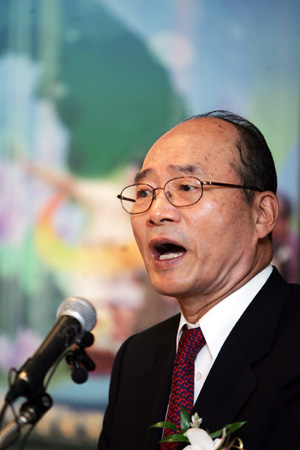 | ||
| ▲ On June 9, a breakfast seminar hosted by the Human Development Institute was held at the Lotte Hotel in Sogong-dong. Jung Sung-jin, Chairman of the Anti-Corruption Commission, delivered a lecture on the theme of "Corruption as a National Policy Issue." / Yeouido Communications, Reporter Kim Jin-seok | ||
"It may be hard to believe at this point in time, but it is a fact that 'corruption functional theory' had considerable persuasive power until the 1960s. Huntington's statement that 'an honest but rigid government is less efficient than a dishonest but flexible government' best represents this. However, now the perspective on corruption has changed. There is a mature atmosphere of acknowledging the continuous flow: reduction in corruption → increased efficiency in resource allocation → increased international credibility → increased foreign investment → increased exports and imports → improvement in national income. In fact, research results have shown that for every unit of 1 in the Corruption Perceptions Index (CPI) released by Transparency International (TI), per capita GDP rises by 2.64% and foreign investment increases by 0.2%."
The English word 'corruption' is reportedly a compound of the Latin 'cor' (together) and 'rupt' (to destroy). The Chinese characters '腐敗' also combine '썩을 부' (to rot) and '무너질 패' (to collapse), carrying the meaning of 'rotting away.' Former British Prime Minister Gladstone defined corruption as "the most certain shortcut leading a nation to ruin." The issue of corruption has thus become an important topic that should be taught not only in 'national ethics' classes but also in 'business management' and 'public administration' classes.
"Then what causes corruption to occur? Explained in economic terms, the desire for corruption intensifies when the expected returns from corrupt acts (bribe amounts, system loopholes, etc.) are judged to be greater than the costs incurred by detection or punishment (probability of detection or punishment, severity of punishment, etc.). Therefore, the basic principle of anti-corruption policy can be said to be minimizing expected benefits and maximizing costs. In Korea's case, sociocultural aspects such as paternalism and nepotism, as well as structural and institutional aspects such as past corruption between government and business and government-controlled finance systems, are also subjects of research. Dasan Jeong Yak-yong's philosophy of '예주법종'(禮主法從), emphasized in 'Gyeongse Yupyo,' also warrants careful examination in this regard."
Of note in this regard is 'corruption equilibrium theory.' This refers to a state in which consensus has formed among members of society regarding the formation of certain types of corruption. Ticket scalping and monetary gifts to teachers are typical examples, but of course, to become an advanced nation, the corruption equilibrium point must be lowered.
"The truly serious problem is the moral insensitivity among Korean youth that is evident through various indicators. The Anti-Corruption Citizens' Alliance conducted a survey of youth in December 2002, and the results were very shocking. To introduce only the main contents: the percentage of youth answering 'yes' to the questions 'There is no need to follow the law if no one is watching' and 'If it could solve a problem, I would provide a bribe' were 47.3% and 27.3%, respectively. I particularly express deep concern at the fact that 16.8% answered 'yes' to the question 'If I could earn 1 billion won even if I spent 10 years in prison, would I engage in corruption?'"
Korea ranked 47th out of 146 countries in the Corruption Perceptions Index released by Transparency International in 2004. This lags far behind Singapore (5th place), Hong Kong (16th place), Japan (24th place), Taiwan (35th place), and Malaysia (39th place) in Asia. According to Chairman Jung, just as there is no tree without roots, these indicators have acted as a host cultivating the poisonous mushroom of moral insensitivity among youth.
"The Anti-Corruption Commission was launched in 2002 as an independent commission directly under the President to comprehensively address these issues. Of course, since it currently lacks investigative and prosecutorial authority, it is, in a sense, waging the war on corruption 'without weapons,' but it is also a fact that it is performing its role to a limited extent. It is coincidental that former Construction and Transportation Minister Kang Dong-seok and former Constitutional Court Justice Lee Sang-kyung, despite public criticism, eventually resigned right after investigative requests were filed with the Anti-Corruption Commission. Going forward, we will perform a role similar to Hong Kong's Independent Commission Against Corruption (ICAC) and contribute to enhancing national competitiveness."
<Yeouido Communications = Reporter Jung Ji-hwan>
Biography of Chairman Jung Sung-jin of the Anti-Corruption Commission
▲ Graduated from Seoul National University College of Law
▲ Master's degree in Law from Seoul National University
▲ Ph.D. in Law from Kyungpook National University
▲ Researcher at the Supreme Prosecutors' Office, Director at the Ministry of Justice
▲ Chief of the 1st and 2nd Divisions, Central Investigation Division, Supreme Prosecutors' Office
▲ Deputy Chief Prosecutor, Northern Branch, Seoul District Prosecutors' Office
▲ Chief of Planning, Justice Administration Training Institute
▲ Director of Planning and Management, Ministry of Justice; Director of Legal Affairs
▲ Chief Prosecutor, Daegu District Prosecutors' Office
▲ Chief, Central Investigation Division, Supreme Prosecutors' Office
▲ Professor and President of Kookmin University
▲ President of the Korean Criminal Policy Association
▲ President of the Korean Criminal Law Association
▲ Director of the Korean Law Institute
Honors: Medal of Order of Service Merit with Crimson Ribbon, Korean Legal Culture Award
Publications: Comparative Research on Protective Disposition Systems of Various Countries, Theory of Unfair Competition, Theory of Internal Investigation, and others
Loading comments…