


'Opening the Dawn Lecture' is a column that relays the breakfast lectures of the Korea Human Development Institute (KHDI), which operates under the slogan "Good people make a good world." For the past 30 years, KHDI has held these breakfast lectures without fail every Thursday morning at 7 a.m., recording 1,397 sessions (as of this week) — the highest number in the nation — and earning recognition as the most authoritative lecture series. We hope that this article, which summarizes the lecture delivered by Korea Forest Service Director Jo Yeon-hwan on April 14 at the Emerald Room on the second floor of Lotte Hotel, with the theme "Dreams of an Advanced Economy and Forest Policy," will be of some help to our local residents in their intellectual development. (Editor's Note)
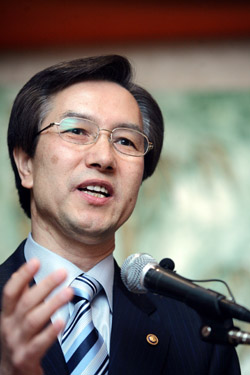 | ||
| ▲ On the 7th, a breakfast lecture hosted by the Human Development Institute was held at Lotte Hotel in Sogong-dong. Korea Forest Service Director Jo Yeon-hwan and Jeon Young-woo, professor at Kookmin University, delivered lectures on the theme "Dreams of an Advanced Economy, Forest Policy, and Our Pine Tree Story." Director Jo delivering the lecture. /Yeouido Communications Kim Jin-seok | ||
Jo Yeon-hwan, Korea Forest Service Director. A man who entered the Forest Service as a junior employee at age nineteen and worked there for 38 years before finally reaching the position of top administrator. The brief sentence with a question mark above is an unexpected question posed to Director Jo by a reporter during an interview shortly after his appointment as Forest Service Director. What was Director Jo's response at that time?
"It was such a fundamental question that I was momentarily at a loss for words. Yet I could not answer, 'A mountain is a mountain and water is water' (laughter). After thinking for a moment, I answered briefly, 'A forest is a mother.' In fact, forests, which occupy 64% of the Korean Peninsula's land area, and the Baekdudaegan ridge and its twelve veins, where all terrestrial life takes root and thrives, closely resemble a mother who cared for her children with unconditional devotion and sacrifice during times of poverty and hardship. However, if I were asked the same question again now, I would like to say, 'A forest is both a mother and a rice bowl.'"
What, then, was the reason for comparing forests to a rice bowl? "Just as people cannot live without rice, forests, like the 'The Giving Tree' in fairy tales, are the source and foundation that make our survival and prosperity possible," Director Jo explained. In this dialogue reminiscent of Zen questions and answers, we can glimpse Director Jo's view of forests.
"As the term 'Geumsugangsang' — meaning a land of great beauty — suggests, the Korean Peninsula was once covered with dense forests. However, as we endured Japanese colonial rule, liberation, and war in succession, our forests began to follow a path of devastation and desolation. In short, the history of Korean Peninsula forests can be said to be one of exploitation and plunder. In that context, restoring dense forests in just one generation after the 10-Year Reforestation Project that began in 1973 is a historic achievement. Yet as Forest Service Director, I must confess that I am not always delighted and proud. Rather, whenever I look at our forests, I feel sad to the point of tears, and my heart feels torn with anguish."
Forests nationwide have become so dense that people cannot enter them, yet why did Forest Service Director Jo Yeon-hwan use such negative language?
"I ask that you read the paradoxical meaning between the lines of my words. It is true that we have reclaimed dense forests, to the extent that the United Nations Food and Agriculture Organization has praised us as a 'successful greening nation.' However, now we need a 'second phase of reforestation and afforestation.' The era of merely planting trees and hoping they grow well has passed. Just as children must be raised well to become talented individuals, forest policy must now shift from pursuing 'quantity' to pursuing 'quality.' Korea's forests have already become adolescents, yet we cannot ask them to wear the clothes we gave them at their first birthday celebration. Korea's forests are experiencing growing pains now, so how could I not feel sadness and anguish?"
There is a saying that crisis is opportunity, and the IMF financial crisis that struck in 1997 provided an opportunity for Korea's forests to be reborn anew.
"It was a 'misfortune' for the nation as a whole, but it was a 'blessing in disguise' for us. As the foreign exchange crisis created masses of the unemployed, job creation became the highest virtue of the era. In March 1998, a proposal for a public works project to nurture the Forest of Life was adopted, and 570 billion won was invested in this project over five years. Compared to the past, when we requested a budget of only 50 billion won under similar names from the Economic Planning Board or the Budget Bureau and were coldly rejected, this represented a dramatic change. At that time, I was a section chief in charge of nurturing the Forest of Life, and I went out to Seoul Station to persuade homeless people — sometimes having my collar grabbed or, in severe cases, getting slapped in the face."
For a young sapling to grow, only one pyeong of land is sufficient. However, a tree that has grown for ten years requires ten pyeong of land. Only then can the tree grow properly, and grasses and flowers can also flourish around it. During the five-year Forest of Life cultivation project, 500,000 hectares — one quarter of the 2 million hectares of forests requiring urgent attention — were cultivated in this manner. However, for this project to continue, a minimum of 120 billion won must be invested annually going forward.
"Of course, some criticize this, asking what profit trees bring, and honestly, whenever I hear such remarks, I feel exasperated. The public value of forests exceeded 58 trillion won as of 2003. Moreover, earlier this year, the Kyoto Protocol to regulate greenhouse gas emissions was also adopted. We do not call Middle Eastern oil-producing countries with 20,000 dollars per capita as advanced nations. Coincidentally, those countries have neither trees nor forests. We must take deeply to heart why the saying emerged that without trees, a nation cannot be advanced. This is precisely why we cannot cease our efforts to cultivate forests befitting a 20,000-dollar advanced nation."
Meanwhile, Jeon Young-woo, a professor at Kookmin University famous as a 'pine tree expert,' also participated as a co-lecturer in this breakfast lecture, explaining the cultural value and contemporary significance of pine trees.
Jung Ji-hwan, Reporter ssal@ytongsin.com
| Career Profile of Jo Yeon-hwan, Korea Forest Service Director ▲ Graduate, Department of Business Administration, Korea National Open University |
Loading comments…