


Governor Nam Kyung-pul: "South Korea's Politics and Economy Need Innovative Change"
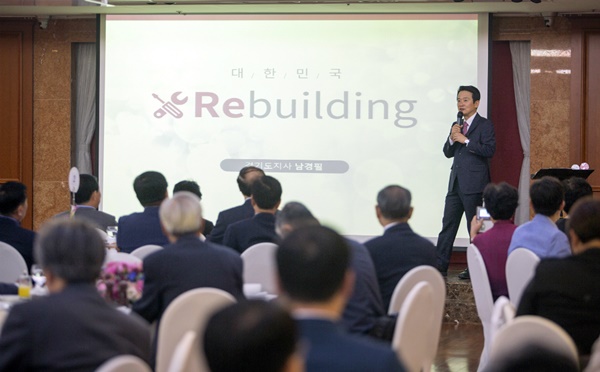
Gyeonggi Province Governor Nam Kyung-pul delivered a lecture on "Rebuilding the Republic of Korea" at the Sejong Forum held at the Sejong Hotel in Myeongdong, Seoul at 7:30 a.m. on the 21st.
The forum was attended by approximately 80 participants, including Ju Myeong-geon, President of the Sejong Institute, Shin Gu, President of Sejong University, Park Geun, Honorary Chairman of the Korea-U.S. Friendship Association, as well as professors, financial sector officials, and corporate CEOs from various fields.
Governor Nam began his lecture by asking, "How is the Republic of Korea?" He addressed the current problems facing South Korea, including youth unemployment, polarization, low birth rates, private education, and the North Korean nuclear issue, describing the reality of a nation not at ease.
Governor Nam stated, "To overcome crises, the role of leadership is important. If we liken the leaders of our time to ship captains, the most important role of a captain is to hold a compass and know where they are positioned. Through this gathering today, I want to analyze the current state of the Republic of Korea and discuss the direction we should move forward."
Governor Nam then pulled out a 100-dollar U.S. bill to emphasize the necessity of "global standards."
Governor Nam said, "The reason the world constantly seeks the 100-dollar bill is not simply because it is money, but because it is the global standard of currency. As our country stands at the threshold of developed nations, we must present various global standards across different sectors to enter the ranks of advanced nations."
Governor Nam cited the example of Germany, which grew from a defeated nation to a European power, explaining that such growth was due to cooperative politics and the social market economy system. He then explained that the cooperative governance projects currently being pursued by Gyeonggi Province and shared market economy models could become global standards.
Regarding cooperative governance, Governor Nam said, "In Gyeonggi Province, politicians from various parties sit at the same table with a unified commitment to serving the people, and conduct meetings to decide on policies and budgets. In the future, we plan to expand this to a cabinet system. We plan to dispatch provincial council members from both opposition and ruling parties as provincial governors of Gyeonggi to establish an efficient system for communication with the central government."
Regarding the economic system, he introduced four companies currently leading the global economy—Facebook, Google, Apple, and Amazon—and presented a shared market economy model through an open platform format.
The shared market economy refers to a public platform that helps private sector growth through budgets, human resources, and land held by the public sector. Notable examples include Pangyo Startup Campus, which supports youth entrepreneurship, and the Gyeonggi Province Stock Company, scheduled to launch in November of this year.
Governor Nam also expressed his views on an all-volunteer military and the relocation of the capital.
Regarding the all-volunteer military, he argued, "Wars in the current era are not won by numbers. Rather than simply maintaining troop numbers through conscription, we must cultivate better-trained soldiers to protect the Republic of Korea."
On capital relocation, he stated, "According to statistics released recently by Seoul National University, nearly 100 local governments will disappear within 30 years. This is due to low birth rates and the concentration of the capital region. It is appropriate to separate politics and economics—moving politics to Sejong while keeping the economy here in the capital region."


Loading comments…