


'Reducing Fiscal Disparity'...Ministry of Interior and Safety Adheres to Original Local Finance Restructuring Plan
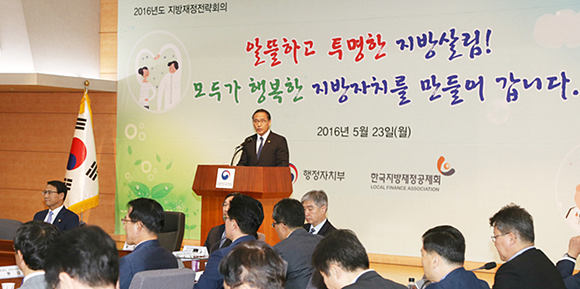
The Ministry of Interior and Safety has decided to proceed with its original policy of eliminating Gyeonggi Province's preferential distribution of adjustment grants and converting half of the corporate local income tax into a joint tax, despite strong opposition from some local governments.
This appears to be in response to growing calls for improving the 'adjustment grant' system to address fiscal disparity between cities, counties, and districts.
According to the Ministry of Interior and Safety, Gyeonggi Province had a special provision for preferential distribution of adjustment grants to six local government units not receiving local allocation tax transfers (Suwon, Seongnam, Gwacheon, Yongin, Hwaseong, and Goyang). However, this measure contradicts the purpose of the system by actually widening fiscal disparities between other cities, counties, and districts in the Gyeonggi region.
The Ministry of Interior and Safety held the '2016 Local Finance Strategy Conference' on the 23rd at the Government Complex Seoul Annex, attended by approximately 500 people including heads of autonomous entities, local public enterprises, academic institutions, and private experts.
At the conference, it was pointed out that the current adjustment grant system operates by allocating more than 80% of resources to local governments in better financial conditions, and that criteria for the adjustment grant system should be improved.
Accordingly, the argument is that the reflection ratio of population and collection results (80%) should be lowered, the reflection ratio of fiscal capacity index (20%) should be expanded, and Gyeonggi Province's preferential distribution special provision should be abolished.
If this occurs, the 524.4 billion won in adjustment grant funds previously provided as priority support to non-receiving units in Gyeonggi Province will be redistributed to 25 other cities and counties within the province, resulting in a clear reduction in fiscal disparities.
Last year, Gyeonggi Province's total adjustment grants amounted to 2.6 trillion won, of which 52.6% (1.4 trillion won) was preferentially distributed to these six entities. Without the special provision, these six entities would receive 32.9% (875.1 billion won), and 524.4 billion won could be distributed to the other 25 cities and counties.
In this case, the 25 cities and counties would be able to receive adjustment grant funds averaging over 20 billion won each.
Furthermore, considering that the province and cities and counties work together to attract businesses, 50% (approximately 1.4 trillion won) of the corporate local income tax, which is a city and county tax, will be converted into a joint tax for cities and counties, and the entire amount will be redistributed to cities and counties within the province through certain distribution criteria based on fiscal capacity.
As a joint tax resource, the corporate local income tax was found to be appropriate, considering that tax revenue increased sharply following the government policy of converting to an independent tax in 2013, but there is a large tax revenue gap between cities and counties, and there is a need to reflect the province's efforts to attract businesses.
The joint tax ratio was analyzed to be appropriate at approximately 50% of the relevant tax category, considering the functions and roles of the province and cities and counties related to business attraction and support.
The province's burden related to business attraction and support amounts to 3.6 trillion won, of which the provincial headquarters supports approximately 1.87 trillion won (51.9% of the entire province's burden).
Meanwhile, the total local income tax in 2015 amounted to 12.8 trillion won (7.7 trillion won for individuals and 5.1 trillion won for corporations). The corporate portion is 5.1 trillion won, of which 2.8 trillion won is collected in the province's area.
Therefore, if the joint tax ratio for the province's area is set at 50%, the final joint tax resource would be approximately 1.4 trillion won, accounting for only about 11% of the total local income tax of 12.8 trillion won.
The method of distributing joint tax revenue among cities and counties within the province will need to be examined through various approaches including fiscal capacity, population, and equal distribution.
The Ministry of Interior and Safety plans to submit an amendment to the 'Local Tax Basic Act' to the National Assembly next year after sufficient gathering of opinions and building consensus through regional discussion meetings and other means during this year regarding the issue of converting part of the corporate local income tax into joint taxes for cities and counties.
The Ministry of Interior and Safety is also promoting the introduction of a 'Local Finance Stabilization Fund' for stable and planned financial management by local governments.
Local taxes are sensitive to real estate market fluctuations, making tax revenue conditions unstable, and year-to-year financial adjustments are difficult due to the principle of independent accounting for fiscal years.
Therefore, the plan is to accumulate a portion of funds when the economy is good and local tax revenue increases, so that it can be used when finances worsen.
The Ministry of Interior and Safety stated that it is necessary to examine funding methods such as allocating a certain percentage of net surplus and allocating a certain portion of local tax revenue increases when local tax revenue significantly exceeds the average of the past three years.
Additionally, the Ministry of Interior and Safety is streamlining events and festivals of local governments to reduce discretionary and wasteful budgets and to enhance the substance of regional festivals.
There have been continuous requests for improvement as small-scale events and festivals have increased, and events and festivals for citizens' unity that are not linked to local economic revitalization have become widespread, burdening local finances.
In response, the Ministry of Interior and Safety is considering introducing an 'Event and Festival Budget Cap System' that sets a certain limit to prevent local government event and festival budgets from exceeding a certain level.
Additionally, the Ministry of Interior and Safety explained that it is necessary to strengthen investment review of the feasibility of large-scale events and festivals of local governments and to evaluate the performance of all events and festivals annually.
Minister of Interior and Safety Hong Yun-sik emphasized that "improving fiscal equity and fiscal soundness between local governments is urgent for balanced regional development and establishing sound finances," and stated, "This local finance reform is aimed at implementing frugal and transparent local government finances and realizing local autonomy where all citizens are happy. We hope that local governments will make joint efforts and participate in this successful reform."
In response, the six local government entities in Gyeonggi Province, which will see significant reductions in adjustment grants due to the system restructuring, are strongly opposing the plan.
They argue that "according to the government's restructuring plan, the budget of the six cities will decrease by up to 270 billion won per city, totaling more than 800 billion won," and "projects to address problems of overcrowded cities, such as welfare, job creation, transportation, and environment, will be completely canceled and finances will collapse."
However, regarding the confrontation between the government and some local governments, there are not a few perspectives that, while the government policy is procedurally unilateral, it is substantively reasonable.
A representative of a conservative civic organization in the Suwon region stated that "while some local governments claim that there will be fiscal collapse if the government policy is implemented, I felt helpless seeing some mayors pour hundreds of billions of won into events with no substance for self-promotion," expressing support for the government policy.
He further emphasized that "after boldly cutting over one hundred such discretionary and publicity budgets annually and substantially reducing media promotion expenses used under the name of co-hosting with media outlets, then criticism should be raised."
In fact, the media's response to the government's local finance restructuring has been varied. Central media outlets have generally released positive reports. They do contain concerns about conflicts with local governments.
However, the coverage by some Gyeonggi region local media outlets where the six non-receiving units are located takes a "do-or-die" stance. The approach concentrates on highlighting negative aspects of the government's local finance restructuring plan by mobilizing articles, editorials, and columns.
Meanwhile, thousands of citizens, who appeared to have been mobilized by some local governments including Suwon, Hwaseong, and Seongnam, staged protests in Seoul on that day.
On the 20th, Yeo Young-taek, mayor of Suwon; Choe Sung, mayor of Goyang; Jeong Chan-min, mayor of Yongin; Chae In-seok, mayor of Hwaseong; and Shin Gye-yong, mayor of Gwacheon met with Minister Hong Yun-sik at the Government Complex Seoul and conveyed each city's position and requested a halt to the implementation of the restructuring plan.
Loading comments…