


Gyeonggi Province and Jeollanam-do Forge Mutual Cooperation Agreement... Third Agreement After Gangwon and Jeju
Suwon NewsPublished 2016.05.10 06:23
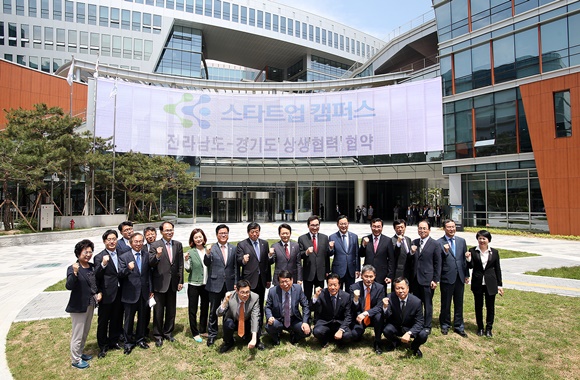
Gyeonggi Province and Jeollanam-do signed a mutual cooperation agreement on the 9th to collaborate in nine areas including education, business, agriculture, and youth exchange.
The mutual cooperation agreement with a metropolitan local government is the third since Governor Nam Kyung-pil took office. Governor Nam previously signed mutual cooperation agreements with Gangwon Province Governor Choi Moon-soon in April 2015 and Jeju Province Governor Won Hee-ryong in August of the same year.
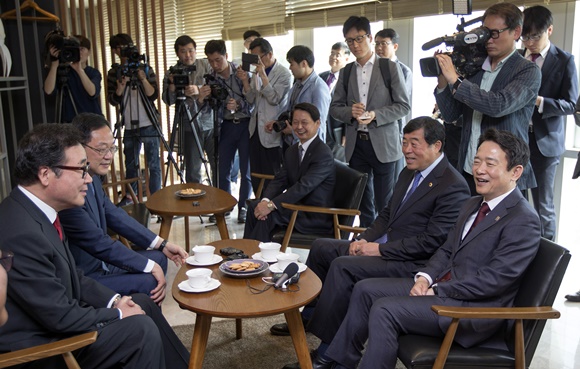
At 11:40 a.m. on this day, Governor Nam signed the "Gyeonggi Province-Jeollanam-do Mutual Cooperation Agreement" with Jeollanam-do Governor Lee Nak-yeon, Gyeonggi Provincial Assembly Speaker Yun Hwa-seop, and Jeollanam Provincial Assembly Speaker Myung Hyun-gwan at Pangyo Startup Campus, and agreed to establish a new model for local government development through sustainable exchange and cooperation.
Through this mutual cooperation agreement, both provinces will collaborate on nine projects.
Looking at the main project details, the "Community Shared Solar Power Plant Construction Project" involves Gyeonggi Province receiving technical support from Jeollanam-do to invest 10 billion won by 2018 to establish a 5MW-class solar power plant, with estimated annual profits of 500 million won to be distributed as scholarships to students residing in the power plant areas of both provinces.
Students from areas near the Hanbit Nuclear Power Station (6 reactors, 5,900MW) located in Hongnong-eup, Yeonggwang-gun, Jeollanam-do are expected to be scholarship beneficiaries.
A Gyeonggi Province official stated, "Gyeonggi Province is the region with the highest energy consumption nationwide," and explained the significance of the project by saying, "This project is a sharing and mutual cooperation initiative where Gyeonggi Province, with the highest energy consumption, increases its energy self-sufficiency through solar power plant construction and supports energy production areas with the resulting profits."
The province also plans to have Jeollanam-do overseas students currently enrolled at 12 universities within Gyeonggi Province move into the "Ttabok Dormitory" (meaning warm and blessed) that is under construction in Gwonseon-gu, Suwon.
The Ttabok Dormitory is a residential welfare project for youth in which the province remodels Sangrok Dormitory, the former Seoul National University Agricultural and Life Sciences College dormitory, for use as a dormitory for university students, with residents expected to move in starting March of next year.
For SME export support, both provinces plan to jointly utilize overseas trade offices they possess to jointly pursue overseas marketing services, dispatch trade promotion groups, and conduct joint promotional activities for SME products.
Gyeonggi Province currently operates 8 trade offices in 6 countries including India, Russia, and the United States, while Jeollanam-do operates 4 trade offices in 4 countries including China and Japan.
To vitalize the bioindustry, both provinces agreed to jointly utilize research equipment from biotech research institutions in both provinces and conduct research together.
Gyeonggi Province has 1,330 research equipment at 22 institutions, while Jeollanam-do has 400 research and production equipment at 53 institutions.
The Gyeonggi Science and Technology Promotion Agency and the Jeollanam-do Biological Industry Resource Promotion Agency will jointly develop technology, which will then be transferred to SMEs in both regions to facilitate their overseas expansion.
Gyeonggi Province, which purchases eco-friendly agricultural products from Jeollanam-do worth 4 billion won across 22 items, agreed to expand the supply of eco-friendly agricultural products by additionally purchasing items from Jeollanam-do with low production ratios in Gyeonggi Province, such as onions, sweet potatoes, and potatoes.
Additionally, both provinces agreed to establish a platform to identify technology needs required by Jeollanam-do's renewable energy companies and match them with Pangyo ICT companies to solve technical challenges, establish a consultative body between both provinces' agricultural technology institutes and flower specialty export agencies to jointly develop and market flower varieties, develop programs to promote youth safety and human rights, and promote mutual exchange and exhibition sales between ceramic industries in Icheon, Gwangju, and Yeonju in Gyeonggi Province and Gangjin in Jeollanam-do.
Governor Nam Kyung-pil said in his opening remarks, "Gyeonggi Province's electricity self-sufficiency rate is less than 30%, yet its electricity consumption is the highest in the nation. When I looked into where the electricity came from, I found that Jeolla Province has many nuclear power plants." He added, "Today's agreement began as a gesture of gratitude to Jeollanam-do residents. General Yi Sun-sin said that without Honam, there is no nation, and similarly, without Honam, there is no Gyeonggi Province," expressing his gratitude to Jeollanam-do.
He continued, "Following the practical philosophy of scholar Dasan Jeong Yak-yong, who connected Gyeonggi Province and Jeolla Province, if both provinces cooperate mutually, we can create many future values. Such cooperation is what our people wish for from politics and administration, and this was also reflected in the recent general election process. I hope that both regions will advance to the next level through today's agreement on the solar power plant and Ttabok Dormitory."
Governor Lee Nak-yeon of Jeollanam-do responded by saying, "I hope that as Jeollanam-do and Gyeonggi Province faithfully implement the nine cooperative projects agreed upon today, we will further expand our mutually complementary cooperative relationship for joint development," and added, "Not only for Jeollanam-do and Gyeonggi Province, but I hope we will cooperate so that the Republic of Korea reduces gaps between classes and regions and prospers evenly, and develops into a unified nation with common prosperity between the South and North."
Governor Lee continued, "When I came to Pangyo, I felt more relieved than envious. I had thought that the industries that have fed Korea's half-century are declining and new outlets are desperately needed, but seeing Pangyo, I could feel that Korea's economic breakthrough is being created here." He praised Governor Nam by saying, "Governor Nam Kyung-pil has created a model for our politics through cooperation, and I express my respect for creating a model for Korea's economy as well."
Prior to the agreement ceremony, Governor Nam and Governor Lee visited Born2Global, a startup company fostering institution located in Pangyo Techno Valley Startup Campus, where they discussed methods for nurturing startup companies.
After the agreement ceremony, Governor Nam and Governor Lee visited the government joint incense burner in Ansan and shared lunch with Sewol ferry victims' families.
© Suwon Ilbo. Unauthorized reproduction and redistribution prohibited.
Loading comments…