


Lee Jae-myeong: "Low-Interest Long-Term Loans Make Individuals Happy, National Prosperity, and Reduce Welfare Spending"
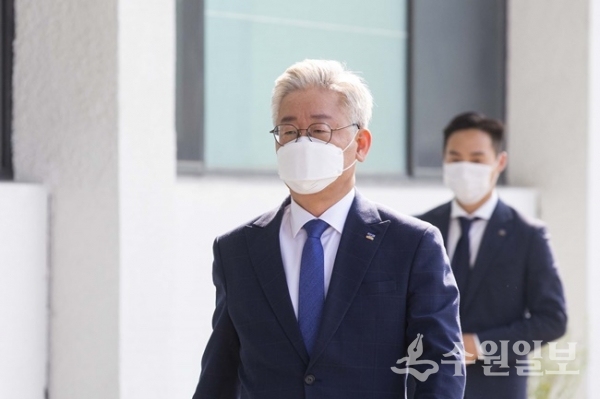
[Suwon Ilbo=Reporter Park Noh-hoon] Gyeonggi Province Governor Lee Jae-myeong mentioned the 'Basic Loan Right' and advocated for the necessity of long-term low-interest loans for ordinary citizens.
Governor Lee expressed these views through his SNS on the 13th, stating, "In addition to interest rate caps of 10% and the invalidation of illegal loans, a long-term low-interest loan guarantee system (Basic Loan Right) is absolutely necessary."
The governor first stated, "It is not natural that those with low income and no collateral pay ultra-high interest rates," and continued, "Since loan companies have low recovery rates, they pass the risk of non-collection onto other borrowers by charging annual rates of 24%. More than 90% repay high-interest principal and interest without default, bearing responsibility for others' unpaid debts." He then pointed out, "Doesn't this seem familiar? It's precisely like tribal levies, personal levies, and forced debt collection."
He further stated, "Shockingly, the state's loan rate for ordinary citizens is also 17.9%. In a welfare state, the government should be responsible for the financial risks of ordinary people, yet even the state passes the responsibility of non-repayment onto citizens at high interest rates. Our country only has welfare that is entirely free and loan systems that are entirely recovered, with nothing in between. In an intermediate form where the state bears losses from partial non-repayment (maximum 10%), there should be a welfare-type loan system (Basic Loan Right) through which anyone can receive low-interest long-term loans," reiterating his advocacy for the Basic Loan Right.
The governor also stated, "We pride ourselves on having the world's lowest level of transfer income (income paid by the government to individuals) and consequently the lowest national debt ratio and the highest household debt ratio. To prevent people from bearing others' credit risks and being exploited only to fall into the category of welfare recipients, it is time to implement a low-interest long-term loan system (Basic Loan) that does not require a large budget."
The following is the full text of Lee Jae-myeong's SNS post.
<Basic Loan Right...Transforming exploitative consumer finance into fair, humane finance...>
In addition to interest rate caps of 10% and the invalidation of illegal loans, a long-term low-interest loan guarantee system (Basic Loan Right) is absolutely necessary.
The state is a community created for people to live together, not a tool of domination by a few powerful over many weak. In a democratic republic where all citizens are equal sovereigns, the benefits that arise from the exercise of state power should be enjoyed equally by all citizens.
Not only should monetary issuance profits be shared, but for substantive justice, the many low-income earners should benefit more than the few high-net-worth or high-income individuals.
When the Bank of Korea supplies currency to commercial banks at the current rate of 0.5% annually, large corporations and high-income, high-net-worth individuals can borrow money at 1-2% annually and enjoy the benefits of monetary issuance, but ordinary citizens with little assets or income to collateralize must borrow from second-tier financial institutions or loan companies at ultra-high rates of up to 24% annually.
It is not natural that those with low income and no collateral pay ultra-high interest rates.
Since loan companies have low recovery rates, they pass the risk of non-collection onto other borrowers by charging annual rates of 24%. More than 90% repay high-interest principal and interest without default, bearing responsibility for others' unpaid debts.
Doesn't this seem familiar?
It's precisely like tribal levies, personal levies, and forced debt collection.
Shockingly, the state's loan rate for ordinary citizens is also 17.9%. In a welfare state, the government should be responsible for the financial risks of ordinary people, yet even the state passes the responsibility of non-repayment onto citizens at high interest rates.
Our country only has welfare that is entirely free and loan systems that are entirely recovered, with nothing in between. In an intermediate form where the state bears losses from partial non-repayment (maximum 10%), there should be a welfare-type loan system (Basic Loan Right) through which anyone can receive low-interest long-term loans.
Since consumer loan companies hold approximately 2 million borrowers with about 17 trillion won in debt, even if the state were to fully cover the maximum 9% default rate (with interest at 1% instead of 24%, there would be almost no defaults), millions of people could borrow under the same conditions as leading large enterprises with a modest budget, making recovery easier and reducing the number of people falling into welfare dependency.
In an era of 1% growth, no business or person can succeed while paying 24% interest. A 24% usurious rate is the last struggle before becoming a welfare recipient, and if left unaddressed, the state will eventually have to incur massive welfare expenditures for those falling into welfare dependency.
Providing low-interest long-term loans to give these people opportunities for self-reliance and capacity development is a path where individuals are happy, the nation prospers, and welfare spending decreases.
Transforming consumer finance from a world of mutual exploitation among ordinary people into a community living together is possible whenever we make up our minds to do so.
We pride ourselves on having the world's lowest level of transfer income (income paid by the government to individuals) and consequently the lowest national debt ratio and the highest household debt ratio.
To prevent people from bearing others' credit risks and being exploited only to fall into welfare dependency, it is time to implement a low-interest long-term loan system (Basic Loan) that does not require a large budget.
Discussion and debate are welcome anytime and anywhere from senior financial officials, economic experts, or business journalists.


Đang tải bình luận…