


Shim Jae-deok's 'Seasoned Experience,' Kim Jin-pyo's 'Policy Expertise,' Nam Kyung-pil's 'Leadership,' Lee Ki-woo's 'Conviction'
The parliamentary audit that began on the 4th is now in its final stages.
Both ruling and opposition parties have set the motto for the National Assembly's 17th term inaugural audit as 'policy-focused audit' as if in unison. However, that promise ultimately came to naught. From the first day of the audit, with controversies such as 'relocation of the national administrative capital' and 'disclosure of state secrets,' the ruling and opposition parties took sharp antagonistic stances, and old habits persisted with the reemergence of 'ideological debates.'
Of course, it is also true that there have been many changes and improvements overall. However, the disappointment of citizens who had hoped for a high-quality audit fundamentally different from the past could not help but be great, given the ruling-opposition political strife that began on the first day of the audit. In fact, the audit NGO monitoring group, composed of some 270 civic organizations, also graded this audit at around a C level.
Though the audit was tainted by political strife, there were certainly members who remained consistent with calm policy inquiries. Our local assembly members, of whom there are as many as three first-term members, also took a different approach to this audit. Let us review the key inquiry contents and activities of our local assembly members at the 17th National Assembly's inaugural audit.
Shim Jae-deok and Nam Kyung-pil Selected as Outstanding Audit Members
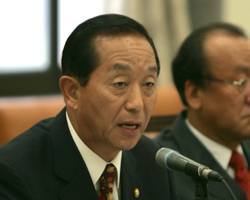
◇Representative Shim Jae-deok (Administration and Self-Governance Committee)
 | ||
| ▲ Representative Shim Jae-deok ⓒ Kim Jin-seok | ||
In particular, during Seoul City's audit held on the 6th, the positions of ruling and opposition members became sharply divided regarding Lee Myung-bak, the Seoul mayor and a leading opposition candidate for the next presidential election. Ruling party members intensively probed allegations of organized government-sponsored anti-relocation rallies by Seoul City, while opposition members voiced statements defending the mayor's position.
Starting with Gyeonggi Province on the 7th, and continuing with local government audits of Incheon, South Chungcheong, North Jeolla, and Jeju, issues related to local affairs were intensively discussed. Representative Shim Jae-deok set as key agendas 'exclusion of local government heads from central party nominations' and 'maintaining settlement boundaries.'
During Seoul City's audit, he explained the rationale for 'relocation of the national administrative capital' by citing the example of King Jeongjo, and during Gyeonggi Province's audit, he intensively discussed administrative restructuring issues such as the introduction of administrative special exemption systems for cities with populations exceeding one million.
Despite political strife between ruling and opposition parties, he continued with calm inquiries, earning selection as an 'outstanding audit member' in the mid-term evaluation announced by the NGO audit monitoring group. However, there is some regret that he focused on somewhat peripheral issues such as 'restroom problems' and 'maintaining settlement boundaries.'
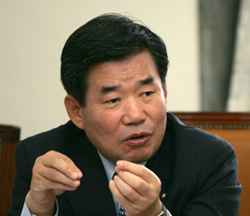
◇Representative Kim Jin-pyo (Committee on Strategy and Finance)
 | ||
| ▲ Representative Kim Jin-pyo ⓒ Kim Jin-seok | ||
Representative Kim, given his track record of being deeply involved in formulating the roadmap for current government economic issues, appeared to sidestep the 'Participatory Government economic policy failures' controversy that the opposition intensively probed, instead focusing on presenting principled policy alternatives. These include 'resolution of personnel congestion in the National Tax Service,' 'necessity of establishing a branch of the Suwon Tax Office,' and 'expansion of fiscal spending to stimulate the economy.'
Representative Kim, with his exceptional understanding of the current government's economic policies, presented various policy alternatives to overcome the current economic situation marked by severe domestic demand shortage.
However, regarding the 'credit card crisis' issue that the opposition intensively probed, he faced difficult situations where opposition members questioned his 'responsibility.' In particular, Representative Nam Kyung-pil of the Democratic Party from the same constituency drew unfavorable attention by disclosing documents reportedly prepared by Representative Kim when he was minister, regarding Industrial Bank's acquisition of LG Card.
Representative Kim has been evaluated as having conducted substantive and quiet audit inquiries, presenting policy alternatives at each questioning session and demonstrating expert-level competence.
Kim Jin-pyo's Policy Alternatives and Lee Ki-woo's Conviction Questions Stand Out
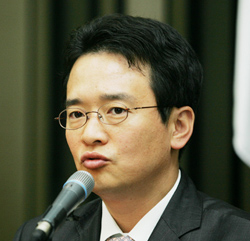
◇Representative Nam Kyung-pil (Committee on Government Administration)
 | ||
| ▲ Representative Nam Kyung-pil ⓒ Kim Jin-seok | ||
Representative Nam spearheaded the opposition's aggressive offensive against the current government's economic mismanagement during audits of the Financial Supervisory Commission and Fair Trade Commission, intensively questioning the problems of economic policy. During the Financial Supervisory Commission audit, he raised issues regarding government support suspicions for LG Card.
Whenever fierce political strife between ruling and opposition continued, such as the controversy over Representative Park Jin's disclosure of classified government documents raised in the Defense Committee, Representative Nam led attacks on the ruling party, fiercely criticizing them as 'partisan politicization of the audit strategy.'
From the second week of the audit on the 11th, Representative Nam intensively probed the government's economic mismanagement and received concentrated media attention. In particular, by being selected as an outstanding audit member by the NGO monitoring group, he demonstrated the experience of a three-term member.
Additionally, during the audit of the Ministry of Patriots and Veterans Affairs, he raised the argument that 'left-wing independence activists' should also be decorated with honors, demonstrating a stance distinctly different from the opposition's 'ideological' offensive.
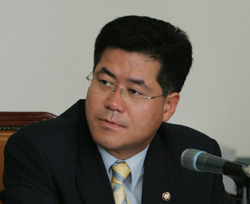
◇Representative Lee Ki-woo (Committee on Health and Welfare)
 | ||
| ▲ Representative Lee Ki-woo ⓒ Kim Jin-seok | ||
He continued with principled inquiries on medical sector issues including the Korean Red Cross's poor blood management, expansion of public medical services, and medical institution evaluations, receiving comparatively greater media attention than other members.
Representative Lee presented alternatives for each organization's short-term and long-term tasks at each questioning, demonstrating the possibility of 'policy-focused audits.' In particular, he received praise for logically resolving sensitive political issues as a ruling party secretary. During audits of the Ministry of Health and Welfare's subordinate organizations including the Korean Red Cross, the National Health Insurance Service, and the Health Insurance Review and Assessment Service, he pre-coordinated ruling party audit strategies, reducing redundant questioning and leading efficient audit operations.
He intensively discussed operational issues in hospitals and clinics such as 'dangers of super bacteria' and 'status of aging CT equipment,' urging government countermeasures, earning praise for sharp inquiries on par with opposition members.
<Yeouido Report=Reporter Kim Dong-hyun>
Loading comments…