


Yom Tae-young: "Resolve Conflicts through Resident-Participatory Redevelopment"
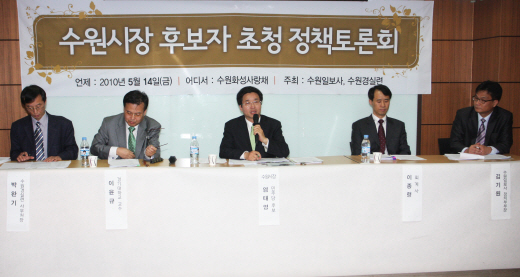
● Moderator: Lee Yun-gyu (Professor, Kyonggi University)
● Panelists: Park Wan-ki (Executive Director, Suwon Citizens' Coalition for Economic Justice), Lee Jong-ryeong (Accountant), Kim Ki-won (Political Affairs Editor, Suwon Ilbo)
● Date and Venue: May 14, 2:00 p.m., Grand Conference Room, Srang-chaei, Hwaseong Management Foundation
● Organizers: Suwon Ilbo, Suwon Citizens' Coalition for Economic Justice
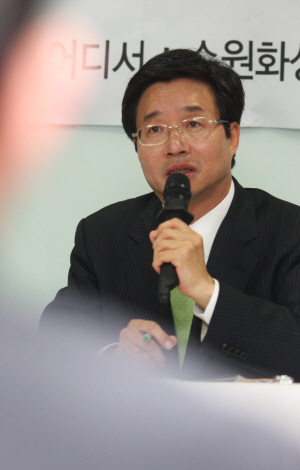
Dear citizens of Suwon, how much hardship are you enduring these days? How much pain have you suffered? The livelihood of ordinary people has hit bottom and citizen sovereignty has collapsed. The government and ruling party are pouring tens of trillions of won into the Four Major Rivers Project, which will have no clear impact on our lives, while citizen welfare budgets are depleted. The government claims to serve citizens as masters, yet we are ignored while witnessing arrogance, arbitrariness, and unilateral rule. The June 2 local elections are a day of national judgment to check this government's arrogance and arbitrariness. We citizens must not overlook arrogance and arbitrariness any longer. As a result of overwhelming support for the Grand National Party in the last election, 100% of metropolitan local governments in the Seoul metropolitan area—Gyeonggi Province, Seoul, and Incheon—were elected from the Grand National Party. Furthermore, eleven of twenty-seven local chiefs within the province were either arrested or indicted. The Grand National Party represents the extreme of corruption and incompetence. We must eliminate entrenched corruption. We must also balance power by giving the opposition a chance and work to stop the Lee Myung-bak administration and create clean local governments. Considering everything, please choose the Democratic Party, the alternative party. Suwon must achieve a transition from the old, past generation to a future democratic and creative generation. Suwon cannot be left stagnant and vitality-drained any longer. We cannot allow Suwon to deteriorate into a second or third-rate city. We must restore Suwon's honor. Beyond the status of a secondary metropolitan center, we must recover first-rate city status and citizen pride. I will lead job creation efforts. I will pioneer new growth engines and create jobs for working generations. I will implement urban regeneration programs to restore and revitalize old city centers and deteriorated commercial districts. I will realize warm welfare for ordinary citizens, normalize public education, and promote eco-friendly free school meals. In the era of citizen sovereignty, I will move from nominal autonomy to substantive resident self-governance, implementing resident participation budget systems and resident proposal systems, with the mayor actively engaging in communication and harmony on the front lines. This is not distant from us. Through elections, by choosing Yom Tae-young, Suwon will recover its pride, become the world's first planned city envisioned by King Jeongjo, a premium city, and raise citizen pride.
■ Redevelopment and Housing Policy Cyclical phased implementation... Introduction of public management system
■ Public Transportation Policy Major road expansion, regional transportation network linked with KTX
■ Budget and Fiscal Management Expenditure reduction through citizen budget monitoring bodies
■ Urban Management Policy Public institution relocation sites converted to cultural and welfare use
■ Regional Economic Revitalization Job creation linked with mid-term new growth projects
◆ Thematic Discussion
1) Redevelopment and Housing Policy
-Park Wan-ki, Executive Director: Various problems including resident conflicts are emerging throughout Suwon from scattered redevelopment projects. How do you plan to resolve these issues?
Candidate Yom Tae-young: First, Suwon's redevelopment and reconstruction projects were populist and impulsive pledges made by current Mayor Kim Yong-seo during the 2006 election. By designating twenty-five zones all at once just before the election out of political self-interest, not a single project has proceeded properly over four years. We must abandon impulsive, populist policies. I will implement redevelopment policies as resident-participatory, ensuring private enterprises do not receive unlimited development profits. I will introduce public management system specialists and dedicated management systems to proceed smoothly and promptly.
Park Wan-ki, Executive Director: Looking at advance promotional materials about the public management system you mentioned, there is mention of designating additional new towns—Yuljon and Jeongja, for example. Twenty sites are already under implementation, with 290,000 residents moving into Gwanggyo and Homaesil, yet some point out concerns about excessive urban expansion in Suwon and side effects like unsold housing crises from additional new town designation. How do you address this?
Candidate Yom Tae-young: Seoul's new towns have created many side effects. Suwon cannot leave deteriorated areas neglected, nor can we implement piecemeal redevelopment projects, I believe. I will divide them and label them as urban regeneration promotion projects instead. We will differ in implementation methods from existing new town projects. Since today is not a venue for major policy announcements, let me state a few points: resident-led regeneration, resident participation. I pledge not to abandon resident conflicts arising from redevelopment hardships.
Additionally, institutional mechanisms such as public manager systems and urban regeneration councils are necessary. For identity-bearing urban spaces, I will secure complex development and self-sufficiency functions beyond mere physical environmental improvement. I will realistically reflect multi-themed complexes with low-carbon cities, green culture and history cities, and marketing into new town projects in detail. To prevent side effects of simultaneous implementation, new town designation areas will proceed in cyclical phases, fundamentally resolving confusion and charter shortage crises from concurrent implementation.
2) Public Transportation Policy
Lee Jong-ryeong, Accountant: Compared to Suwon's scale as a city of 1.1 million people, public transportation is insufficient. Actual public transportation users have many complaints about bus detours and service intervals. Please explain your specific improvement policies for Suwon's public transportation if elected.
Candidate Yom Tae-young: Suwon was once well-connected with transportation. It has now deteriorated into a city with chronic traffic congestion, with neither major transportation network expansion nor internal transportation network management succeeding. Fundamentally, I will make public transportation most convenient and establish it as a core transportation policy.
Regarding regional transportation network improvement, we must secure transportation connections linked with KTX. Although the line does not pass through Suwon, we must secure connection points in Hwaseong. We must address citizen inconvenience in using Gwangmyeong, Cheonan, and Daejeon. Additionally, while we have subway line Shinbundang and Suin lines as core public transportation, Bundang line extension has been under construction for 7-8 years with three more years remaining. It must be completed urgently. Last year, 90% of this year's budget was poured into the Four Major Rivers. Investment crises must never recur. Regional expressway connections are also necessary. For internal transportation networks, I will systematically improve major road expansion based on vehicle congestion in old city centers, plan to introduce green transportation means such as electric buses and streetcars in phased stages, and must link with green transportation networks including bicycle and pedestrian path environments.
Lee Jong-ryeong, Accountant: You mentioned streetcar introduction, but light rail private investment encountered criticism about connections with the public, high costs, and funding issues. What are your thoughts on light rail?
Candidate Yom Tae-young: Elevated light rail lacks feasibility. It could harm Hwaseong, a UNESCO World Heritage site, and Suwon's landscape, and historically and culturally does not fit. It is fortunate that Mayor Kim Yong-seo abandoned light rail. Light rail does not suit Suwon.
3) Budget and Fiscal Management
Lee Jong-ryeong, Accountant: Suwon's fiscal self-sufficiency has declined from its peak in the late 1990s. Large-scale housing development projects have decreased since the late 1980s, ending with Maetan 4 District. Additionally, social welfare sectors incur rising costs, worsening fiscal conditions. What are your measures for securing insufficient funds and managing budget execution?
Candidate Yom Tae-young: Suwon is the top population-ranking basic local government city, yet unfortunately not the top budget city. Suwon's fiscal self-sufficiency is declining and budgets are not expanding. It fell to 65% in 2008, which is not comfortable. Debt exceeds 300 billion won. It is not stable. Particularly, as major companies like manufacturing have relocated, regional economy worsens and corporate tax shortfalls persist. Considering realistic funding, using city budgets entirely for welfare policies would impede other projects; this is not a local government role. Therefore, we must reduce wasteful and superficial expenditure budgets to secure welfare budgets. Regrettably, Suwon events have many conscription-type activities.
I will establish citizen budget monitoring bodies to prevent Suwon's overly burdensome projects. Rather than building facilities, I will create revenue by providing operations and services, establish community networks and responsible systems, and efficiently operate welfare using low budgets through resident community networks.
Lee Jong-ryeong, Accountant: As local finance deteriorates, urban infrastructure expansion becomes difficult. In this regard, what are your thoughts on developing Jijidae Park with private investment?
Candidate Yom Tae-young: The city plans to build a golf course at Jijidae Pass. Certainly, private investment is necessary. However, the Jijidae Pass vicinity is Suwon's gateway. Urban parks and natural parks have significant roles, but private investment like golf courses is not appropriate.
4) Suwon Urban Management Policy
Park Wan-ki, Executive Director: Suwon has the highest population density among major cities except Seoul. Population will grow in coming years, likely exceeding development project target populations. There are many land-use change requests for factories. What are your thoughts on land-use changes, and do you have plans to recover SK Chemical development profits through long-term charter housing?
Candidate Yom Tae-young: For example, can agricultural land be rezoned and transferred to developers? Regarding land-use changes from public institution relocations, conflicting interests may arise. Land-use change issues must not be approached hastily. If preempted by plans through other methods, that is acceptable; however, private sector rezoning is risky. I plan to actively review long-term charter housing.
Park Wan-ki, Executive Director: Many cases require converting sites like the Rural Development Administration to parks, cultural, and sports facilities. This year, Suwon has fourteen public institution relocations; except for the National Institute of Local Administration, large-area sites may be sold for apartment development. What is your opinion?
Candidate Yom Tae-young: About twelve Suwon locations with public institution relocations total approximately 3.2 million square meters. This area resembles Yeouido's size. Rather than addressing each individual location separately, I will principally aggregate resident opinions to introduce parks, welfare, and cultural functions residents request, making them local revitalization hubs. I will strengthen R&D functions to foster new industries and, in response to the climate change era, create future-oriented, low-carbon green premium residential complexes or resident benefit facilities like renewable energy utilization and carbon-neutralizing forests. I will approach this principally.
5) Regional Economic Revitalization
Kim Ki-won, Political Affairs Editor: While Suwon has grown into a city of 1.1 million, it has not become economically self-sufficient. What measures will you take for regional economic revitalization to achieve self-sufficient city growth? Additionally, the economy is concentrated on Samsung, showing dependency, and Suwon Industrial Complex has low occupancy rates. What is your business recruitment plan?
Candidate Yom Tae-young: Regional gross product has fallen to one-third level, and self-employed individuals have doubled from ten years ago, creating a dire situation. To raise regional gross product, first, we must implement future new growth engine projects in Suwon or nearby areas. Industries like Samsung LED must either expand in our surrounding regions or establish as new industrial clusters.
Samsung Electronics and Samsung Semiconductors must be protected; the current government attempts to relocate them to Sejong City. I will create employment through future new growth engine recruitment and link with small and medium enterprises to create jobs. I must actively leverage Samsung's brand value. Marketing strategies are needed to compensate for the limitation that research development-focused zones do not become production bases through research development effects.
I will remodel empty buildings in old city centers into digital museums and link with Yongsan electronics commerce, allowing use of latest electronic products so foreign tourists can purchase electronics in our region. I believe there is no better alternative regarding Samsung's value.
Kim Ki-won, Political Affairs Editor: There are concerns that, as someone with civil society background, you may have anti-business leanings.
Candidate Yom Tae-young: Civil society organizations are absolutely not anti-business. We propose and check to guide business correctly. I worked at Samsung for about ten years and in civil society, but opposed business not at all; rather, led in environmentally friendly sectors. Limiting business activities is not our primary focus. Going forward, our region developing environmentally properly is fundamental, and economy and environment must develop in balance. It is necessary to actively recruit businesses.
6) Personnel Management
Kim Ki-won, Political Affairs Editor: Currently, Suwon faces civil service bottlenecks and pathologies from high school alumni monopolizing key positions. Passive administration causes aging and morale decline. There is concern you may not escape this. If elected, how will you maintain and proceed with Suwon's personnel administration?
Candidate Yom Tae-young: Not one candidate has not attended high school. This means no one can be entirely free. We should judge by how that person conducts city affairs. Your concern about which high school I attended is groundless. Current concerns exist because such situations occur now. I will eliminate factional hiring, close-associate appointments, and excessive personal connection appointments. I will approach this systematically. To enhance personnel transparency and predictability, I will implement personnel notification systems. I will find ways to substantialize external appointments. I will conduct appointments differently from before.
At various worksites, merchants and residents said "officials coming here are considered demotions" and "certain key positions mean promotions." I will overturn such mindsets. I will also consider fieldwork officials. I will introduce departmental personnel quota systems. Certain departments accumulate non-promoted personnel. Quota systems will eliminate excessive personnel bottlenecks in departments and implement balanced personnel systems. Below the director level, personnel decisions can be delegated to department head authority. I will conduct balanced personnel policies. Personnel determines everything; revolutionary Suwon requires unconventional personnel policies. I will pursue predictable personnel policies.
Kim Ki-won, Political Affairs Editor: Many local governments face investigation for close-associate and entrenched corruption allegations. The pathology of gathering unverified supporters for political advantage repeats. If elected this way, merit rewards occur. How will you manage close associates and campaign aides?
Candidate Yom Tae-young: Throughout my ten years in civic movements, enterprises, and public service, had I any moral flaws, I would not be in this position. I have remained free from such issues. Among those who worked hardest during my campaign, I will distance myself from them. Of course, if capable and in appropriate positions, I will utilize political appointees. Political positions are limited, with almost no positions for external appointments available. Within existing civil service frameworks, there is no reason to bring in outsiders.
◆ Internet and Audience Questions:
-Unless development profits from Gwanggyo New City are used in advance, it will become like Seongnam's luxurious city hall. How will you use development profits?
Candidate Yom Tae-young: Gyeonggi Province and the Gyeonggi City Development Corporation are concerned. Looking back at Gwanggyo New City from the start, development profits seemed good, but unsold units and various factors like road construction increased development costs, requiring examination of development profits. There will certainly be development profits. Yesterday, I announced Hwaseong Haenggung restoration policies before Hwaseong Haenggung. I will use new city development profits for old city center regeneration programs. Going forward, when promoting residential environment improvement and bojeong-jari housing projects and multi-household rental housing projects, shouldn't new city development profits be used? That is my thinking.
-Suwon Aekyeong Station is attempting additional expansion of retail facilities. Due to Aekyeong Station, elderly and disabled individuals' mobility became inconvenient, yet expansion is planned without public transportation improvement or shuttle parking improvements. What are your thoughts?
Candidate Yom Tae-young: With AK Plaza established, a 'black hole' phenomenon appears where commerce concentrates with other commercial areas dying. As it becomes a hub used by many, congestion around the station is severe. Moreover, is additional expansion justified? When I ran in 2006, I presented bird's-eye views of Suwon Station restructuring and redevelopment, transforming its surroundings, but policy-focused elections did not materialize and it was shelved.
Suwon Station's mixture of buildings and traffic requires new approaches. Through careful deliberation, I will achieve consensus on new appearances. Personally, I believe AK Plaza's commercial expansion is not desirable. Commerce triggers traffic generation. Given severe Suwon Station vicinity conditions, additional expansion plans are inappropriate.
-Hwaseong sacralization projects are stagnating. If you become mayor, what will you do? Also, do you plan to designate inside Hwaseong fortress walls as special autonomous district?
Candidate Yom Tae-young: The late Representative Shim Jae-deok proposed Hwaseong sacralization, and Representative Nam Gyeong-pil also proposed it, yet they languish. For stagnating projects, regional political capabilities must unite for certain decisions. Furthermore, Hwaseong fortress residential environments cannot remain neglected forever. That improvement is more important. Broadly speaking, Hwaseong requires local economic revitalization strategy, residential environment improvement projects, and for Hwaseong restoration, beyond physical fortress walls, restoration of old paths, village creation, and residential improvement traditional livelihood job creation are more necessary. Making Hwaseong a special autonomous district is a consideration-worthy idea. However, answering hastily seems inappropriate.
-What is the development direction for West Suwon region?
Candidate Yom Tae-young: West Suwon lags behind East Suwon. West Suwon faces noise and vibration damage from an airfield and residential environment deficiency from development backwardness. While East Suwon is residential complexes, West Suwon is regulated by green belts but is it not pleasant? Except noise. Therefore, long-term West Suwon cannot overlook airfield relocation. Airfield relocation pledges are stale; I want to conduct serious monitoring with a ten-year roadmap. West Suwon contains agricultural administration and bio-science complexes, and as relatively underdeveloped regions, while Homaesil housing complexes will encroach somewhat, substantial greenery can be utilized as bio valleys.
Four years ago, I proposed a baseball dome stadium, but it transferred to other cities. We need women's comprehensive hospitals, atopic natural healing centers, theme park bio-related facilities, and such. As societies develop, urban agriculture and urban farming advance. I will create strategic models where families in nearby locations relax while cultivating fields.
-Long-term unimplemented facilities restrict citizen property rights, with compensation reaching 2 trillion won. How do you plan to resolve this amid financial difficulties?
Candidate Yom Tae-young: Long-term unimplemented facilities restrict citizens' property rights. I consider this administrative overreach. In the resident self-governance era, such situations should not exist. Now we must count facility periods by purpose, and if not executed, return to original uses through sunset clause methods. Long-term unimplemented facilities number around 300 sites covering 8.5 million square meters. I will establish special temporary committees managing neglected achievements, separately address affected-area purchase releases and transparent, fair execution system establishment and implementation. Citizens must not have their convenience tied up.
Kim Ki-won, Political Affairs Editor: What are your thoughts on administrative district consolidation of Suwon, Hwaseong, and Osan?
Candidate Yom Tae-young: Administrative district consolidation was a major pledge four years ago. Consolidation offers much for co-prosperous development. Some Hwaseong regions have misunderstandings. Persuasion suffices. This time, I have not emphasized consolidation as a major policy, yet misunderstandings may arise; I wish to clarify. Last year-end, President Lee Myung-bak forced consolidation through hasty administrative convenience. That is not the path toward smooth consolidation. Consolidation is essential, yet procedures and resident consensus are necessary.
Originally, Hwaseong and Suwon share roots as Suwon-gun and similar sentiments. Suwon's boundaries are narrow, making balanced long-term development difficult. Hwaseong cannot expand resources, becoming a symbol of haphazard development. Resolving mutual shortcomings requires consolidation. Budget appropriateness and securing Northeast Asia hubs as West Sea entry points connecting with China are necessary. For example, Hwaseong attempts to attract KTX stations, but Hwaseong alone cannot achieve this. Considering population, joint middle stations between Suwon and Hwaseong are necessary for feasibility. These are not one or two examples. Regarding Suwon, Hwaseong, and Osan consolidation, the Democratic Party plans announcing 40-article consolidation policies, and if elected, I pledge to cooperate with these region leaders and conduct metropolitan urban planning.
◆ Closing Remarks:
Through various questions and answers, I am pleased that we are at least resolving what we could not see four years ago. It was refreshing that despite not being candidate-to-candidate debate, we could conduct deep and sharp discussions in this short time. I thank and am truly grateful for participation invitations. One more unmentioned pledge exists: Gyeonggi High Court establishment, a Suwon issue. We will reduce inconvenience of traveling to distant trials. Additionally, eco-friendly free school meals are the most important election interests, and we will realize differentiated eco-friendly free school meals as mandatory meals by utilizing region-produced eco-friendly products as free meal ingredients.
My running for Suwon mayor reflects that, as a Suwon citizen growing up, regional activities became my calling or destiny. I have not looked elsewhere. Affection for Suwon became today's motivation for challenging the mayoral position. I accept this not as opportunity but as conviction and destiny. At this point, as the Grand National Party is characterized by arbitrariness and arrogance, and citizen sovereignty faces starvation, we need clear evaluation and judgment through anti-Grand National Party coalitions.
If elected Suwon mayor, I will prioritize worksites. I will never stay in City Hall. I will conduct open debates at redevelopment conflict sites, promoting citizen consensus and communication, and introduce citizen jury systems resolving conflicts and policy issues. Rather than an aging, stagnant Suwon, I will work for economically vibrant Suwon. I will not rule over citizens; I will address SSM-type issues that kill alley economies and wrinkle citizen worries. You will encounter me at traditional markets, Ingye-dong, and the station area. I will meet environmental sanitation workers and disabled individuals, becoming a friend-like mayor sharing tea with citizens. I am not a candidate appointed by parachute. I did not freeload. Through primary elections, I underwent bone-carving spiritual discipline and challenged elections. I have not confined myself to comfortable, easy positions. I have walked a path of principle. I will not hesitate if it is a path to recovering pride. I will return the glory of volunteer force near citizen revolution creating new mayors. You will feel pride and joy witnessing surprising results, changes, and miracles at elections. I ask for your full support, citizens. Thank you.
Loading comments…