


Special Committees in Name Only... Existence Itself is 'Special'
In parliamentary democracy, special committees have the same character as standing committees, but due to their activity characteristics, they are constituted temporarily when special issues arise and are dissolved when their purpose disappears—that is what a special committee is by definition. However, the gravity of the word 'special' carries with it issues that are core in nature and contain absolute necessity and justification.
So then, what results has the Suwon City Council's special committees produced on these core issues so far?
The Suwon City Council has thus far composed three special committees: 'Measures to Address Damage Related to Suwon Air Force Base and Relocation (hereinafter Suwon Air Base Special Committee)', 'Suwon Hwaseong Sanctification Project (hereinafter Hwaseong Tourism Activation Special Committee)', and 'Preservation and Protection of Gwangyosan (hereinafter Gwangyosan Special Committee)' and has been active.
However, with the special committee activity period remaining until the end of September and end of October this year, concrete results have yet to be produced, leading to observations that the agendas of each special committee may carry over to the 9th City Council.
Noteworthy here is the case of the Incheon Metropolitan City Council. On April 14, the Incheon Council rejected extension proposals for two special committees, including the Climate Change Special Committee, at the 173rd extraordinary session plenary meeting. The reason was insufficient special committee activity. Ultimately, the point is that 'special committees in name only' are not helpful to citizens.
All three issues held by the Suwon City Council special committees are important. However, the council must ask itself—as the importance directly connects to Suwon's regional development and improvement of citizens' quality of life—whether tangible results should not emerge. How is the council accepting arguments for self-reflection? We examined the achievements these special committees have made so far and the tasks ahead.
● Suwon Air Base Should Be Treated as 'a Problem for All of Suwon, Not Just Some'
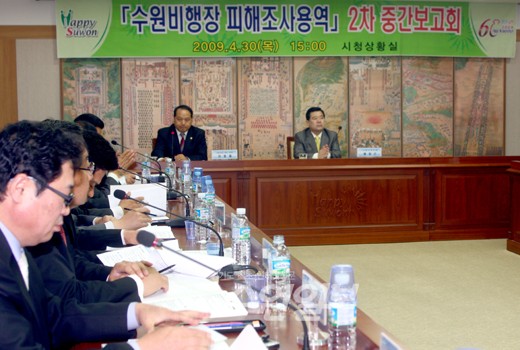
The Suwon Air Base Special Committee, established on January 31, 2007 (Chair Lee Jong-pil, 14 members), is active with the goal of establishing rational measures in response to noise damage from the air base and presenting policy alternatives for base relocation.
The committee is focusing on establishing measures addressing not only noise from military aircraft, but also mental, physical, and economic damage due to altitude restrictions around the base and emergency runway, as well as damage to students' right to study. To this end, it has conducted activities including visits to the Gyeonggi Province Office of Education, Suwon Air Force Base (10th Fighter Wing), and the U.S. military base in Okinawa, Japan.
Particularly, through the 'Suwon Air Base Damage Survey Project' commissioned in February 2008, concrete research results emerged showing that residents' right to health and property, as well as students' right to study, are being seriously infringed upon by the Suwon Air Force Base.
From the damage survey project results held on January 22 and April 30 this year, it was found that noise from the Suwon Air Base impairs residents' sleep and mental health, as well as reduces students' learning ability. Additionally, it was proven that residents suffer property damage including impaired exercise of property rights due to altitude restrictions and decline in land values.
Despite these achievements, there are virtually no concrete measures or legislation to actually resolve damage caused by the Suwon Air Base.
Bills for support around military air bases remain dormant in the National Assembly, and although the committee has visited the Suwon Air Force Base multiple times for meetings, it has failed to receive clear answers from the base, with analysis pointing out limitations when efforts rely only on local governments and basic councils.
An official in Suwon said, "What is important is that the government and military must recognize residents' damage situations caused by base noise and take substantive measures such as enacting related legislation or easing altitude restrictions."
Given that Suwon Air Force Base is a national facility for military operations and national security, analysis suggests that activities to draw attention and financial and legal support from the central government and political circle must be strengthened.
Moreover, with the recent approval of Lotte World II, residents of Seongnam City are unanimously demanding altitude restriction relief. It is pointed out that Suwon must also view and address the air base issue as a problem and issue for all of Suwon, not just specific areas like Gwonseon-gu.
Lee Jong-pil, Chair of the Air Base Special Committee, said, "It is rare to find cases domestically or internationally where a military air base is located within an urban area like Suwon Air Force Base," and added, "When the damage survey project is completed in September, we plan to actively recommend measures to the government, military, and central political circle based on this."
● Tug-of-War Over Installation of Ecological Corridors with Korea Expressway Corporation
The Gwangyosan Special Committee, established on March 30, 2007 (Chair Hong Jong-soo), shortly after the Air Base Committee was formed, sets activity goals including installation of ecological corridors (eco-bridge) in areas where Gwangyosan's green space axis is disconnected, creating eco-friendly organic farm experience villages, and guiding environmentally-friendly development of Gwangyosan.
However, the committee achieved the outcome of demolishing 10 abandoned power transmission towers in March this year that had been criticized for damaging Gwangyosan's landscape, while other activity plans such as ecological corridors have yet to show progress.
In particular, the Gwangyosan Committee, pursuing installation of Gwangyosan ecological corridors as its top priority, has held multiple meetings with Korea Expressway Corporation officials.
In October 2007, the committee delivered signatures from 13,624 Suwon citizens to the Expressway Corporation and urged the installation of ecological corridors, engaging in negotiations with the corporation until April this year, but has shown no progress.
Moreover, the committee had agreed last year with the Expressway Corporation to conduct a research project to investigate the feasibility of installing ecological corridors, but differences over the scope and cost of the project have yet to reach a consensus.
Having devoted itself to negotiations for approximately one and a half years over ecological corridor installation, citing the urgency of restoring Gwangyosan's disconnected ecological axis caused by the Yeongdong Expressway construction, the committee has yet to produce tangible results, and concerns are even emerging that other special committee activity plans are stalling.
The Gwangyosan Committee, having concluded negotiations with the Expressway Corporation on April 16, plans to request cooperation from the National Assembly and take more active and multifaceted measures to pressure the passive Expressway Corporation, but with only about 5 months remaining until the end of activity in September.
Hong Jong-soo, Chair of the Committee, said, "I will request the installation of ecological corridors from the local constituency's National Assembly member or Assembly members belonging to the National Assembly Land and Maritime Committee."
Regarding the organic farm village, Chair Hong stated, "We plan to develop approximately 30,000 ㎡ of eco-friendly organic farm village targeting farmland in the Hagwanggyo-dong area of Jangan-gu," and added, "We will complete coordination with the executive branch to support the organic farm village by May."
● Focused Only on Paldal Mountain Monorail?
The Hwaseong Tourism Activation Special Committee, which began activities from November 1, 2008 (Chair Hong Seung-geun), sets major activity goals including tourism activation themed around Hwaseong Fortress, revision and enactment of related ordinances, and protection of property rights due to cultural property protection zone designations.
The Hwaseong Tourism Activation Special Committee presented the 'Paldal Mountain Monorail (Haengung~Seojangdae, elevation 144m) installation plan' at the committee's 5th meeting on February 10 this year to attract Hwaseong tourists and create stay-type tourism products.
To this end, it also benchmarked monorails installed at Samcheok Daegeum Cave and Mungyeong Open Set in March and April respectively.
At the special committee activity report meeting held on April 9, the Mungyeong Open Set monorail was reported as a case applicable to Paldal Mountain.
Actually, one committee member stated, "The Paldal Mountain monorail is more effective and environmentally sound than the Hwaseong tourism train using diesel in terms of tourism revenue."
However, with various procedures piled up from cultural heritage landscape change permits to monorail feasibility studies, considerable time is expected to implement them, raising concerns that the Hwaseong Tourism Activation Special Committee may be viewed as a committee only for 'monorail' installation.
Additionally, regarding the monorail, diverse subjects of tourism activation, environment, cultural heritage preservation and protection require consensus from citizens and civic organizations, as well as broad communication through public hearings.
A Suwon civic organization official expressed concern, saying "It will have environmentally and aesthetically negative impacts, potentially creating adverse effects on Hwaseong tourism instead."
With activity deadline until October 31 this year leaving about 6 months, demands are emerging for the committee to focus not only on the monorail but also on other Hwaseong-related issues.
With the Hwaseong Special Planning Zone project suspended, residents in the area are voicing grievances over development restrictions, and there are calls for the committee to support the city executive branch or cooperate (共助) so that the Hwaseong restoration project becomes a national support target.
In fact, on February 4 this year, the committee held a meeting with residents' representatives from Nam-su-dong, Paldal-gu, which was formerly part of the Hwaseong Special Planning Zone. However, the meeting proceeded at the level of empathizing with residents' damage situations and pledging to make every effort for them.
In relation to this, Chair Hong Seung-geun and Secretary Lee Hee-jung plan to meet with National Assembly member Nam Kyung-pil (Hannara Party, Suwon Paldal) on and after the 14th to hold meetings regarding Hwaseong-related issues.
Loading comments…