


Referee's "Must Be Your Period" Comment Shakes Women's Soccer; Association Claims "It Never Happened"
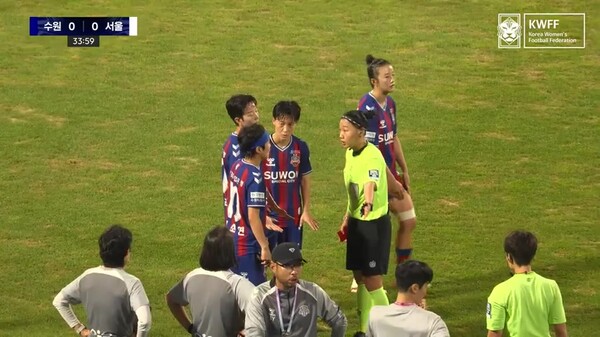
A controversy over a referee's alleged sexually harassing remarks that erupted during the 2026 WK League match between Suwon FC Women and Seoul City Hall at Suwon Sports Complex on August 28 has escalated into a battle over the truth. A direct confrontation has occurred between the concrete testimony of the affected player and the complete denial from the Korea Football Association.
The incident began around the 30-minute mark of the first half. On the Korean Women's Football Association's YouTube livestream, referee Bae Sun-young is shown giving Ji So-yeon a yellow card, and Ji So-yeon going to the bench and protesting with evident frustration before throwing a water bottle. The match was halted for approximately four minutes.
In a post-match interview, Ji So-yeon stated that she heard referee Bae say during a radio transmission, directed at her, "She's been on edge from the start. Must be her period." Ji So-yeon said, "When I said that could be grounds for discipline, I was given a yellow card." It is reported that Bae's camp initially denied the remark itself, but when protests continued, changed their position to say it was "something we said among ourselves."
The controversy has actually expanded following the Korea Football Association's referees team issuing a statement on the 29th. According to MBC reports, the association's referees team denied the claim, stating that "while the referee and assistant referee did communicate, the word 'period' was not used, and it was not directed at a specific player," while simultaneously stating "unnecessary conduct was inappropriate" and promising preventive education.
This explanation has drawn criticism both within and outside the sports world for being contradictory. Questions are being raised: if the problematic word was not used and no specific player was targeted, what constitutes "unnecessary conduct" and what is there to "prevent recurrence" of? There is also criticism that the association issued its position before reviewing the referee's report and the observer's report, suggesting it reached conclusions before conducting an investigation.
Criticism is also emerging that the association's explanation overturns the victim's account without investigation. According to the association's position, Ji So-yeon's testimony—in which she specifically detailed the content of the remarks, the situation at the time, and even the sentences she used in protesting—would be false. Since it is standard procedure in sexual harassment cases for the credibility of the victim's statement to be verified through investigation, critics point out that such a response before investigation could constitute secondary victimization.
Meanwhile, Ji So-yeon is now unable to play in league matches on September 2 due to the accumulation of yellow cards received that day. Alongside criticism over fairness—that only the player making the complaint faces disadvantages—the issue of retroactive remedies for the yellow card penalty issued during the protest is expected to become a point of contention.
Suwon FC Women is preparing to formally raise the issue with the Korean Women's Football Association and plans to issue a statement soon. The federation stated it would "request the evaluator's report and referee's report from the association, review them, and then understand the specific details." Since radio communications use an official channel heard by all referees on the field, cross-checking the communication record at the time and the statements of the referees is expected to be crucial to the investigation.
Suwon FC Women is the women's team of Suwon FC, a citizen-backed club of Suwon City, and uses Suwon Sports Complex as their home. Ji So-yeon is the all-time leading scorer of the Korean women's national team and a flagship figure in Korean women's football, having played in England's Chelsea before returning to the domestic stage.
Loading comments…