


UN-Habitat Official Platform Features Suwon's 'People-Centered Smart Inclusive Urban Policy' Report
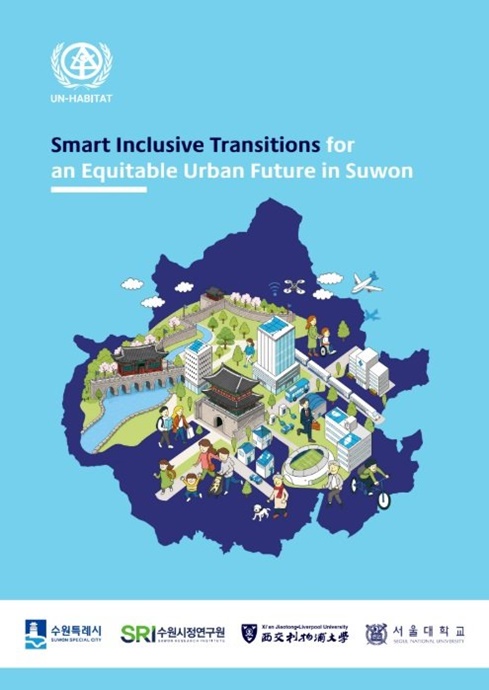
[Suwon Ilbo = Reporter Jung Jun-sung] A report documenting people-centered smart inclusive urban policies of Suwon Special City, including the Saekbbit House, was recently posted on the official UN-Habitat platform. UN-Habitat evaluated Suwon's shift from a technology-centered smart inclusive urban paradigm to a people-centered approach as an international case study.
The report posted on the platform is "Smart Inclusive Transitions for an Equitable Urban Future in Suwon," jointly published by Suwon City, the Suwon Institute for Research and Development, China's Xi'an Jiaotong-Liverpool University (XJTLU), and Seoul National University. It was officially published following UN-Habitat's technical and strategic review and editorial approval process.
Paradigm Shift in Smart Inclusive Urban Development: 'From Technology-Centered to People-Centered'
The report presents Suwon as an international reference case for shifting the direction of smart inclusive urban development from 'technology construction' to 'people-centered inclusion,' and for the first time globally applied the Smart Inclusive Transitions (SIT) framework that systematically diagnoses this shift across the entire city.
'Smart Inclusive Transition (SIT)' is a concept presented by UN-Habitat, with diagnostic frameworks jointly developed by Xi'an Jiaotong University and Seoul National University. It comprehensively diagnoses cities across diverse areas including housing, transportation, digital, governance, and inclusion. It is a people-centered smart city model that evaluates whether technological innovation leads to improved quality of life for all citizens.
UN-Habitat stated on its official platform: "Suwon is the first city to apply the SIT framework city-wide and demonstrate results." The organization presented Suwon as the first demonstration model to measure 'people-centered smart inclusive cities' by combining data-driven analysis and citizen participation, and evaluated Suwon as the world's first 'Global Reference City.'
Comprehensive Score of 80.0 Points from 53-Indicator Diagnosis: Achieved 'Very Good' Rating
Based on the UN's 'Global Urban Monitoring Framework (GUMF),' the diagnosis employed a system of five strategic pillars, 20 priority areas, and 53 indicators. Suwon achieved a comprehensive score of 80.0 points by global urban standards, earning a 'Very Good' rating.
Robert Ndugwa, Head of UN-Habitat's Data Analysis Division, stated: "This is the best demonstration case that sophisticatedly combines global monitoring data with Suwon survey and Suwon Research Institute (SRI) citizen panel data to prove the city's complex interconnectedness," adding that "it will become a global standard guideline that many cities worldwide seeking to transition to people-centered smart inclusive cities can reference and implement."
Saekbbit House, DRT, and Other Key Suwon Demonstration Cases Selected
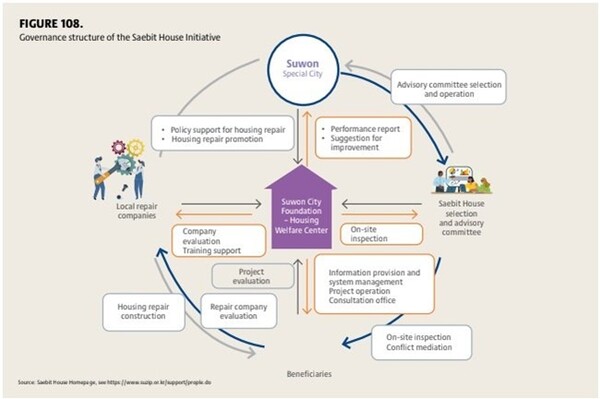
UN-Habitat introduced Saekbbit House, DRT (Demand-Responsive Transit), and Suwon Urban Foundation as flagship demonstration cases implementing Smart Inclusive Transitions (SIT) in practice.
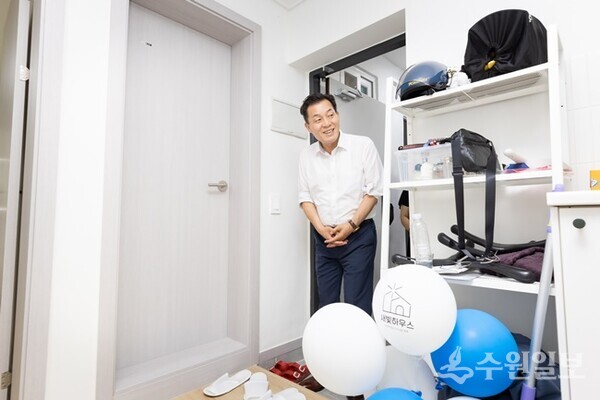
The resident participation-based housing regeneration policy 'Saekbbit House' was evaluated as a people-centered housing welfare model that realizes 'housing for all' beyond merely improving dilapidated housing.
Saekbbit House is a project that supports home repair costs for aging low-rise housing within designated repair support areas. Since beginning its first home repairs in October 2023, it has supported repairs for a total of 3,003 homes. Saekbbit House has established itself as a representative housing welfare policy that improves the residential environment of aging neighborhoods and enhances citizens' quality of life.
Artificial intelligence-based transportation welfare 'DRT (Demand-Responsive Transit)' is a responsive bus service that flexibly changes routes based on passenger calls by utilizing an AI real-time demand-matching algorithm.
When a passenger calls, the route, boarding point, and boarding and alighting times are calculated in real-time based on the nearest DRT vehicle and provided to the passenger. It was introduced as a case that addresses transportation blind spots and realizes equity in last-mile mobility.
Suwon Urban Foundation was evaluated as a co-production governance platform that breaks down barriers between administration, citizens, and businesses, delivering on-site solutions from alley business district analysis to housing support for vulnerable populations.
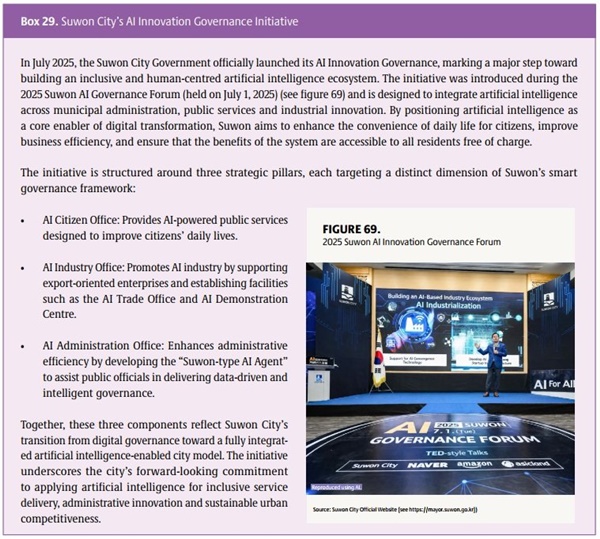
Additionally, the mobile citizen participation platform 'Saekbit Talk Talk' received a score of 96.3 points ('Excellent') in the digital innovation category, and other key cases such as 'Urban Policy Citizen Planning Group' (2013 UN-Habitat Award), 'AI Innovation Governance,' and 'Human Rights Impact Assessment' were also included.
Suwon Case as 'International Reference Model for Self-Diagnosis' for Cities Worldwide
UN-Habitat evaluated that "Suwon's case can serve as an 'international reference model for self-diagnosis' and an implementation guideline that enables cities worldwide to independently diagnose and evaluate their level of smart inclusive transition."
All cities can utilize the 53-indicator system demonstrated by Suwon to quantitatively diagnose whether smart city transitions are actually improving citizens' lives regardless of age, gender, or residential area, and reflect the results in governance, budget allocation, and policy adjustment.
'International Collaborative Learning Platform' Expanding Starting with Comparative Research in Liverpool, UK
As Suwon's urban model receives international recognition, global policy partnerships are gaining momentum. Following the report's release at the 13th World Urban Forum (WUF13) held in Baku, Azerbaijan in May, major cities worldwide including Barcelona, Spain and Amman, Jordan expressed their intention to "apply the Smart Inclusive Transitions (SIT) framework to diagnose their cities."
In September, 'Suwon-Liverpool Comparative Research' with direct UN-Habitat participation will commence in Liverpool, UK. The project will apply Suwon's verified diagnostic methodology to Liverpool and conduct mutual learning.
This report is expected to be sequentially applied and compared across multiple cities worldwide starting with Liverpool, and Suwon's case is projected to expand on the global stage as an international 'collaborative learning platform' among cities beyond merely transferring models.
Mayor Lee Jae-jun stated, "The significance of this report lies in the fact that Suwon's policies have presented policy methodologies that can serve as reference for cities around the world," adding, "Going forward, Suwon will continue to establish international standards for people-centered smart inclusive urban development."
The full text of "Smart Inclusive Transitions for an Equitable Urban Future in Suwon" can be accessed on UN-Habitat's official research platform at https://unhabitat.org/smart-inclusive-transitions-for-an-equitable-urban-future-in-suwon.
Loading comments…