


Gyeonggi Province Forges Joint Response with Cities and Counties Against Capital Area Exclusion in Semiconductor Special Act Implementation Decree

[Suwon Ilbo=Reporter Kim Gapdong] Gyeonggi Province has launched a joint response system with its cities and counties in response to the capital area exclusion clause included in the government's 'Special Act Implementation Decree on Strengthening and Supporting Semiconductor Industry Competitiveness.'
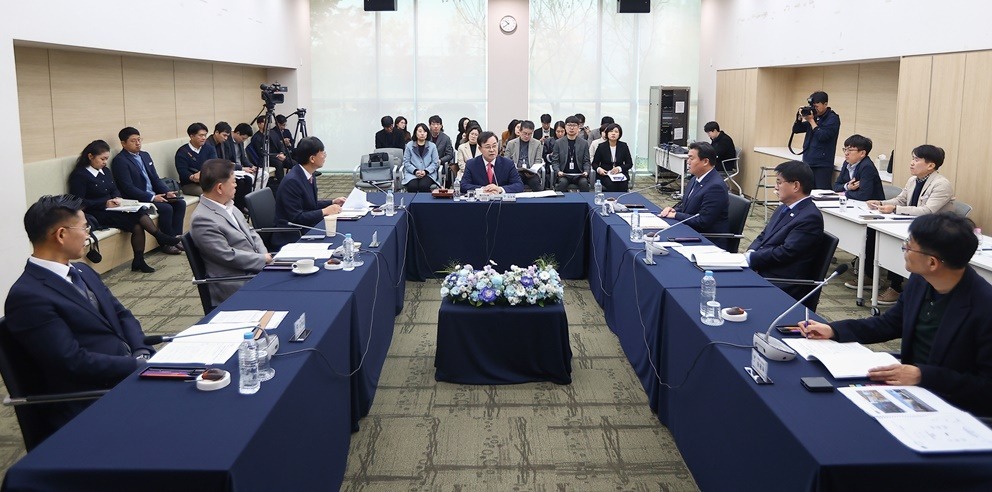
On the 28th, the province held an 'Emergency Policy Meeting on the Capital Area Exclusion in the Semiconductor Special Act Implementation Decree' at Yulgok Hall of Gyeonggi Provincial Government, presided over by Hyun Byung-cheon, director of the Future Growth Industries Bureau, with the attendance of department and bureau heads from cities and counties in the province, as well as related organizations including the Next-Generation Convergence Technology Institute, Gyeonggi Economic Science and Technology Promotion Agency, and Korea Nano Technology Institute.
The meeting was convened to jointly discuss countermeasures after the Ministry of Industry, Trade and Energy specified 'non-capital area' as a requirement for semiconductor cluster designation in the implementation decree of the Semiconductor Special Act currently under legislative promotion.
On the 21st, the province officially submitted its opinion to the Ministry of Industry, Trade and Energy requesting deletion of the capital area exclusion and non-capital area preference clauses from the implementation decree, and through this meeting plans to share current issues with cities and counties and strengthen the joint response system.
During the meeting, discussions focused on △the current status of the Semiconductor Special Act implementation decree and problems with the capital area exclusion clause △the impact of the implementation decree on the semiconductor industry △joint countermeasures by the province, cities, and counties.

The province is currently promoting the creation of a K-Semiconductor Mega Cluster with a scale of 1,126 trillion won centered on Yongin, Pyeongtaek, Icheon, Hwaseong, and Seongnam, and investments from global semiconductor companies including Samsung Electronics, SK Hynix, ASML, AMAT, and LAM continue.
Cities and counties participating in the meeting raised major concerns about the potential damage to regional industries in preparation for the enactment of the implementation decree.
The types of damage can be summarized into three categories.
First, there is concern that regional strategies for attracting and fostering foreign investment companies and semiconductor parts and materials companies following government policy could be undermined by the implementation decree. Osan City mentioned the possibility of disruptions to the creation of research complexes linked with global equipment companies such as AMAT, and Bucheon City stated that the implementation decree could negatively impact ongoing negotiations for foreign corporate investment linked with DB Hytek. Gwacheon City expressed concerns about adverse effects on AI and AX new industry development strategies utilizing Knowledge Information Town and abandoned thoroughbred and horse racing track sites, while Siheung City raised the possibility of weakening the specialized Physical AI region and strategic industry ecosystem. Seongnam City pointed out that policy confusion could occur between the Fabless 10x Growth Strategy being promoted centered on Pangyo and the capital area exclusion clause.
Second, concerns were raised about potential disruptions to the creation of hinterland regions linked with anchor companies such as Samsung Electronics and SK Hynix. Pyeongtaek City stated that adverse effects are expected on the creation of hinterland areas linked with Samsung Electronics' 5th and 6th plants and attraction of parts and materials investment, and Hwaseong City explained that the capital area exclusion clause was announced during the preparation process for designating the 3rd phase specialized complex for parts and materials, raising regional industry concerns. Suwon City also stated that difficulties are expected in pursuing Samsung Electronics-centered specialized research areas and economic free zones.
Lastly, concerns continued that the damage to northern Gyeonggi regions, which have long been subject to overlapping regulations due to being in the capital area, could be further exacerbated. Yeoncheon County and Gapyeong County appealed that despite enduring various regulations for decades as depopulated and border regions, they could again be hindered by capital area regulations. Goyang City expressed concern that industrial growth stagnation and poor industrial complex sales could further weaken the potential for hub growth upon future inter-Korean relations improvement, and Uijeongbu City explained that development strategies for returned land and economic free zones are facing disruptions due to overlapping regulations. Gimpo City pointed out that despite being a region with large potential for advanced industries linked with airports and ports, future growth momentum could be weakened by the implementation decree.
Going forward, the province plans to maintain a cooperative system with cities, counties, and related organizations in connection with the Semiconductor All-Care Task Force, and to establish joint response strategies reflecting the characteristics of each city and county, including production bases in Yongin and Pyeongtaek, parts and materials industry cities in Ansan, Hwaseong, and Osan, and regulated regions in northern and eastern Gyeonggi.
Additionally, the province plans to establish a coordination system with capital area local governments and related organizations including Seoul and Incheon to jointly respond during the implementation decree's legislative notice and related organization consultation processes.

Loading comments…