


Gyeonggi Province Approves 2040 Anseong Master Plan...Targeting Population of 280,000
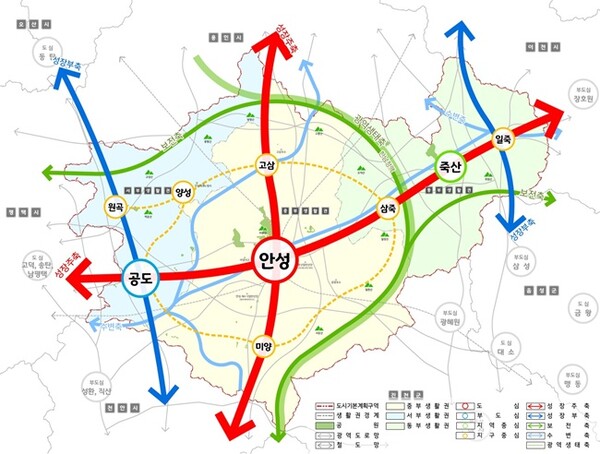
[Suwon Ilbo=Reporter Kim Gap-dong] Gyeonggi Province has given final approval to the "2040 Anseong Master Plan," which outlines long-term development directions for Anseong City on the 20th.
The "2040 Anseong Master Plan" is the highest-level spatial plan that serves as a foundation for Anseong City policies, containing urban spatial structure and land use plans. Through this master plan, Anseong City has presented future development strategies reflecting changes in urban conditions, including the opening of the Sejong-Pocheon Expressway.
A key component is the target population for 2040. Considering population inflow from various development projects and population projections from Statistics Korea, the target population has been set at 280,000, up from the current 210,000.
The land use plan designates 18.435㎢ as planned urban development area in preparation for future urban growth within the entire administrative district (553.460㎢), confirms the existing developed area of 33.427㎢ as developed urban area, and designates the remaining 501.598㎢ as conservation area.
The spatial structure has been configured with 1 central district, 1 secondary district, 1 regional center, and 6 district centers to systematically disperse urban functions in order to achieve balanced regional development and encourage specialized growth suited to regional characteristics.
Living zones have been planned as 3 regions in total—western, central, and eastern. The western living zone focuses on strategic new city development and residential areas linked with public amenities, the central living zone emphasizes enhanced urban functions and advanced industrial clusters (semiconductor supply chain), and the eastern living zone features complex logistics and an eco-friendly urban-rural complex hub.
The transportation plan reflects road and railway projects presented in higher-level plans such as the National Road Network Plan and National Railway Network Plan. The road network has been planned with 4 east-west axes, 7 north-south axes, and 2 circular axes to enhance connectivity and accessibility between regions.
Kim Hee-seong, Director of Urban Policy at Gyeonggi Province, said, "With the approval of the 2040 Anseong Master Plan, we have laid the groundwork for Anseong City to leap forward as a future cultural city." He added, "Going forward, Anseong will grow into a city where advanced industry and citizens' daily life harmonize, by linking station area complex development with the opening of metropolitan railways and connecting it with the semiconductor supply chain specialized complex."

Loading comments…