


Gyeonggi Province Moves to Minimize Loss of Life and Property from Natural Disasters This Summer
[Suwon Ilbo=Reporter Kim Gapdong] Gyeonggi Province will implement disaster prevention projects based on advanced technologies such as artificial intelligence and strengthen cooperation systems with cities, counties, and the private sector to protect residents' lives and property from natural disasters including heavy rain, typhoons, and lightning this summer.
The province announced on the 15th that it will begin implementing the '2026 Summer Windstorm, Flood, and Lightning Comprehensive Countermeasures' from the 15th through October 15th.
The province has established four implementation strategies aimed at 'minimizing disaster damage to residents through building organic governance among the province, cities and counties, related agencies, and the private sector': △Strengthening the control tower function of the Provincial Disaster Safety Response Headquarters △Advancing the disaster response system through the adoption of AI and advanced technology △Expanding disaster management capability at the metropolitan level △Enhancing disaster response capacity based on organic governance.
□ Strengthening Control Tower Function of Gyeonggi Province Disaster Safety Response Headquarters
The province will provide meteorological analysis data to six regional zones considering local characteristics, establish preparations and response frameworks tailored to local conditions, and strengthen the situation transmission system centered on the Gyeonggi Province Disaster Safety Response Headquarters by operating social network service (SNS) communication channels and maintaining a hot-line with the Korea Meteorological Administration.
Previously, starting in February, the province proactively operated a 'Pre-Summer Disaster Prevention Countermeasures Dedicated Organization (TF)' composed of the province, cities, counties, and the private sector, selecting 54,000 key management facilities across eight sectors with potential for casualties and deploying 903 'Disaster Safety Keepers' to conduct joint public-private on-site inspections. The province plans to continuously verify compliance with identified issues.
In particular, beginning this year, as the authority to issue evacuation orders has been granted to heads of eup, myeon, and dong offices, the province will strengthen disaster response capabilities centered on frontline operations and establish a support system for eup, myeon, and dong offices where emergency personnel are directly deployed from city and county headquarters starting from emergency level one. Support personnel will play roles in preventing casualties including surveillance and inspection of hazardous facilities, control of hazardous facilities, and evacuation assistance when evacuation situations occur.
□ Advancing Disaster Response System Based on AI and Advanced Technology
This year, the province is implementing a 'Climate Crisis Response Strategic Project' investing 43.4 billion won across ten projects including flood detection alarm devices, reservoir level gauges, automatic river-side barriers, and in-home broadcast installations based on artificial intelligence (AI) and information communication technology (ICT).
For rapid situation management, the province will pilot a situation management system that automatically displays on the control center when meteorological conditions exceed the control and evacuation guideline standards prepared by the province. In situations requiring resident evacuation, the system will conduct emergency broadcasts including civil defense warning facilities to enable immediate evacuation, and through hot-lines with vice heads of cities and counties when disaster-level heavy rain occurs, confirm whether resident evacuation is implemented.
□ Expanding Disaster Management Capability at Metropolitan Level
The province will also operate the Gyeonggi-type support system established through ordinance amendments in July last year for swift daily recovery of affected areas. The province operates a 'Special Support Zone' system to support cities and counties that fall short of the special disaster zone criteria but suffer substantial actual damages, and has established a system providing additional daily recovery support funds by damage type including small business owners, farms, and livestock farms. The province has also expanded metropolitan reserve warehouses in the northern Gyeonggi region, establishing a foundation where disaster management resources can be provided and reinforced to all areas of the province within two hours.
The Provincial Disaster Safety Situation Room will strengthen metropolitan-level monitoring systems through the 'Gyeonggi Smart Video Center' linking approximately 195,000 CCTV units from 31 municipalities' smart city integrated operation centers, grouping high-risk areas with potential for casualties and underground overpasses.
□ Enhancing Disaster Response Capacity Based on Organic Governance
The province will systematize cooperation with cities and counties, related agencies including police and fire departments through governance, hazardous facility control, and pre-evacuation, and operate a tight coordination system using the disaster safety communications network.
By integrating existing autonomous disaster prevention units including village patrol teams, the province will compose 'Resident Evacuation Support Teams' centered on autonomous disaster prevention units to supplement limited public personnel through surveillance activities and swift evacuation support. The province plans to operate with priority given to supporting those with priority evacuation needs who have difficulty evacuating independently. The province has organized 8,859 resident evacuation support members across 31 municipalities and completed one-to-one matching for 1,551 priority evacuation beneficiaries.
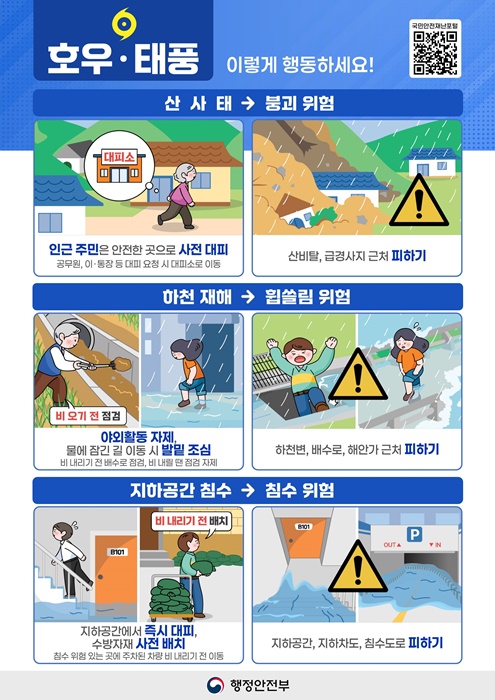
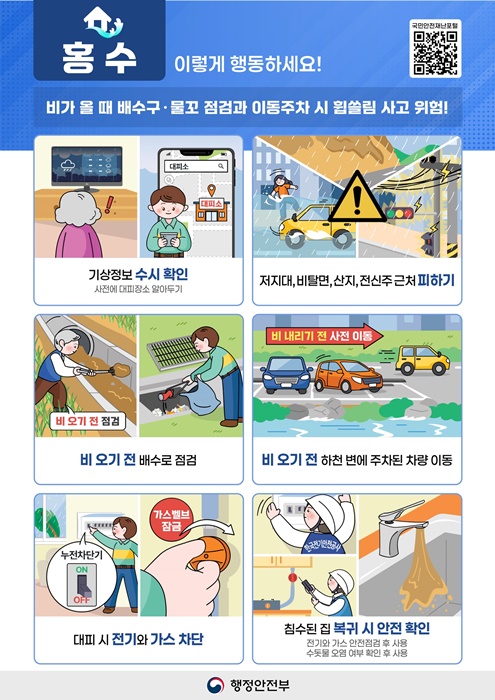
The province plans to strengthen promotional efforts by intensively broadcasting citizen action guidelines videos using various media including G-Bus TV and apartment elevator media boards that showed high promotional effectiveness last year during the summer countermeasures period.
Governor Kim Dong-yeon stated, "As casualties occurred from concentrated heavy rain exceeding 100mm per hour last year, we will do our best to ensure that similar damage does not cause casualties," and urged "residents to familiarize themselves with action guidelines and actively implement voluntary evacuation and other measures before dangerous situations occur."
Loading comments…