


Special Feature Suwon Has Changed 5 - Suwon Strengthens Fiscal Soundness

[Suwon Ilbo=Reporter Jung Junseong] The settlement audit for Suwon Special Metropolitan City's FY2025 budget, which began on April 10, concluded on the 29th.
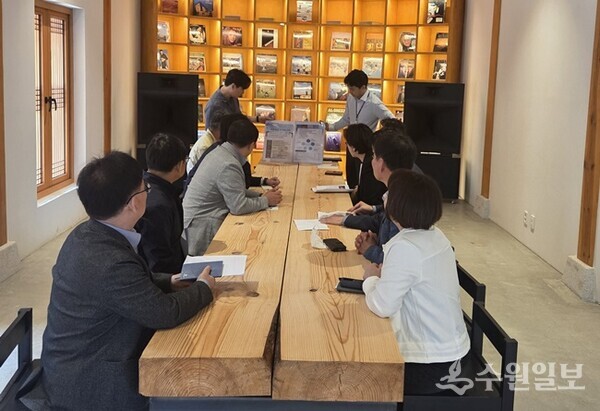
Settlement audit committee members, comprised of members of the Suwon City Council, certified public accountants, and tax accountants, examined documents and ledgers based on the settlement statement (draft) prepared by Suwon City after closing the FY2025 accounts and inspected major project implementation sites related to the FY2025 settlement. On the 23rd, they visited the Ingye-dong Administrative Welfare Center and the Namsu-dong Hanok Village (Namsuheon) for inspection.
Settlement audit opinion reports will be collected and submitted by May 8. Improvements suggested in the settlement audit will be reflected in the next fiscal year's budget and financial management.
A settlement audit is a process in which settlement audit committee members appointed by the council conduct accounting audits to verify the settlement amount, financial statements, and appropriateness of budget execution before the settlement statement is submitted to the council. It confirms whether the budget has been executed properly in accordance with its intended purpose and examines the efficiency and accountability of financial management.
Total debt decreases, net assets increase
According to the settlement statement prepared by the city after settling revenue and expenditure for FY2025, total debt decreased and net assets increased, indicating strengthened fiscal soundness.
Suwon City's total debt for FY2025 was 317.2 billion won, down 74.2 billion won (19%) from 391.4 billion won in FY2024. Debt decreased significantly as the city repaid 67.6 billion won in long-term borrowings.
Debt obligations were also substantially reduced. Debt for FY2025 totaled 142.8 billion won, down 62.6 billion won (31%) from 205.4 billion won in FY2024. The city repaid 67.6 billion won in debt obligations for 54 projects, including the Suin Line underground project and the agricultural and fisheries market modernization project.
Debt that stood at 371.2 billion won in 2021 decreased to 333.4 billion won in 2022 and 276.1 billion won in 2023, showing a consistent downward trend.
Per capita debt continues to decline
As debt size decreases, per capita debt among residents is also declining. Per capita debt, which was 231,000 won in 2023, decreased to 172,000 won in 2024 and 120,000 won in 2025.
The fiscal base expanded. Suwon City's net assets for FY2025 stood at 19.95 trillion won, an increase of 429 billion won from the previous year. Assets for public convenience facilities increased by 280.2 billion won, and social infrastructure assets increased by 97.9 billion won. The construction of the Hwanggu Stream Ecological Water Resources Center, land acquisition for road development, and the creation of a public parking lot in Gurun Park appear to have contributed to the increase in net assets.
For FY2025, the budget appropriation was 4.27 trillion won, revenue settlement was 4.34 trillion won, and expenditure settlement was 3.94 trillion won. Compared to the previous year, the budget appropriation increased by 10.4%, revenue settlement increased by 10.5%, and expenditure settlement increased by 13.1%.
Efforts to expand finances result in increased revenue settlement
The increase in revenue settlement reflects efforts to expand finances, including an increase in local taxes such as corporate local income tax, systematic collection of overdue taxes, and proactive administration to secure national and provincial subsidies.
The settlement surplus, calculated by subtracting expenditure settlement from revenue settlement, is 402.2 billion won. The net carryover surplus, excluding carryover amount and actual subsidy refunds, is 190.2 billion won, a decrease of 10.2 billion won from the previous year.
Net carryover surplus has been consistently declining from 305.6 billion won in 2022 to 298.8 billion won in 2023 and 200.4 billion won in 2024.
The decline in net carryover surplus is a result of reduced execution remainder from budgets being executed as planned, which indicates improved efficiency in financial management.
A city official stated, "Going forward, we will focus on debt management and maintaining fiscal soundness. We will efficiently utilize the budget to invest in public infrastructure with high citizen satisfaction and work to revitalize the local economy."

Loading comments…