


Gwangmyeong City Ranked #1 in Regional Resilience Nationwide; Explores Sustainable Urban Development with Citizens
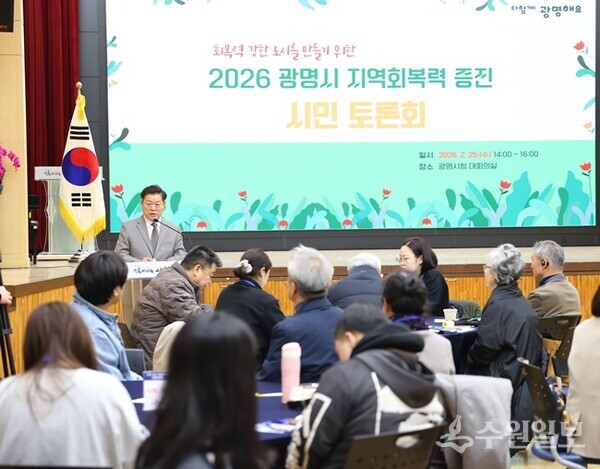
[Suwon Ilbo=Reporter Yu Je-sung] Gwangmyeong City, selected as the most resilient city nationwide, explored sustainable urban development plans together with its citizens based on this achievement.
On the 25th, the city held a '2026 Citizen Forum on Enhancing Regional Resilience' at the City Hall conference room with approximately 70 participants including experts and citizens, sharing the results of achieving the top ranking in the '2025 Hankyoreh Regional Resilience Evaluation' and seeking to build a 'city with stronger resilience.'
The forum was organized to recognize that the core driving force of 'regional resilience'—the ability to respond flexibly to complex external crises and shocks—lies in citizen participation and solidarity and cooperation among communities that the city has accumulated over time, and to develop this into specific policy initiatives.
The city achieved well-balanced results across all sectors including environment, economy, and society in this evaluation, ranking first (Grand Prize) among 226 local governments nationwide. This is interpreted as proof that beyond simple excellence in administrative indicators, a community system in which citizens participate as subjects of policy and care for one another is actually functioning in practice.
On this day, Mayor Park Seung-won stated in his remarks, "It has been proven that the trust and capacity built through a process where citizens participate as subjects of policy and show solidarity with one another are Gwangmyeong's strongest asset. The valuable proposals drawn from this forum will serve as a foundation as we build an increasingly sustainable city where citizens' lives are protected."
The forum featured presentations by Seo Jae-gyo, director of the Institute for Our Social Economy, on 'Regional Resilience Evaluation Results and Implications,' and Park Eun-gyeong, director of the Toward a Better Society Research Center at the Hankyoreh Institute for Economic and Social Research, on 'Cases of Citizen-Led Resilience Enhancement.'
Director Seo emphasized, "True regional resilience is not merely about recovery after a crisis, but about establishing a system to prevent crises in advance and respond elastically to them. At the local government level, we must enhance citizen capacity and institutionally guarantee the foundation for participation, while simultaneously pursuing policy efforts to structuralize sustainability through the introduction of local circular economy and the realization of a carbon-neutral city."
Director Park stated, "Gwangmyeong City's excellent evaluation is the result of consistently pursuing citizen participation and sustainability as core driving forces of city administration. When we further refine resident-participatory governance, build an economic structure in which local resources circulate, and expand carbon-neutral practice as policy within daily life, resilience will become even stronger."
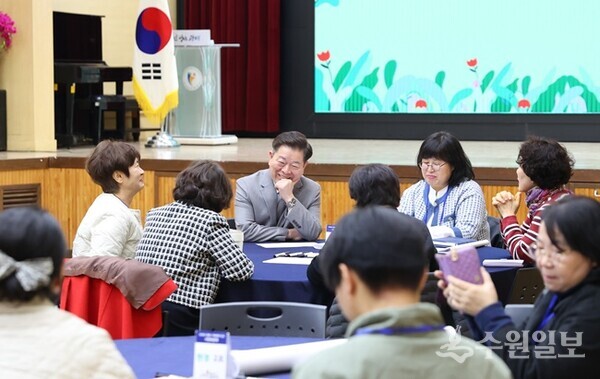
Subsequently, approximately 70 citizens divided into 8 teams across 3 sectors—environment, economy, and society—held discussions on the theme of 'Implementation Strategies for Overcoming Regional Crises.'
In the environment sector, proposals were made for effective operation of the carbon savings account system and strengthening of citizen-led resource circulation systems. In the economy sector, proposals emerged for building a sound local circular economic structure centered on Gwangmyeong Love Currency and social solidarity economy.
In the social sector, policy alternatives were developed for expanding community foundations, including strengthening integrated care safety nets for single-person households and elderly populations, and advancing resident participation platforms.
The city plans to carefully review citizen opinions presented at the forum with relevant departments and reflect them in city administration after comprehensively assessing feasibility and policy effectiveness.
Loading comments…