


Mayor Park Seung-won of Gwangmyeong: "I Will Complete Gwangmyeong's Future with Our Citizens"

[Suwon Ilbo=Reporter Yu Je-seong] Mayor Park Seung-won of Gwangmyeong expressed his determination to complete capable Gwangmyeong by using the core values built with citizens as momentum.
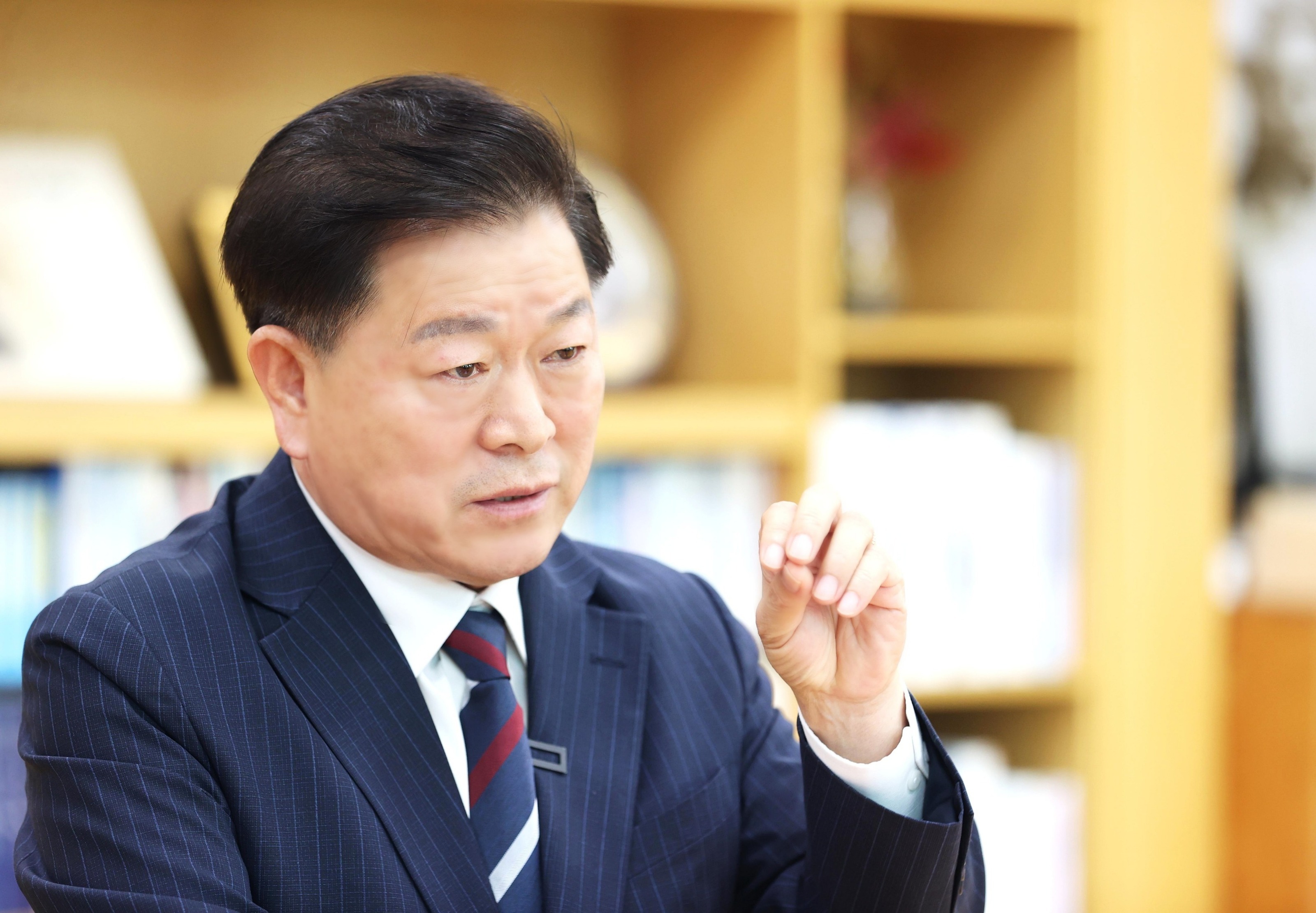
At a New Year's press conference held at the city hall auditorium on the morning of the 12th, Mayor Park said, "The current Gwangmyeong is not a city led by administration, but a city created by capable citizens who voluntarily choose to participate. In 2026, we will elevate Gwangmyeong's core values—citizen sovereignty, lifelong learning, carbon neutrality, resource circulation, social solidarity economy, garden city, and basic society—to a stage of completion together with capable citizens," he declared.
Mayor Park emphasized that the achievements of the past eight years were possible because of collaboration with citizens.
The city has institutionalized citizen participation systems by pioneering the transition to neighborhood governance councils in all districts in 2020 and implementing the open recruitment system for district chiefs in 2025. Through eight rounds of 500-person round-table discussions and the operation of approximately 160 citizen committees, the city has driven substantial changes that enable citizens to exercise authority as true stakeholders of the city.
Additionally, the city has strengthened citizen capacity by providing lifelong learning support funds to citizens in their 50s, operating an integrated online lifelong learning platform and Gwangmyeong Autonomous University, elevating this into city competitiveness.
Membership in the "1.5℃ Climate Army," a citizen-led initiative for carbon-neutral lifestyle practices, surpassed 17,000 as of January 2026, presenting a new standard for citizen participation in the age of climate crisis. The city is leading the circular economy by pioneering the introduction of a customized free collection system tailored to residential types, the first in the nation.
Additionally, Mayor Park explained that the "social solidarity economy" policy for all members of local communities and the "garden city" policy that adorns the city with nature everywhere are results reflecting citizens' values of choosing cooperation over competition and coexistence over development.
Mayor Park emphasized that all these policies operate toward a single goal: a "basic society" where everyone's basic needs are protected "without discrimination, without exclusion."
Mayor Park stated, "Citizens have been at the center of all Gwangmyeong's policies, and they have been the source of resilience that rebuilds our city even amid crisis. Gwangmyeong is evaluated as the city with the most resilience in the nation because of all of you citizens."
He continued, "Using the power of these capable citizens as momentum, we will complete our city administration in 2026," presenting three major tasks as key implementation directions: △completing sustainable city foundations, △realizing a basic society built together, and △achieving "completion" beyond "growth" in urban development.
■ Completing sustainable city foundations where people and nature, today's and tomorrow's citizens live together
Mayor Park revealed plans to make a quantum leap to a carbon-neutral smart city by adding advanced technologies in four sectors—energy, transportation, safety data, and more—based on the carbon-neutral policies Gwangmyeong has established.
The city was selected in the 2024 Ministry of Land, Infrastructure and Transport competition and is pursuing the "Compact Smart City Project" with 16 billion won in project funding.
In January, the city opened the "G-SMART HUB," a hub center to drive innovation toward smart cities. By the end of this year, the city plans to sequentially complete innovative smart projects including △construction of renewable energy power generation facilities, △building an integrated flood and overflow control system based on spatial intelligent Internet of Things (AIoT), △operating eco-friendly delivery services, and △establishing data stations and integrated platforms.
Mayor Park also revealed a vision for realizing a garden city, stating, "By creating a citizen garden belt connecting Dodeok-san, Gureum-san, Gahak-san, and Seodok-san, designating the Anyang Stream as a national garden, and creating waterfront spaces at the Mokgam Stream, we will transform the entire city into one green living zone."
Starting with the Gahak-san Arboretum of approximately 32,820 square meters opening this year, through the Soha Culture Park of approximately 82,889 square meters and the Yeonghoe-won Waterfront Park of approximately 121,080 square meters, the city will ensure rest and relaxation become part of daily life.
Mayor Park also stated, "We will further strengthen local circular economy where citizens become economic actors leading regional growth."
The city plans to introduce paper-based Gwangmyeong Love Currency and expand its usage to support alleyway economy circulation, and with the Social Economy Innovation Center opening this year, will concretize a local community asset-building model where local wealth is reinvested within the region.
■ Realizing a basic society where capable citizens can enjoy their inherent rights
Mayor Park stated, "The basic society is not a single project but the foundation of all administration. We will approach and implement all policies from a basic society perspective so that citizens can enjoy their inherent rights," expressing his commitment.
Gwangmyeong City established Korea's first basic society ordinance among local governments in October last year, and launched the country's first Basic Society Committee among local governments on the 5th, solidifying the foundation for advancing basic society policies.
Mayor Park also stated, "Based on the care integration support ordinance enacted first in the nation, we will advance integrated care projects in earnest to safeguard citizens' dignified lives."
To this end, starting in March this year, the city will fully operate "home healthcare centers" where doctors, nurses, and social workers form one team to directly visit homes of those deemed to require home-based medical care among long-term care grade recipients and provide medical services.
Additionally, the city will implement a "mandatory home visit system" by deploying dedicated care managers in each district to proactively identify and closely manage high-risk groups, while implementing a "gap care" project that broadly supports housekeeping, meal provision, home care visits, and residential environment improvements to fill care gaps occurring after the termination of existing services, establishing a comprehensive welfare safety net without blind spots.
Furthermore, lifelong learning and employment policies for seniors will be pursued from a dignity perspective, and 152 units of youth-specialized public rental housing in the Gwangmyeong Soha District will be developed as a foundation for nurturing future dreams beyond mere housing, implementing policies encompassing life across all generations.
The city will enhance the quality of administration by adding future technology on top of this inclusive welfare.
Mayor Park pledged, "Aligning with the nation's trajectory as one of the world's three AI superpowers, we will establish an 'AI Gwangmyeong Implementation Plan' to achieve administrative innovation in three phases."
Additionally, to help citizens maintain meaning in their lives amid rapidly changing technological environments, the city will implement the "Gwangmyeong Life and Happiness School" focusing on life and happiness by life cycle, in combination with the lifelong learning system.
This is designed to ensure that human dignity as a life foundation does not waver even in a technology-centered society, with the city pursuing administration that takes final responsibility for citizens' lives and happiness.
■ Realizing city vision through K-Arena and seven railroad networks that will be the foundation for Gwangmyeong's 100-year future
Mayor Park stated that as this is a year when large-scale urban development projects that will form the foundation for Gwangmyeong's future become visible, he will turn the vision long envisioned into reality.
Mayor Park stated, "Each decision made during this period when the city's framework will be completed within five years shapes Gwangmyeong's future for the next 100 years. We will make every effort to achieve 'completion' beyond the city's 'growth' through urban development projects," he said.
In particular, Mayor Park expressed his determination to take responsibility for Gwangmyeong's 100-year future by attracting a 50,000-seat K-Arena within the Gwangmyeong-Siheung Third New City.
Gwangmyeong City, in line with the national policy of "medium and large-scale multipurpose performance hall-type Arena (K-Arena)," has been concentrating administrative resources on attracting the K-Arena since last year by establishing a dedicated policy task force and establishing a basic attraction strategy.
Mayor Park stated, "We will open a new growth path for Gwangmyeong centered on culture and tourism industries, going beyond simply installing performance facilities."
He also said, "To ensure successful urban development, we will make full efforts in expanding the metropolitan transportation network, including seven railroad lines, to establish the foundation for Gwangmyeong's leap as a transportation hub city in the southwestern Seoul metropolitan area."
In particular, the city is aggressively pursuing a two-track strategy—separate from the reflection in the 5th National Railroad Construction Plan—to promote the Sincheon-Haan-Sillim Line connecting Gwangmyeong from east to west through private investment projects for swift progress.
The Wolgot-Pangyo Line and Sinan Line are currently under construction, and the Gwangmyeong-Suksak High-Speed Rail will commence full-scale projects upon completion of basic planning.
The Gwangmyeong-Siheung Line is included in the metropolitan transportation improvement measures, and the city is preparing for follow-up procedures.
Additionally, the city is making multifaceted efforts to ensure that GTX-D and GTX-G (Song-woo-Pocheon Line) are reflected in national plans such as the 5th National Railroad Construction Plan.
Moreover, to address increased traffic demand from redevelopment and reconstruction, the city will establish new bus routes, expand roads to increase accessibility to Seoul, and begin autonomous shuttle bus operations from the latter half of this year, realizing the goal of becoming an advanced mobility city.
The public library in Gwangmyeong 3-dong and Youth Counseling and Welfare Center opening this year and other living infrastructure facilities will serve as important foundations for daily urban life where citizens gather, build relationships, and regain trust.
Major projects that will reshape the city's map will proceed without interruption.
By the end of this year, the Gwangmyeong-Siheung Techno Valley Urban Advanced Industry District will begin sales after completion, and the national land in Haan-dong (former Youth Welfare Center site) will begin demolition in the first half of this year to take the first step in creating a K-Innovation Town.
Additionally, sites for the Gwangmyeong-Haan 2 Public Housing District and Gureum-san District urban development projects will be created, and proper compensation procedures for the Gwangmyeong-Siheung Third New City development will be fully underway.
Finally, Mayor Park stated, "If these policies continue, by 2030, Gwangmyeong will become the standard of the most livable city in the Seoul metropolitan area and an economically self-sufficient city. We will listen more humbly and ask more deeply, completing Gwangmyeong's future with our citizens," he emphasized.
Loading comments…