


Suwon Special City Establishes 'People-Centered Wildfire Response System'
[Suwon Ilbo=Reporter Jung Jun-sung] Suwon Special City announced on the 26th that it will establish a wildfire response system centered on people.
The city has established the '2026 Suwon City Comprehensive Wildfire Prevention Plan' with the vision of 'Beyond Forests to People, Promise of 30-Minute Golden Time.' The direction of the comprehensive plan is people-centered, technology-centered, and field-centered.
It consists of 4 major promotion strategies—△situation-based preemptive response △science-based response grounded in advanced technology △all-out extinguishing response centered on the field △customized prevention and publicity by cause—and 8 implementation tasks.
The 8 implementation tasks are △operation of Suwon-type 5-stage resident evacuation (priority task) △data-based wildfire prevention countermeasures headquarters operation and advance preparation enhancement △securing 30-minute golden time using wildfire spread prediction system △24-hour surveillance using AI CCTV information and communications technology (ICT) platform △efficient operation of wildfire suppression helicopters and coordination with neighboring local governments △mobilization of general civil servants by stage and installation of joint integrated command centers △intensive crackdown on major causes such as incinerator wildfires and accidental fires caused by mountain visitors △enhancement of citizen awareness and training using various media.
The wildfire response direction shifts from 'forest-centered' to 'protection of citizens' lives and residential areas.' The 'Suwon-type resident evacuation system' strengthens the resident evacuation system using scientific data and establishes risk zones reflecting the urban geographical conditions.
The Suwon-type 5-stage resident evacuation for wildfire disaster (based on geographical criteria) consists of Stage 1 situation monitoring (automatic smoke detection), Stage 2 preliminary defense line (beginning movement toward residential area), Stage 3 safety last line of defense (village boundary), Stage 4 final defense line (100m from residential area), and Stage 5 safety confirmation (entry into designated evacuation shelter).
Based on data from the Korea Forest Service's wildfire spread prediction system, citizens' safety is proactively secured according to the estimated time for the wildfire to reach residential areas. At Stage 1, a first emergency alert text is sent, and at Stage 2, elderly and mobility-impaired residents are relocated first.
When Stage 3 is declared, vehicle control, resident evacuation orders, and facility closure measures are implemented. At Stage 4, all residents evacuate immediately. At Stage 5, residents in evacuation shelters are protected and relief supplies are distributed.
The city has been operating a wildfire prevention countermeasures headquarters at 5 locations—the Park and Greenbelt Business Division and 4 district offices—since January 20. The number of staff members totals 192, including 79 forest disaster response personnel (wildfire monitors). The countermeasures headquarters will operate until May 15.
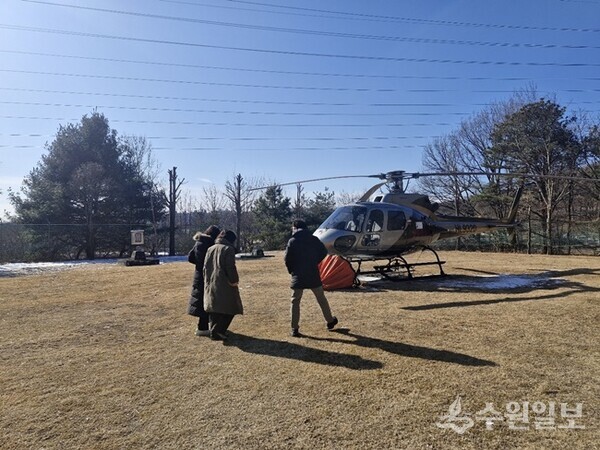
The wildfire response helicopter will operate until June 14. The helicopter, linked with advanced equipment such as the wildfire prevention ICT (information and communications technology) platform, performs initial suppression when a wildfire occurs and prevents wildfire spread.
A city official stated, "We have established a response system based on advanced technology to protect citizens' lives and forest resources from wildfire threats," and added, "We will secure a 30-minute golden time using the wildfire spread prediction system."
The official continued, "The wildfire suppression helicopter is a key resource that can overcome geographical limitations when a wildfire occurs and play a decisive role in initial suppression," and said, "We will do our best to protect residents' lives and minimize property damage."


Loading comments…