


Gwangmyeong Mayor Park Seung-won Proposes 'Decentralized Climate Policy System' to Address Climate Crisis
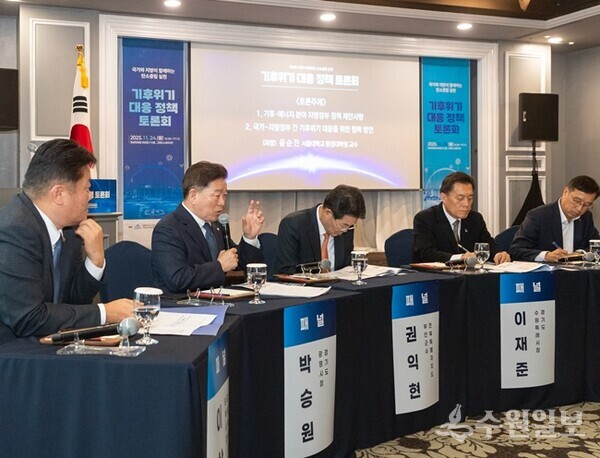
[Suwon Ilbo=Reporter Yu Je-sung] Gwangmyeong Mayor Park Seung-won approached the climate crisis as a human rights issue and proposed establishing a decentralized climate policy system.
Mayor Park attended the ‘Policy Discussion Forum on Realizing Carbon Neutrality with National and Local Governments Together, Addressing Climate Crisis’ held at the Kensington Hotel in Yeouido, Seoul on the 24th, stating that climate decentralization for local governments is necessary.
Mayor Park stated, “The climate crisis goes beyond environmental issues and is a human rights issue that threatens the basic rights of climate-vulnerable populations including life, health, housing, and safety,” and emphasized, “To protect vulnerable populations, local governments, which are more closely connected to individual citizens, must directly design and implement effective policies.”
He continued, “Local governments must substantially strengthen personnel, finances, and authority so they can directly promote carbon neutrality and climate adaptation policies suited to regional characteristics,” and requested the establishment of a decentralized climate policy system.
Mayor Park proposed eight policies to distribute central government budgets and authority to local areas and strengthen the foundation for climate policy implementation centered on local governments.
First, he emphasized that 100 carbon-neutral cities should be selected to provide customized support suited to local realities, and that the national climate response fund should be allocated as regional climate response funds, enabling local governments to independently discover and implement projects suitable to their regions.
Additionally, he requested the institutionalization of participation by local government representatives in the National Carbon Neutrality Committee, strengthened support for dedicated personnel and finances for carbon neutrality, and expansion of customized consulting and direct support to local governments so they can effectively design and implement policies.
Along with this, he proposed evaluating local governments' carbon neutrality policies and activities to select excellence cities and provide subsidies, and expanding mandatory installation of renewable energy in educational facilities to strengthen schools' energy self-reliance and reinforce local communities as carbon neutrality hubs.
Lastly, he emphasized that the enactment of a special law on energy decentralization is necessary to introduce a ‘community-based solar energy benefit-sharing system.’ He stated that to establish a distributed renewable energy system, legal foundations must be prepared to grant local governments and communities the authority over energy production and profit distribution, going beyond a centralized structure.
Mayor Park stated, “These policies will serve as a foundation for local governments to directly design and implement carbon neutrality and climate adaptation policies suited to regional characteristics,” and said, “The central government and local governments must cooperate to enable effective community-centered climate response.”
Meanwhile, the discussion forum was jointly hosted by the National Assembly Climate Crisis Special Committee and the Local Government Council on Climate Crisis Response and Energy Transition. It proceeded after Kim Jeong-in, Professor Emeritus of Chung-Ang University, presented on the topic of ‘National Tasks in Addressing Climate Crisis and the Role of Local Governments.’
Members of the National Assembly Climate Crisis Special Committee and mayors of member cities of the Local Government Council on Climate Crisis Response and Energy Transition shared climate crisis response policies linked to the People's Power Government's pledges and discussed plans for climate decentralization for local governments.
Loading comments…