


27-Square-Kilometer Industrial Park Cluster to Be Built in Yeongju's Ganam District

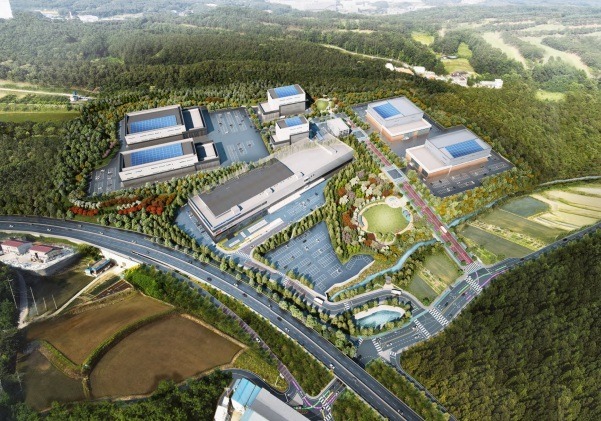
[Suwon Ilbo=Reporter Kim Gap-dong] A large-scale industrial park cluster spanning 271,663 square meters (approximately 82,000 pyeong)—equivalent to 38 soccer fields—will be developed in Ganam, Yeongju.
Gyeonggi Province announced on August 1st that the 'Yeongju Ganam General Industrial Complex Cluster Development' project, which has been pursued as part of Governor Kim Dong-yeon's 'Eastern Gyeonggi Major Development Plan,' passed review by the Capital Region Maintenance Committee under the Minister of Land, Infrastructure and Transport on July 27th, marking the beginning of full-scale cluster construction.
This represents a tangible achievement of Governor Kim's ambitious push for regional economic growth through regulatory easing under the Eastern Gyeonggi Major Development Plan.
Eight cities and counties in eastern Gyeonggi Province, including Yeongju, have been designated as a nature preservation zone following the implementation of the 'Capital Region Maintenance Plan Act' in 1983, remaining restricted for over 40 years.
The first large-scale industrial park cluster spanning 38 soccer fields to be located in the Seoul Metropolitan Area's nature preservation zone carries significant symbolic meaning as it achieves long-sought rationalization of Seoul Metropolitan Area regulations, which has been a standing aspiration of Gyeonggi Province.
Particularly, the Yeongju industrial complex cluster will be developed focusing on semiconductor materials, components, and equipment (SME) industries, according to Yeongju's plan. After completing necessary administrative procedures, construction is scheduled to begin in late 2024, with completion expected by 2027.
This is expected to generate 1,242 jobs in total, comprising 859 direct positions and 383 indirect positions, primarily in the semiconductor industry.
The province anticipates that job creation from the industrial park cluster will have significance beyond mere numbers, enabling a virtuous cycle of regional economy through increased inflow of population, followed by growth in housing, education, and consumption. Additionally, since the industrial complex cluster itself constitutes an ecosystem where knowledge, capital, and technology circulate rapidly among institutions and talent, diverse economic synergies are expected to emerge.
Furthermore, the province assessed that this industrial park development will actually support nature conservation, the original purpose of the Capital Region Maintenance Plan Act, rather than causing environmental damage.
Historically, in eastern Gyeonggi Province including Yeongju, 92 percent (6,640 out of 7,221 total) of factories have been operated as individual plants scattered haphazardly. Strengthening regulations under the pretext of a nature preservation zone has ironically turned eastern Gyeonggi into a hotbed of unplanned development. Moreover, the wastewater discharge per unit area of small factories is higher than that of industrial complexes, leading to environmental pollution contrary to the intended purpose of the Capital Region Maintenance Plan Act. With this industrial park development, prospects have emerged for gradually addressing the unplanned development problems caused by the proliferation of small individual factories.
A provincial official stated, "Under Governor Kim Dong-yeon's strong will, beginning with the Yeongju industrial complex cluster, we will coordinate with the Ministry of Land, Infrastructure and Transport to expand opportunities for economic revitalization while preserving the legislative intent of the Capital Region Maintenance Plan Act," and added, "We will pursue second and third Yeongju-type industrial complex clusters."

Loading comments…