


Suwon Establishes '2025 Population Policy Implementation Plan' for 'City Good for Raising Children'
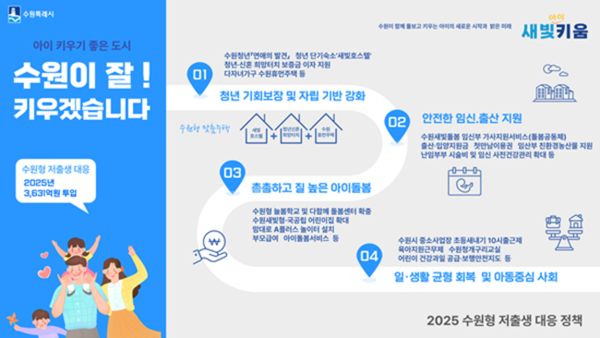
[Suwon Ilbo=Reporter Jung Jun-seong] Suwon Metropolitan City has launched full-scale efforts to create a 'city good for raising children' by investing 360 billion won in low birth rate response projects.
On the 24th, the city established a 2025 Population Policy Implementation Plan with the vision of 'Suwon where everyone's life shines' and set three major policy objectives—improving quality of life for all generations, promoting awareness and spreading understanding of regional social changes in demographic structure, and integrated management and systematization of low birth rate and aging society policies—and four promotion strategies.
Based on four major promotion strategies—'Living Together' (creating a society that works together and cares together), 'Living Long' (building a healthy and proactive aging society), 'Living in Hope' (creating a society where everyone's capabilities are fully utilized), and 'Living in the Future' (adapting to changes in demographic structure)—the city will pursue 125 projects that address low birth rates and aging while caring for citizens across all life stages.
In particular, 363.1 billion won will be invested in low birth rate response projects ('creating a society that works together and cares together') to develop new programs and expand existing projects in pregnancy, childbirth, parenting, and childcare sectors.
Major projects include the 'Elementary Newcomer 10 a.m. Start Time' for small and medium businesses, expansion of community childcare centers, childcare services, Suwon Saebbit Childcare community building projects (household services for pregnant women), infertility treatment subsidies for couples and prenatal health management support, housing support through Suwon Human Housing for multi-child families, and Froggy Classroom.
The 'Elementary Newcomer 10 a.m. Start Time' for small and medium businesses provides incentive allowances to small and medium enterprises that introduce '10 a.m. start times' for employee parents of first-graders. To enable elementary newcomer parents to work shortened hours without loss of salary, Suwon City provides up to 600,000 won per employee for two months.
Additionally, starting this year, in connection with Suwon Saebbit Childcare, household support services such as cleaning and laundry are being provided to pregnant women. Infertility treatment subsidies for couples, which previously provided 25 sessions per person, were expanded from November last year to '25 sessions per birth (5 sessions for artificial insemination, 20 sessions for in vitro fertilization).' The out-of-pocket rate was previously 30% for those under 45 and 50% for those 45 and over, but age distinctions were eliminated and standardized at 30%.
Suwon's total fertility rate in 2024 was 0.73, which is 0.02 lower than the national average of 0.75. The elderly population aged 65 and over was 168,332, accounting for 14.1% of the total population.
The number of births in Suwon in 2024 increased by 8.97% compared to the previous year. This is nearly three times the national average growth rate of 3.1%, the highest increase rate among metropolitan cities with a population of over one million.
A city official stated, "As childbirth and parenting policies and policies in various sectors such as housing, childcare, and employment gradually take effect, the number of births in Suwon increased by nearly 9% last year. We will actively support young people and newlyweds to settle in Suwon and build 'Suwon, a city good for raising children.'"

Loading comments…