


Gyeonggi Province Finalizes Plan for 'Major 2040 SOC Development in Western and Eastern Regions'
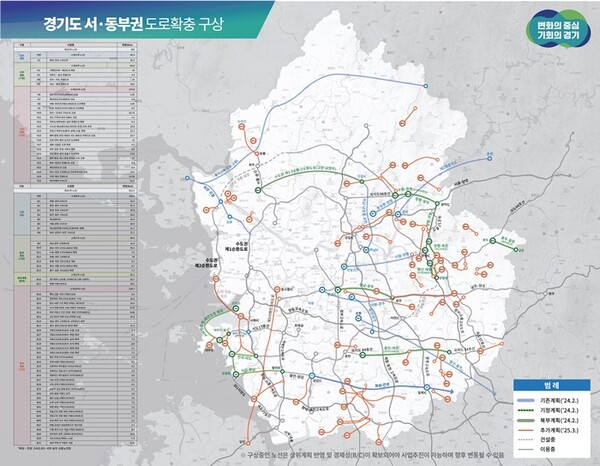
[Suwon Ilbo = Reporter Gim Gap-dong] Gyeonggi Province has finalized a large-scale project called the 'Major 2040 SOC Development Initiative for Western and Eastern Gyeonggi Regions' aimed at balanced regional development and improving residents' quality of life.
The province announced on the 17th that it will invest a total of 112 trillion won across 224 projects by 2040 to create a new model for balanced development and economic revitalization of the nation. This initiative is the result of one year of cooperation between the public and private sectors following the inaugural declaration ceremony of the 'Major SOC Development for Western and Eastern Gyeonggi' held last year.
The target is 14 cities and counties in the western regions (Hwaseong, Ansan, Pyeongtaek, Siheung, Paju, Gimpo, Anseong) and eastern regions (Yongin, Namyangju, Gwangju, Icheon, Yangpyeong, Yeoju, Gapyeong) that have been relatively neglected due to development centered on the Gyeongbu Axis.
The SOC major development plan involves selecting 224 detailed projects by 2040 and investing 112 trillion won across transportation infrastructure (roads and railways), emotional leisure areas including the Gyeonggi Dulle-gil, private-public development areas including urban development, and development support areas including administrative support and institutional improvements. The province estimates that this will generate a production inducement effect of 155.3 trillion won.
By sector, roads comprise 76 total routes with a total project cost of 34.1 trillion won, including △11 expressway routes such as Hwaseong-Anseong △26 national routes such as the Second Gyeongchun △34 provincial routes such as Giheung-Cheorin △5 city routes such as Ujeong-Hyangnam, strengthening inter-regional connections and improving congested traffic sections.
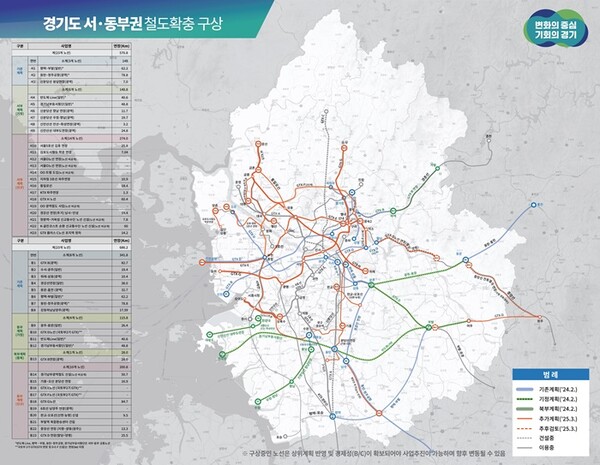
Railways comprise 46 total routes with a total project cost of 54.3 trillion won, including △11 KTX and GTX routes such as KTX extension to Paju △35 general, metropolitan, and urban railway routes such as Pyeongtaek-Bubat, eliminating regional disparities and providing transportation convenience.
The development initiative covers a total area of 193㎢ with a project cost of 23.6 trillion won, including △14 station area development projects such as the second phase of Gwangju Station development linked to metropolitan infrastructure including railway networks △7 urban development projects such as the former U.S. military return area in Paju for creating a low-carbon eco-friendly city △17 industrial park development projects such as the Bio Triplex Siheung specialized complex for fostering technology-intensive industrial clusters △23 tourism development projects such as Yeoju Sinreuk Temple for securing stay-type tourism and leisure zones.
To realize the SOC major development initiative and activate private investment, the province has been operating the Gyeonggi Private Development Support Center since August of last year. The center provides one-stop administrative services including risk prediction and management for large-scale development projects led by the private sector such as urban development, industrial parks, and tourism complexes, and expedited processing of permits and licenses. Recently, it has discussed the establishment of an international theme park tourism complex in Hwaseong and the Bukhangang Green Mobility project in Gapyeong as major agenda items, and achieved the designation of Hwaseong International Theme Park as a tourism complex in December of last year.
Furthermore, the province has, after more than a year of consultation with the Ministry of Land, Infrastructure and Transport, led amendments to the 'Guidelines for Adjacent Development in Natural Conservation Areas' that allow industrial parks of up to 300,000㎡ to be developed when certain conditions such as establishing plans to prevent haphazard development within natural conservation areas are met. Going forward, the province plans to continuously consult with relevant central government agencies and push for amendments to related laws and guidelines jointly with cities and counties for regulatory rationalization such as 'realization of reasonable differential regulations within natural conservation areas to improve overlapping regulations' and 'securing additional industrial zones to strengthen self-sufficient functions of third new cities.'
Notably, this initiative actively reflects the opinions of local residents and relevant private organizations. The province established specific implementation plans based on opinions gathered through various channels including meetings, coordination meetings, public hearings, and policy briefing sessions, and plans to continue systematic management by reviewing feasibility every four years in accordance with the 'Ordinance on Support for Major Area Development Initiatives in Gyeonggi Province' enacted in January to provide legal grounds.
Sohn Im-seong, Director of Urban and Housing at the Province, said, "This SOC major development is not merely a plan but a tangible foundation for balanced development created together by the private and public sectors, and the nation's first medium to long-term plan embodying the spirit of cooperative governance of the 8th Popular Mandate term," and added, "We will do our best to ensure that private investment can expand in the SOC sector, which has been regarded as a public domain, through establishing concrete and systematic roadmaps leading from the planning to implementation stage and active policy promotion."
Loading comments…