


Gyeonggi Province's 45-Day Emergency Economic Response: Revitalizing People's Livelihoods, Hope, and Gyeonggi
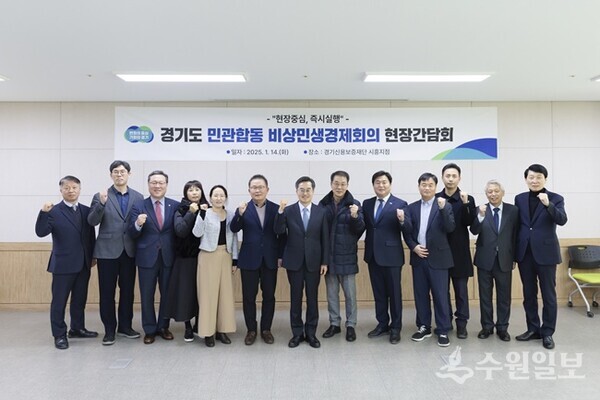
[Suwon Ilbo=Reporter Kim Gap-dong] Following the martial law crisis, Gyeonggi Province continues its efforts to support a frozen people's economy and export companies affected by high exchange rates.
In December last year, under the direction of Governor Kim Dong-yeon, Gyeonggi Province established the 'Gyeonggi Emergency Economic Livelihood Conference,' a public-private joint body bringing together related government offices including the Economy Office and Policy Coordination Office, Gyeonggi Credit Guarantee Foundation and related public institutions, and private economic organizations including small merchants, traditional markets, tourism associations, and SMEs, actively pursuing field-centered people's economic recovery measures.
On the 12th of last month, Governor Kim held the first Gyeonggi Emergency Economic Livelihood Conference at the Provincial Government Building, where he ordered the province to proceed with emergency determination to revive the people's economy under three principles: △field-centered approach, △rapid response, and △bold measures. Accordingly, the Province has visited field sites across six sectors—①small and medium enterprises and small merchants, ②investment and exports, ③tourism, ④disaster, ⑤agriculture and livestock, and ⑥employment and labor—a total of eight times (nine times including the first meeting) to hold emergency economic livelihood conferences and listen to field voices while implementing corresponding measures.
The investment and export sector was the most frequently visited among the emergency economic livelihood conferences, accounting for four out of eight total visits, or half.
The emergency economic livelihood conference held a field meeting on December 20th last year at the Gyeonggi Institute for Economic Science and Technology with about 20 employees from foreign investment companies including Linde and Air Products. Subsequently, on January 8th, it met with the American Chamber of Commerce in Korea (AMCHAM) and the European Chamber of Commerce in Korea (ECCK), and on the 9th, visited global semiconductor company onsemi to discuss cooperation measures for creating a stable investment environment and encourage investment expansion.
In meetings with these foreign investment companies, Governor Kim focused on reassuring investors, saying, "I hope you will trust Gyeonggi Province and Korea and conduct more business actively, and if there are things Gyeonggi Province can do, I will do my best to support you."
As these efforts continued, on the 14th, François Jackow, Chairman of French company Air Liquide, visited Gyeonggi Province and announced investment plans worth 25 million dollars (approximately 35 billion won in Korean currency).
Field visits to SMEs and small merchants were conducted twice, on December 26th and January 14th of this year. The key request at the sites was 'financial support.' Representatives of major organizations including the Gyeonggi Business Executives Association requested expanded financial support, simplified approval procedures, sales channel support, lower loan rates, and expanded export support.
In response, the Province immediately decided on 2 billion won in investment support targeting approximately 100 small and medium enterprises within the province exposed to exchange rate fluctuation risks. The Province decided on exchange rate fluctuation insurance enrollment and insurance payment, and additionally confirmed the scale of provincial SME development funds at 2 trillion won, expanded by 250 billion won compared to the previous year. This includes 630 billion won in SME support and 450 billion won in 'operational stability funds' for small merchant management stability (startup, management improvement, and debt restructuring).
Additionally, the Province held meetings with the hardest-hit food service industry and collected suggestions including activating public delivery apps such as Baedal Speedy and expanding office cafeteria closure policies. The Province first shortened evening cafeteria operating hours to Monday, Tuesday, and Thursday, prompting revitalization of surrounding businesses. Furthermore, even the new year press conference was held as a 'Seolleongtang Conference,' with Governor Kim taking the lead in reviving alley businesses and actively encouraging employees' group dining to provide direct support to recovery of small merchant areas.
Additionally, to activate public delivery apps such as Baedal Speedy, the Province concluded agreements with Shinhan Bank's 'Ttangggyeoyeo' and Meokkkaebi Co., Ltd., and completed negotiations to enable regional currency use on private delivery apps as well. Starting in February, users of Shinhan Bank's 'Ttangggyeoyeo' can now use Gyeonggi regional currency.
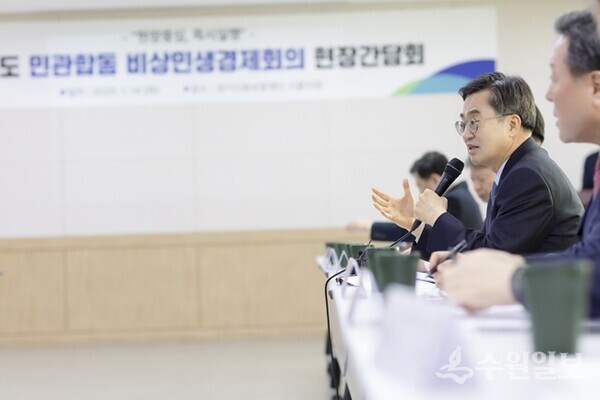
At the emergency economic livelihood conference held on the 14th at the Siheung branch of the Gyeonggi Credit Guarantee Foundation, Governor Kim directly promoted the policy by assisting with applications for the 'Small Business Fighting GO Card,' the nation's first operating expense-exclusive card for small merchants. The Fighting GO Card, a so-called '3無 (no) Card' with no interest, guarantee fee, or annual fee, is not a card issuance but rather a Gyeonggi Credit Guarantee Foundation guarantee for 5 million won, representing a 'guarantee plus credit card' concept.
The 'Small Business Fighting GO Card,' which allows use of up to 5 million won in essential operating expenses such as materials and utilities interest-free for up to 5 years through a 6-month payment plan, also provides cash back of up to 500,000 won and tax deduction benefits, generating strong field response. The Province allocated 15 billion won in this year's budget and has been supplying 150 billion won total for 30,000 people starting January 6th.
To support farmers and fishermen dealing with heavy snowfall damage last year, the Province is providing '30% discount coupons.' Allocating 25 billion won, the Province designated the Gyeonggi Agriculture and Fishery Promotion Agency as the commissioned operator and began implementing the project to execute business funds rapidly in response to the emergency economic livelihood situation.
The Province plans to continue holding emergency economic livelihood conferences in the field to reflect authentic voices in policy. Issues received through meetings will be managed in card format with the policy that they will be continuously managed until resolved.
Governor Kim Dong-yeon returned on the 24th after attending the 2025 World Economic Forum (WEF) in Davos, Switzerland to stabilize investment sentiment among global companies. Emphasizing that this is now the time for the economy, Governor Kim stated, "While the current difficulties are profound, our people's latent strength and DNA for overcoming crises will be sufficient to overcome them," and stressed, "Until then, Gyeonggi Province will do its utmost in the field to ensure the flame of people's livelihoods does not extinguish."

Loading comments…